

You let an app run in the background, share bandwidth you’re not using anyway, and get crypto in return. Zero effort after setup.
Grass (formerly known as GetGrass) works exactly like this. You don’t take surveys, you don’t click on anything, you don’t fill out anything. The app runs, you do something else.
But you need to know one thing before you get started. The platform isn’t for those looking for immediate rewards. It requires patience and consistency, and if you don’t have them (or don’t want them), there’s no point in continuing to read.
The rest of the review shows exactly how it works, how much you earn, and whether it’s worth the setup effort.
What is Grass, and how does it work?
Grass is a platform that buys a portion of the internet bandwidth you don’t use. Technically speaking, it’s called a DePIN, which stands for Decentralized Physical Internet Network. Basically, you give them some of your connection, and they give you money. If you’ve heard of Honeygain or Pawns, the mechanism is similar, with a few differences we’ll get to below.
Why do they need your internet? Grass uses it to collect public data from the web in real time. This data goes to AI labs around the world and is used to train artificial intelligence models. You provide the connection, they collect the data, the AI labs use it. That’s it.
The platform isn’t new, though not everyone knows its history. It launched in June 2023 under the name GetGrass.io and remained in beta for seven months, until January 2024. The official launch took place in February 2024. The first round of airdrop rewards reached users in October 2024, eight months later (a long wait, especially if you didn’t know exactly what to expect).
In April 2025, the platform rebranded from GetGrass to simply Grass. The same name is now also the platform’s official crypto token: GRASS. A small detail, but relevant if the crypto aspect matters to you, not just passive income.
There are now over three million active users sharing the internet through Grass. Everyone is waiting for the second round of airdrops.
The main way to earn money on GetGrass is to share the internet bandwidth you’re not using anyway. At first, you could only use the browser extension. Now there’s also a desktop app and a mobile app.
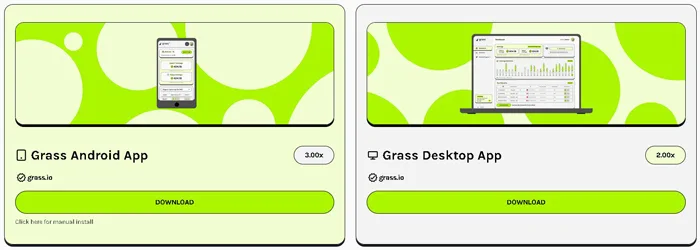
Earnings come in the form of Grass Points and depend on two things: how long you’re connected and the quality of your connection. Grass determines the quality based on your country: Tier 1 countries get 100%, the rest of the world gets 75%.
Points vary by device:
- Chrome extension (1x), 100 points per hour
- Desktop app (2x), 200 points per hour
- Mobile app (3x), 300 points per hour
You can run multiple devices at the same time, including on the same network. If they share the same IP, earnings decrease on all of them. To earn the full points on each, you need different IPs, meaning different networks.
Installation is simple: install the program, log in, configure how you share your bandwidth, click “Connect.” That’s it. From there, you can monitor the connection and watch the points grow. Resource usage is low. You won’t even notice it’s running in the background. Your computer remains usable, and you can do whatever else you want.
Refer Your Friends
The second way to earn money on Grass is through referrals. You send your link, someone signs up through it, and they become your referral. Or you give them the code directly and tell them to enter it when they sign up (if you’d rather explain a bit about the platform first). The result is the same.
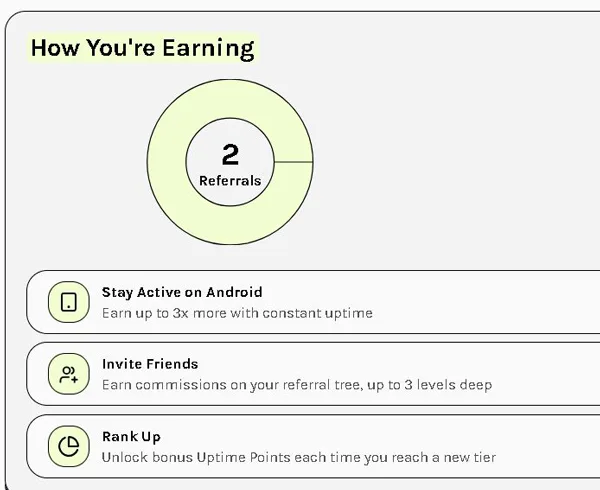
You receive 20% of what your referral earns. The money comes directly from Grass, not from their points. They earn what they earn. You receive your share separately. This is different from how other similar programs work, where the commission is deducted from the invited person’s earnings.
There’s also a bonus of 2,500 Grass Points if your referral remains active for 100 hours. It’s a one-time bonus per person, but it’s in addition to the regular commission.
And the program works on three levels. If your referral invites someone else, you receive 10% of that person’s earnings. If that person invites someone else, you get another 5%. In other words, you can earn from the activity of people you didn’t invite directly (but who were invited by someone you invited).
5% is small. But it depends on how many remain active.
How do you get paid?
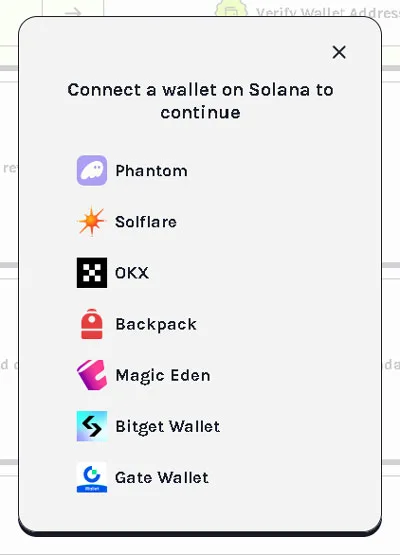
The payment system is token-based. You earn points from bandwidth usage, the points become Grass tokens, and Grass tokens are already traded on crypto platforms, so they have real monetary value. You can transfer them to any Solana wallet. There’s a transfer fee of a few cents, since you’re on the Solana network and fees there are low.
So far, everything is clear.
What’s different from almost any other platform: you can’t withdraw whenever you want. Grass distributes tokens via airdrops at times announced by them. The first one has already taken place. The second one doesn’t have a confirmed date. In a call with token holders in November 2025, they announced that the second airdrop will be structured differently from the first, with distribution via a native wallet integrated directly into the Grass dashboard, and eligibility details will be published once the infrastructure is ready. Their estimate: the first half of 2026.
So you’re still waiting. And you don’t know exactly how long. That’s what I found hardest to accept at first, especially since on other platforms you withdraw once you hit a threshold and that’s it.
I received tokens in the first airdrop (I’ve been there since launch), so I know the mechanism actually works. But if you join now, airdrop 2 is the closest opportunity you’ll have to claim anything.
Something I’ve seen going around that really matters: there are scammers posing as Grass and announcing fake airdrops to empty crypto wallets. Don’t follow any source other than the official website and their official social media accounts.
And once you have the tokens in your wallet, you have the option to stake them, meaning you lock them up for a period of time and earn additional crypto passively. It’s not mandatory, it depends on how much you want to tie up your money there.
How much money can you make with Grass?
Your earnings depend on how many different public IP addresses you have. Location matters too, but IP addresses are the main factor.
If you install the software on five computers sharing the same public IP address, the earnings are split among them. You end up in the same situation as if you had run it on a single device. It’s not worth keeping multiple devices running on the same connection, especially since you’re paying for electricity for nothing.
It’s worth expanding only if you have access to networks with different public IPs. At home, at the office, at someone else’s place, anywhere you can get a separate connection. That’s where you add a device and your earnings actually go up.
With a single IP, progress is slow. Not impossible, but slow. The tokens accumulate, but the problem is that it takes time. If you don’t expect much right away, it’s okay.
You don’t have to keep an eye on it after you install it. It runs on its own, without clicks, without tasks. And I liked that.
How to maximize Grass.io earnings?
How many GRASS tokens you earn depends on four things. Three of them are up to you. One isn’t.
Connection time is the first factor. The longer your devices stay connected to the network, the more Grass Points you accumulate, and these points are converted into tokens during each reward round.
The number of devices matters too: more devices running simultaneously means more total accumulated time.
Different networks on each device is where things get a little complicated. If you run three devices on the same IP, you don’t get three full sets of points, but fewer. Each device needs its own network to earn full points. In practice, this means it’s not enough to just have the devices; you also need access to separate IPs, which isn’t always easy to arrange.
And the final factor, the value of the GRASS token, is the only one you have no control over at all.
At launch, the token started somewhere between $0.65 and $0.94, after which it rose quickly. The post-launch low was $1.25. The high reached: $3.95, on November 8, 2024. In mid-May 2026, it was between $0.32 and $0.36, with a circulating supply of approximately 243.9 million tokens.
4 simple tips to earn more Grass rewards
Grass runs in the background and collects points over time. If you stop it frequently, you’ll lose your streak. You don’t have to do anything, just leave it running.
If you have multiple devices, use them all, each one contributes separately. But they all need to be on different IP addresses. If you install the app on three phones connected to the same Wi-Fi, you’re still on a single IP (the network matters, not the device). One on your home Wi-Fi, another on mobile data.
Referrals help, but less than it seems if they’re inactive. A referral who installs the app and forgets about it won’t earn you anything. What matters are the people who let Grass run constantly.
The more Grass Points you collect, the more tokens you’ll get in each airdrop round.
Who can use Grass?
The platform is available pretty much everywhere, but you can’t sign up directly. You need an invitation code, which isn’t immediately obvious if you land on the site without any context. You can get the code either from their Discord server or through a referral link, like the one at the end of my review.
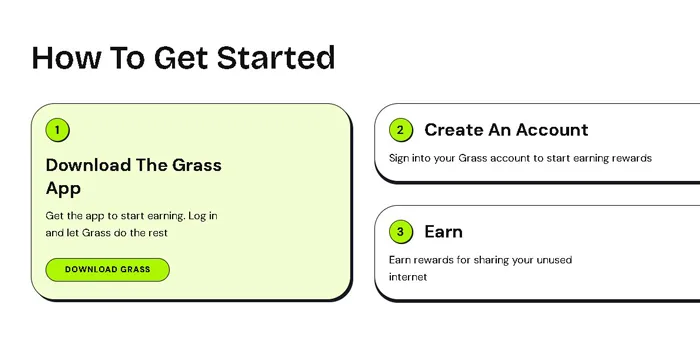
Once you have the code, the steps follow one after another without any complications. You fill out the registration form, install the browser extension, enter your login details, and you’re done. The extension launches, and your account is active.
The only point where you might get stuck is with the invitation code. If you know where to get it, the rest takes just a few minutes.
Can you use it on your phone?
When I first tested GetGrass, there were no mobile apps. Everything ran in a browser on a computer. That really limited the whole “passive” idea.
Since then, they’ve launched an Android app. You can find it on the Google Play Store, which is more convenient than it was at first, when you had to download it directly from the website. They’ve also released a desktop version, if you prefer to use it on your computer.
The app isn’t complicated. You get used to it quickly, which is all that matters for something that runs in the background.
If you have an iPhone, this isn’t for you. There’s no iOS version.
Is Grass worth it?
Grass works simply: you install the extension, let the network run in the background, and earn points for the internet bandwidth you’re not using anyway. The idea isn’t bad in itself.
The problem is that you don’t make any cash from it. Not at all, at least for now. All you get is crypto, which might be okay or might be exactly why it’s not worth using, depending on what you’re looking for. If you want money in your account at the end of the month, Grass isn’t the answer.
Earnings come slowly, that’s for sure. You don’t sign up today and walk away with anything significant next week. It’s the kind of platform you let run and check in on from time to time, not one you rely on. To me, honestly, that seems like the biggest drawback compared to other options, not the lack of cash itself.
If you want options that pay out directly, I have a list of 10 apps that give you real money without any initial investment. The earnings are more tangible and faster there.
If you’ve tried Grass or have questions, leave a comment below.