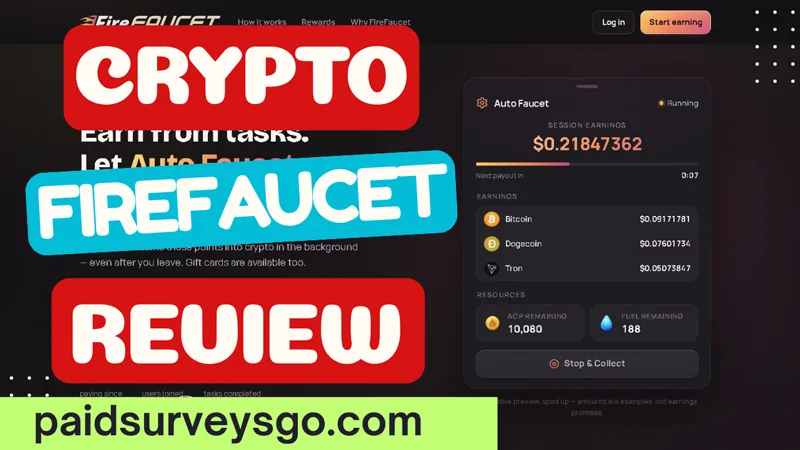

I’ve seen enough scams on Facebook to spot them quickly. They all look alike, with millions promised if you bring in three more friends and if you pay someone you don’t know for a course on blockchain.
When I read that FireFaucet gives out free cryptocurrency, I closed the page within the first five seconds. It looked just like those scams. Then I laughed at myself for judging so fast, and I opened it again. I’m not sure why I stayed. I think what mattered was the free time I had, and curiosity, maybe too much of it.
I thought I’d just be wasting my time. But the site works. It won’t make you rich, but it pays small, real amounts that I was able to verify. I saved them as screenshots, at first just for myself, to convince myself that the payments really existed and I wasn’t imagining them. Now you can find them in the article too, if you want proof.
I also liked that I wasn’t tied to one boring task, repeated over and over. When I felt like reading I did surveys with questions about brands I don’t use, when I didn’t have the energy to focus I watched ads, and when I wanted something mechanical I solved CAPTCHAs. I picked depending on what kind of day I was having.
I didn’t make a fortune and you won’t either, but I don’t think that’s the point. So why spend your time on it? Because a lot of us waste our free time scrolling Instagram anyway, and here at least that time turns into a bit of pocket change. And you also learn how cryptocurrency works without risking a single cent of your own.
Below I’ll tell you how much you make, in real numbers, how long I waited for my first payment, what limits the site has, and where it moves so slowly that it gets on your nerves. You’ll also find the moments when I got mad at it, and the ones when I got as excited as a kid when the payment notification popped up.
What is FireFaucet, and how does it work?
Sites that give you cryptocurrency for small tasks come and go quickly. Many shut down after a few months, and often they don’t even make it to a year. When I first came across FireFaucet, I expected it to be one more of them. But it’s been active since 2018, its user base isn’t shrinking, and it has been paying consistently for a few years. In the world of crypto faucets, it’s a long-standing, well-known name, and that’s rare.
FireFaucet is a paid-to-click (PTC) and rewards site. You view ads, check in, fill out surveys, or do other similar tasks, and you get cryptocurrency for them, from Bitcoin, Ethereum, Solana, Litecoin, and Dogecoin to many others. The full list is further down in the article.
The site is for anyone who wants to collect cryptocurrency or gift cards through simple tasks. And there’s also the other side, the people who pay for the ads: those who want to advertise on the site, through PTC ads or other forms of advertising.
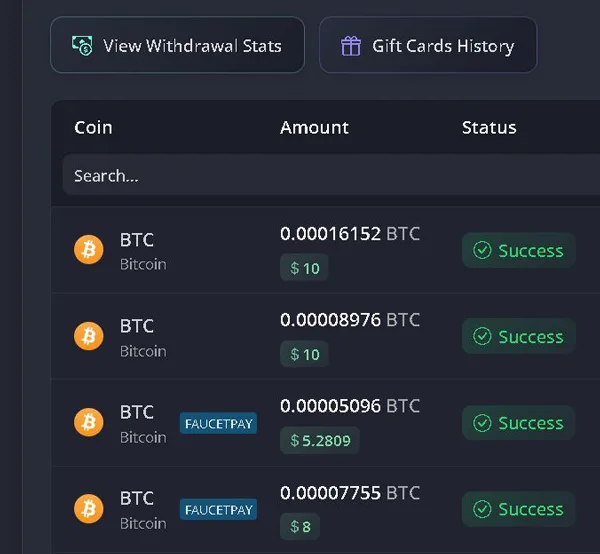
I know for sure that it pays, because I’ve received money from them countless times. I’ve added proof of one of the payments lower in the article, and you’ll see it as soon as you scroll down a bit.
But a payment coming through doesn’t yet tell me whether the site is right for you. I also care about how much time and effort you put in to get to it, and you only see that in how each earning method works. So I’ll go through them one by one and look at how good each one is and what it costs you.
A site can be trustworthy and still not be worth your time.
Paid surveys
When I got to the surveys on FireFaucet, I was expecting to find something similar to GG2U or Attapoll. I’m used to doing surveys on those, and I always find more of them there. Here I found something different.
FireFaucet doesn’t have surveys of its own. It takes offerwalls from market research companies, such as CPX Research, Pollfish, TimeBucks, PureSpectrum, BitLabs and TheoremReach, and puts them on the site. When you finish a survey with one of them, the company pays FireFaucet, and FireFaucet passes a percentage of that money on to you, in ACP (Auto Claim Points). Out of what gets paid for your answers, only part of it reaches you, and not as money, but as points.
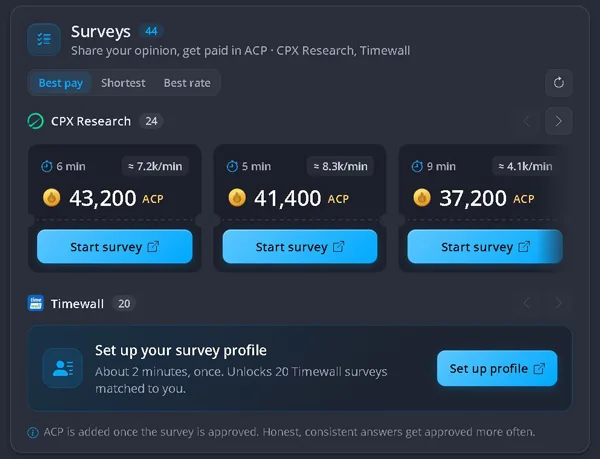
The fact that it’s a middleman isn’t a problem for me. But they could have said so more openly, because someone who goes in there easily assumes the surveys are theirs.
Every survey starts with the qualifying questions. If you have the profile they’re looking for, you get in. If not, you move on to the next one. And you don’t always qualify, which takes patience. On sites built only for surveys, the algorithms do a bit better at choosing what they send you, and if you’re coming from one of those, the difference can annoy you. Here, I had the feeling it was more a matter of luck which surveys I got. But when I get all the way through, the ACP payout isn’t small.
The steps are the same for every survey:
- You open one of the survey partners available on your account page, for example CPX Research.
- If it’s your first time, you answer the pre-screening questions about age, region and gender accurately.
- You pick a survey card. For one that promises 40,000 ACP, you get about $0.35-$0.40, but only if you complete it successfully.
- You read each question all the way through and answer honestly, without rushing, because some of them are trap questions that check whether you’re reading.
- You wait for approval. At the bottom of the page it says “ACP is added once the survey is approved.” Until then, the partner holds the points as “pending” while the company that commissioned the survey checks whether your data is good quality. That can take anywhere from a few minutes to 72 hours.
40,000 points sounds like a lot, but it’s under 40 cents. For one dollar I need about 3 completed and approved surveys, and each one can sit pending for up to 72 hours. As long as the points are “pending,” they’re not mine yet, and it’s hard for me to be happy about a survey until I see it approved.
I’ve tried several ways of collecting activity points on FireFaucet, and surveys are the quickest way to get them. If you’re on the site anyway and you like surveys, they’re worth a try, especially if you want to change up your usual routine. The qualification rate won’t impress you. For me, doing everything from one place, without jumping between several sites, outweighs the surveys I don’t qualify for.
Complete free offers and random tasks
I expected the paid offers to be the easy part, because many of them only ask you to answer a survey or a quiz, download an app or a game on your phone, watch a video, or sign up for a website. But each offer has its own instructions, which show up when you click on it, and if you skip even a single step, the offer doesn’t count as completed and the reward never arrives. It’s a shame to lose the time you put into an app you downloaded for nothing. Since I didn’t want that to happen to me, I read the instructions down to the last line before starting on any offer, and only then did I begin.
These offers are on offerwalls, which you get to when you’ve run out of surveys to do. An offerwall is a place on the site where other websites and mobile apps advertise, and you get rewards when you complete what they ask of you.
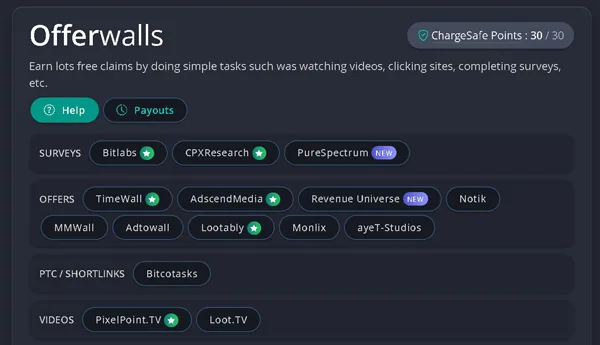
When I tested Fire Faucet myself, I counted 9 offerwalls, from TimeWall and AdscendMedia to Revenue Universe, Notik, MMWall, Adtowall, Lootably, Monlix, and ayeT-Studios. For me, that’s enough. I almost always had an offer to choose from, and I wasn’t left without anything to do once the surveys were gone.
You open an offerwall, pick the offer that suits you, and see next to it how many ACP you get if you finish it. I like knowing the amount in advance, because that way I can compare the ACP with the time the offer asks of me and skip what isn’t worth it. And you get something extra too: another 10% of the reward as activity points, which I’ll tell you about further down.
The promised reward comes after you finish the offer. But not always right away. Some offers pay on the spot, while others go through verification first, and it takes longer for the money to reach you. If the reward doesn’t show up in your account right away, it’s just the verification that isn’t finished yet.
ACP (Auto Claim Points) Faucet
Anyone who’s run into survey disqualifications will find the exact opposite at ACP Faucet on FireFaucet. You don’t fill out any profile, and nobody stops you halfway through. You solve a captcha, press a button, and you can come back after 30 minutes.
A faucet is actually an online system that gives out very small amounts of cryptocurrency or points for free. In return, the site shows you banner ads.
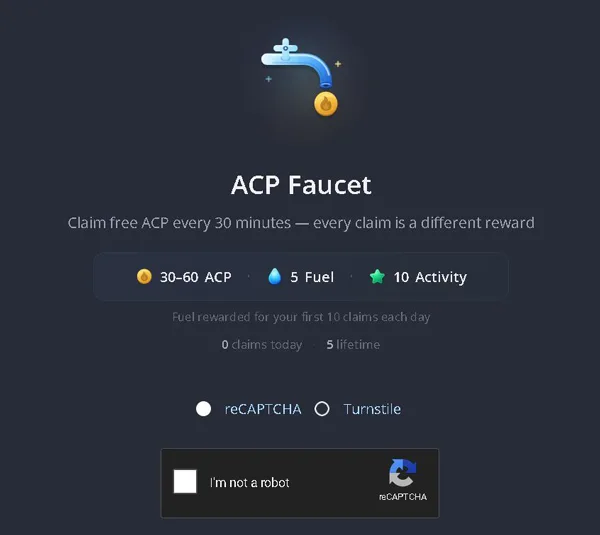
I went through three steps. I chose between reCAPTCHA (from Google) and Turnstile (from Cloudflare) as the verification system, clicked the box that confirms I’m a human and not a bot, and then pressed the dark blue button that says “Claim My ACP.”
I was hoping this simplicity would show up in the money too. But it doesn’t. I took the best case, where you click exactly every 30 minutes for 12 hours without a break. That gives you 24 claims and between 720 and 1,440 ACP, which add up to about one cent. A single cent for 12 hours in which you have to go back to the tab every half hour. It’s not even two bucks. It’s a lot less.
A single claim gets you between 30 and 60 ACP (Auto Claim Points), the site’s internal currency. Based on 2026 values, 1 ACP is worth between $0.0000085 and $0.0000099, so one claim comes to between $0.00025 and $0.00059. To get to one dollar, you’d have to click roughly 1,700 to 4,000 times. Who has the patience for that many clicks? I don’t have that kind of patience.
You also get two things that aren’t money. One is Fuel, 5 per claim, a token that speeds up the Auto-Faucet, meaning the automatic script that turns ACP into real cryptocurrency. With Fuel, several claims get processed at once, and you no longer have to keep the browser tab open for hours on end. I liked that, because the open tab was exactly what bothered me in the calculation above. But you only get Fuel on your first 10 claims each day.
The other is the 10 Activity Points, which raise your account level. The higher the level, the bigger the permanent bonus FireFaucet gives you on whatever you earn from then on. It’s a very small percentage. But it’s the only thing here that stays with you even after you close the tab.
Refer your friends
I expected the referral program to be the easiest part of the site. You send your invite link, the person signs up through it, and they become your referral. That’s all FireFaucet asks of you to get a referral.
But the money doesn’t come from the sign-up. It comes from what the person does after that, because you get 20% every time they earn something from any of the methods on the site. A friend who signs up and then never logs in again doesn’t bring you anything, and no matter how high the percentage is, 20% of 0 is still 0.
I’m glad FireFaucet pays the commission out of its own money and the person you invite keeps all of their earnings. I would have found it hard to send my link to someone knowing that part of what they earn goes to me.
The program is built on four things:
- A unique invite link, which you get from FireFaucet.
- Separate tracking links. You can make several, each one different, and see which places or social networks bring the most sign-ups, which is useful if you post the link in more than one place.
- 20% of the ACP the person you invite earns from tasks, surveys, and offerwalls, added to your account as a bonus from the site, without being taken out of their earnings.
- 5% of deposits for PTC (Paid-To-Click) ads, if the person you brought in is an advertiser and not a regular user.
There are also referral contests, which FireFaucet runs from time to time and which last for a limited period. For its anniversary it had one with a prize pool of over $2,000, and each person’s score was calculated based on how much their referrals earned from offerwalls. Here too, what counts is what the people you bring in do, not how many of them there are.
To me it’s a decent passive income, as long as the people you invite are really interested in the site. With a friend who logs in often and does tasks, the 20% adds up little by little.
How do you get paid?
Everything you do on Fire Faucet turns into ACP (Auto Claim Points) and activity points, which I wrote about above. ACPs are what you exchange for money, and you decide how.
The simplest option is gift cards. If you don’t want to deal with cryptocurrency, you exchange your points for codes from regular stores such as Amazon, Apple or eBay, plus Mastercard or Visa prepaid cards and many others. The threshold is the same for all of them: $5. And you don’t need a crypto wallet, which matters to a lot of people.
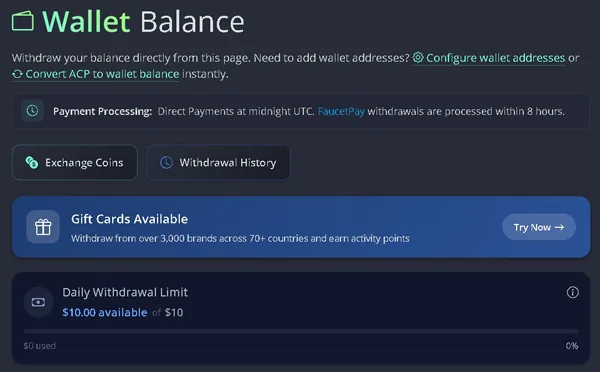
The other option is to exchange your ACPs for one of the cryptocurrencies the site accepts and then withdraw it to your own wallet. This part bothers me a little. My points are worth whatever the coin is worth at the moment of the exchange, and I can’t know in advance how much I’ll get for them.
Fire Faucet has between 12 and 15 cryptocurrencies, including Bitcoin, Ethereum, Litecoin, Dogecoin, Tron and Tether USDT. And there are two routes the coin can take to leave the site.
FaucetPay is a kind of middle account that connects small rewards sites with each other. The cryptocurrency doesn’t go through the main blockchain network, where it would move slowly and cost a lot. Instead, it arrives instantly in a micro-account. This route has the lowest withdrawal thresholds on Fire Faucet, often $2-3, depending on the coin.
A direct transfer sends the coin to your personal wallet (Trust Wallet, for example) or to your account on an exchange, such as Binance. Fire Faucet then pays the network transaction fees (gas fees), and the thresholds go up a lot. For Ethereum, the direct payout minimum has been 0.003 ETH for a long time. For the other coins, a direct payout requires at least:
- $25 for Tether, the highest of all
- $10 for Bitcoin
- $4 for most of them: Binance, USD Coin, Solana, Cardano, Dogecoin, Litecoin and Tron
- $3 for XRP and Nano
- $2.50 for Dash, Monero, Zcash and Digibyte
Which route is better? It depends on the coin. For Dash, Monero, Zcash and Digibyte, the direct threshold is $2.50, about the same as on FaucetPay, so you’ll barely notice the difference. For Bitcoin it goes up to $10, and for Tether to $25, which is 10 times the lowest threshold on the list. And the higher the threshold, the more you have to collect before your first payout.
With so many coins, routes and thresholds, the system is more complicated than on other GPT sites. But once you get used to it, nothing should trip you up when you cash out your rewards.
All your ACPs make their way to you in the end. But some routes to the money are shorter than others.
FireFaucet Payment Proof
How much money can you make?
A full hour of PTC ads and short links (shortlinks) gets you between $0.01 and $0.10. I did the math, and in the best case it comes out to about 6 minutes of clicking for one cent. Those minutes frustrate me, because they add up quickly and the money doesn’t come with them.
In my experience, that’s also the site’s big problem. How much you earn depends on how often you log in and how much the site pays. The first part is up to you. The payment part isn’t, and the rewards are small.
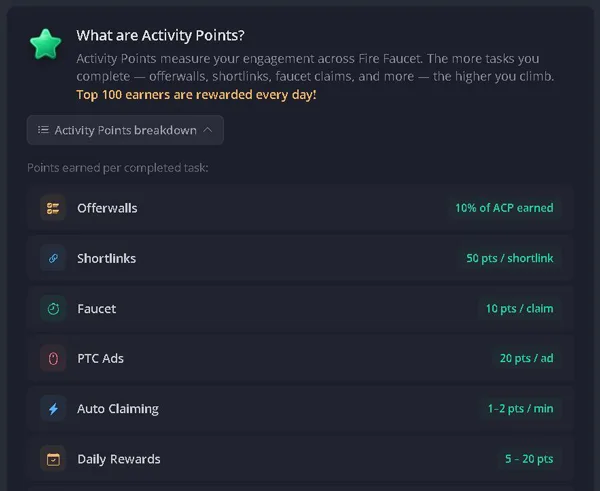
The site softens this a little with level bonuses. As I said above, every offer or task you finish gives you a number of activity points, and those points raise your account level. With each new level you get some ACP and something else that stays with you: you earn a bit more from everything you do after that. I like that this bonus doesn’t go away. But it only helps a little. Your earnings go up, and the potential is still small.
Payment comes in crypto, and prices keep changing. That’s why a faucet earning is best measured in dollars, at what it was worth the moment you finished. In dollars, the methods look like this:
- PTC ads and short links: 60 minutes of active tasks for $0.01-$0.10.
- High-tier surveys: 15-30 minutes for $0.20-$0.75, but only if you qualify. It’s the best pay per minute on the whole list.
- The realistic daily cap: 1-2 hours of work and $0.30-$0.50 at the end.
- The theoretical maximum, for those in the top 20 on the leaderboard: almost nonstop activity and an extra bonus of $1-$2.
- The daily faucet and gift boxes: one captcha solved once a day, or a button pressed now and then, for free ACP. The daily bonus is small, around 50 ACP, less than a cent, but it asks almost nothing of you.
- Level and leaderboard bonuses: every task gives you EXP, and as your account level goes up, you get a small, permanent multiplier on auto-claims. The top 20 users of the day also get extra daily rewards.
When I put the rows side by side, the survey is the only one that pays for your time at all, as long as you qualify. The rest take whole hours for a few cents, including the realistic cap, where two hours of work bring in half a dollar at most. And the top 20? There, the $1-$2 bonus requires you to stay on the site almost all the time. To me, that doesn’t seem like a good trade for that much time.
With the level bonuses, your earnings go up a little, but it will take a while before you build up a decent amount to withdraw.
How do you ask for help?
If a withdrawal gets stuck, the easiest thing would be to call someone or write to them in a chat. I expected to find at least an official email address on FireFaucet. I didn’t find one. There’s no public phone number or live chat either, at least not one confirmed by anyone outside the site, based on what’s openly available online.
And so people help each other. Many users look for answers to problems with their earnings or withdrawals on forums and in conversations with other members. That’s understandable, but the person answering you there also sees the site from the outside, like you, and has no way to fix your balance.
The official route is a ticket. I logged into my FireFaucet account, opened the support center, created a ticket, wrote the details of the problem in it and sent it, because the form only shows up after you’ve logged into your account. And what if you can’t get into your account anymore? Then you can’t get to the ticket either, and there’s no other official way to reach the team. That’s what worries me a little.
For small questions, you don’t need a ticket. The site has help pages and an FAQ section that explain the faucet, the daily bonus and automatic collection. Most of the basics are covered there, and only when you can’t find what you’re looking for does it make sense to write to the team.
Support is okay for members. You have an easy way to reach the team, even if it’s the only one and it goes through your account. An extra email address would have given me more peace of mind.
Red flags you should never ignore
So you can’t use a VPN on FireFaucet. No proxy either. No multiple accounts. And if you get caught, your money is gone. Just like that. Only thing is, the blocking doesn’t always come from a person. The offerwalls belong to other companies because FireFaucet doesn’t run their own, so the IP and device fingerprint just does the filtering on its own. Which is probably why users keep saying the filter is opaque and way too harsh.
Independent reviews and their documents also bring five more things to the surface:
- Blocking right at withdrawal. Multiple independent reviewers, each on their own, tell the same story. Account closed and balance wiped the moment they requested a payout.
- The site’s terms. They give themselves the right to close or delete your account and empty everything in it, for whatever they consider a violation. That includes “dishonest or unnatural methods,” which are defined nowhere. Not once.
- The company behind it. No name, no address, no applicable law. So there’s no one to take your complaint to.
- The privacy policy. It doesn’t say how long they keep your data, and they don’t name an EU or UK representative, no data protection officer either, so GDPR is basically left in the dark.
- No KYC. They frame it as a perk (and honestly, it is convenient, I won’t argue that), but a site with zero verification is more exposed to money laundering and fraud, which can lead to sudden shutdowns or blacklisting.
I know this sounds bad. But these are things worth having in your head before you open an account.
I’ve requested payouts multiple times and every single one came through without delay, no matter which method I picked. My account hasn’t been blocked. My balance hasn’t been wiped. And nobody asked me for KYC when I withdrew.
So why does it happen to others? Because you can’t see the full context from the outside, and what the person did before requesting that payout, neither you nor I have any way of knowing. Especially with the withdrawal blocks. I think those hit people who are trying to game the system.
The money came through.
Stick to their rules and you won’t have problems. That’s really all you need to remember. For as long as I’ve been using FireFaucet, nothing from that list above has touched me.
FireFaucet on Trustpilot
All of us who collect points on sites like this expect the same thing. We reach the threshold, ask for our money, and get it. Many of the complaints about FireFaucet say that’s where it all broke down, because people were banned or had their accounts restricted right after their first withdrawal request, and they often lost everything they had collected over weeks or months. Reading that gives me chills. The work is lost at the exact moment it should turn into money.
People also complain about offerwall tasks that weren’t credited to them, and about points coming in too slowly for how high the minimum withdrawal threshold is. Because the threshold is high and the points come in slowly, the road to the first withdrawal is long. And it’s right at the end of that road that accounts get blocked.
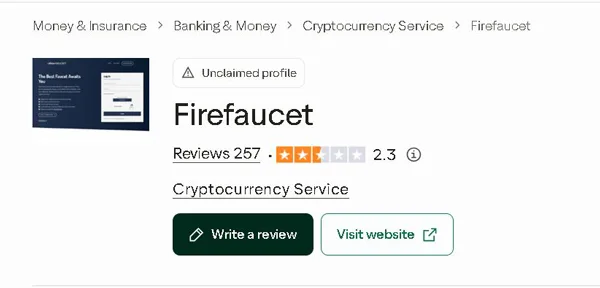
The ratings match. Trustpilot has 257 reviews and a TrustScore of 2.3 out of 5, plus a warning that the company might be linked to high-risk investments. I don’t like that warning at all, and I take it seriously. Reviews.io has an even lower average, 1.44 out of 5, but from only 9 reviews, which don’t carry as much weight as the 257. And ScamAdviser, which rates sites automatically with an algorithm, gives the domain a fairly low trust score and says the site might be a scam.
About half of the people who wrote reviews are complaining, about 4 in 10 are satisfied, and the remaining 10% or so are neutral, except that they say earning is slow. The satisfied users have their reasons too. They like the auto-claim feature and how convenient the automatic faucet is. They received small payments without problems and had fast withdrawals, as long as their account didn’t trigger the security checks. What exactly triggers those checks isn’t clear from the reviews, and that’s something I would have liked to know.
The ratings are either very high or very low, with little in the middle. Some of the satisfied users ask others to leave high ratings to cover up the negative reviews. A rating given on request is more of a favor than an opinion. But that doesn’t mean the good reviews are fake, because I didn’t find any clear evidence that anyone is organizing fake reviews.
So why do I still trust it? Because FireFaucet has paid me every time. Since I started using it, I haven’t had any problems with payments. They all arrived on time, with no errors and no delays. I’m one person with one account, and I can’t say the others didn’t go through what they describe. But my payments are what I can check myself, and they tell me that, for now, FireFaucet is trustworthy.
I’ll add every new payment I receive from them to this review.
Who can join FireFaucet?
I expected the FireFaucet sign-up to stop somewhere around a photo of my ID or a selfie holding it next to my face. It didn’t. The sign-up page clearly says there’s no KYC (identity verification), and it’s true: you don’t send a driver’s license, passport, or selfie, either when you create your account or when you want to get your money. Because there’s no verification step, the account is ready in about 30 seconds. And I do like this part, because my documents stay with me.
What do you need to sign up? Not much. An internet connection, a valid email address, a device the site supports, and you have to be at least 18 years old. You don’t need any particular training, and you don’t pay anything for a basic account.
It doesn’t matter where you live either. The site is open worldwide. According to the official data, since 2018 more than 1.6 million people have signed up and completed over 943 million tasks (ad clicks, surveys, and more). If I take their numbers as they report them and divide one by the other, that comes to about 590 tasks per person, which tells me people don’t just sign up, they also stay and work there.
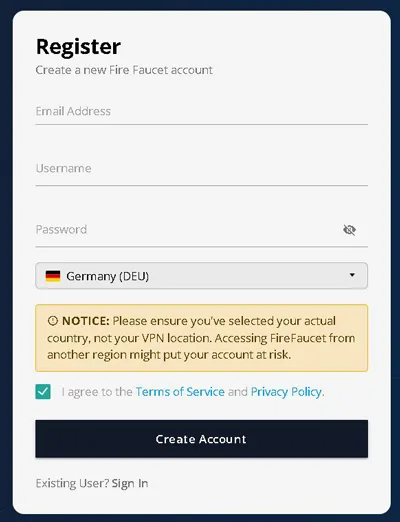
When I opened the form, the location was already filled in, because the system checks your connection automatically (for someone in the United States, for example, it shows United States). From there, the sign-up goes like this:
- You choose a username, a password of at least 4 characters (that seems a bit short to me as a minimum, so it’s worth using a longer one), and you enter your email address.
- You check the box confirming that you live where you’re registering.
- You also check the required box for the Terms and the Privacy Policy.
- You click the confirmation link you get by email, and the registration is done.
- You get 1,000 ACP, the sign-up bonus.
But this easy sign-up comes with a second rule written on the same page, and that one I don’t take lightly. The site warns that if you use FireFaucet from outside your region, your account can be banned. This means you’re not allowed to hide your location with a VPN. If you sign up on a VPN or turn one on later, the security system bans your account on the spot and freezes your points. I’d be really annoyed to build up points and lose them all because of a VPN I turned on just once.
So if you want to use the site, never turn on a VPN while you’re on it, keep your account tied to the place where you actually live, and make sure no one else on your home network goes on FireFaucet.
The rule is easy to follow, except you have to follow it all the time, not just when you sign up.
Can you use it on your phone?
Most of the ways to earn on FireFaucet have you open a lot of tabs in your browser. When I worked from my phone, the tabs kept piling up, I kept switching from one to another and back, and it all got annoying fast. Because of that, I recommend using the site mostly from a laptop or desktop.
Can you still use it from a phone? Yes. FireFaucet doesn’t have its own app to download, but you go to the site in your phone’s regular browser, Chrome or Safari, and log in as usual.
You’ll also come across “Claim Crypto Faucets” or “Claim Multi Faucet” in the app stores. I call them apps because that’s where they’re listed, but they aren’t made by FireFaucet. They’re just simple browsers that open the desktop site inside an app wrapper. I’m wary of putting my login details into a wrapper like that when I already have Chrome or Safari on my phone.
The site is built to work on a small screen too, and the text is readable without zooming. But only up to a point. The page layout is still designed for computer screens, and on a small phone everything looks cramped and cluttered, so sometimes it’s hard to find what you’re looking for.
And most of us end up on a computer anyway. About 25.21% of visits come from phones, and the remaining 74.79% come from computers.
For me, the phone is useful mainly for the offerwalls that specifically require a mobile device, and there the text being readable without zoom does help. Everything else works better on a laptop or desktop, tabs and all.
Is FireFaucet worth it?
I’ve been using FireFaucet for a good few years, and my account has never been blocked. Every payout I’ve requested has arrived on time. That matters a lot to me, because I put my free time into this site, and I’d hate to have put it in for nothing.
But I’m only one part of the story. The site has been running since 2018 and it does pay, but not everyone. It has some very aggressive automated anti-fraud systems that often block accounts right when someone requests their first withdrawal. I think of someone who patiently collects points, clicks the payout button for the first time, and finds a closed account instead of money. It’s a shame about the work they put in, and I’m afraid I could end up there too.
What still keeps it going is how long it’s been around. And the auto-claim that runs in the cloud really is convenient.
So I see it as a site for someone who treats small online earnings as a bet, knows they might lose the time they put in, and doesn’t count on it for steady or guaranteed extra income. With those expectations, I think it’s worth it.
I like working on FireFaucet, and for me it’s a real, trustworthy site. That’s my opinion as of today. If things change, I’ll come back here and write honestly about what happened.
And if you’ve had an experience on FireFaucet, good or bad, or you have a question, leave me a comment. I can’t wait to read it!