

Earnopolis is a new GPT site (short for “Get-Paid-To,” the sites that pay you to do tasks), built entirely around Greek mythology. I was really drawn to the theme, because sites like this are a lot alike. Almost all of them start from the same template, give you the same tasks, and pay you small amounts that you collect bit by bit.
When I signed up, I was hoping a design this different would also come with more money. I was worried, though, that it would just be pretty packaging over the same offers you find everywhere.
The trust part is simple. Earnopolis is a trustworthy site, and it pays you for the offers you complete, the way it promises to. But that’s only part of the answer. A site can pay honestly and still not be worth the time you put into it. And time is money too, right?
Below, I’ll tell you how Earnopolis works, what games it has that the other sites don’t, how much you can earn on it, and what methods you can use to withdraw your money. By the time you reach the end, you’ll know what to expect and whether it makes sense to create an account there.
What is Earnopolis, and how does it work?
Anyone who has collected points on rewards sites has surely run into the old, clunky ones too, with surveys stacked one under the other on a page and that’s about it. I expected Earnopolis to be the same. And I was wrong.
Earnopolis is still a GPT site (short for “get paid to”, a name that says exactly what it does), where you earn money from your browser for small tasks you do online. You can play mobile games, try apps, answer surveys, watch videos, and complete offers from companies that advertise there. According to their official materials, the site launched in January 2026. I have no way to verify the date. I only know it from them.
The difference from the classic sites is obvious right away. Earnopolis is much more polished than most of them, and it’s built like a game, with a community around it. You get levels to move up through, achievements to collect, a section for the community, and contests, all layered on top of the earning methods so you’ll want to come back even after the initial curiosity wears off.
If you’ve used Pawns, EarnLab, or Swagbucks, you’ll see that Earnopolis is closer to the newer generation of sites, built around earning on your phone and around keeping people there as long as possible. For me, this part cuts both ways. I like going to a site that looks good and doesn’t bore me. But every level and every contest wants a little more of my time, and that time has to pay off.
I have no doubt that it’s trustworthy. Earnopolis pays for the answers you give. Whether it’s worth your time only becomes clear once you look at the earning methods, which I go through one by one below, and at how much they pay.
If the methods pay well, the game side of it becomes a nice bonus.
Complete free offers and random tasks
The big payouts on the offer list got my attention too. Puzzles & Chaos: Frozen Cast pays up to $332.71, $298.86, or $262.06, depending on the device, and I thought that was a really good offer for a puzzle game. Why would a puzzle game pay that much? Because along the way, you’re the one who has to pay. Any game in the account that promises over $100, like Puzzles & Chaos or Slot Mate Vegas Slot, is built so that it’s mathematically impossible to reach the end for free within the 30 days. The last stages, the ones that pay well, only unlock if you spend real money on in-game packs.
And that money isn’t safe. If you spend $50 on microtransactions to get past a level and the app doesn’t record your progress, you lose all of it. Paying out of my own pocket for a shot at a game’s money isn’t a trade I’d make, because I’m at a loss from the first pack on. It bothers me that the whole reason these offers sit in the account is to get you to spend.
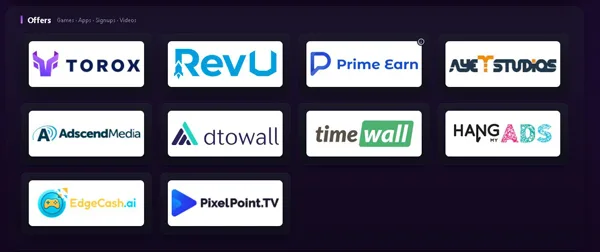
All the offers, big or small, come from outside. Earnopolis doesn’t pay you out of its own money. It’s just the middleman. It works with ad networks called offerwalls or offer suppliers (Offer Providers), and in your account you can see how many active tasks each one has for you right then. When I checked, they looked like this:
- RevU, 88 offers
- Torox, 87 offers
- ayeT Studios, 44 offers
- EdgeCash, 21 offers
- Adscend Media, 15 offers (the fewest of them)
Prime Earn, dtowall, time wall, HANG MY ADS, and PixelPoint.TV also show up on the page.
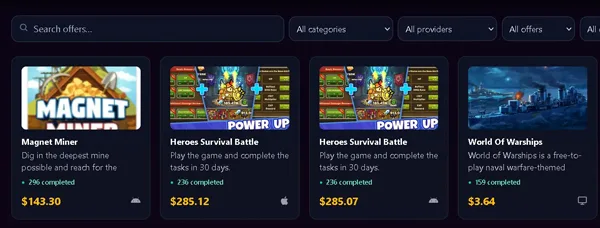
Most of the offers there are mobile games, far more than anything else. My account had 239 active game offers, then apps with 53, casino and betting with 27, entertainment with 14, the “Other” category with 6, and only one offer each in finance and crypto and in lifestyle. I added up everything that isn’t a game and got 102, less than half the number of games. Anyone who doesn’t play games on their phone won’t find much to do here.
Tile Hole Master shows up twice in the account, once for each type of offer, and it’s the easiest way to see the difference. You can filter for either type in the account settings. The Multi-30 version pays in stages, up to $33.54, for the goals you reach in the tile puzzles. If you quit halfway, you keep the money you earned for the first levels. The standard version pays $30.74, but only if you complete all the requirements within 30 days. The same game pays less in exactly the version where you risk more. I don’t understand who would pick it.
That’s how all offers with multiple rewards (Multi-Reward) work, paying you step by step as you reach the goals in the game. Puzzles & Chaos: Frozen Cast is in this category too. Pinata Fiesta pays up to $92.71 for rewards unlocked within 30 days, and Free My Cat (Multi-30 days) pays $26.23 for goals reached within a month.
Single-task offers are all or nothing. You don’t see a single cent until you’ve done everything in the instructions. You get to 90%, your time runs out, and you get $0. It’s a shame about all the time you put into the game up to that point, because none of it counts anymore. Slot Mate Vegas Slot pays $125.44 after you open the game, create an account, and finish everything you’re asked to do. Candy Grab pays a fixed $11.76 for the download and basic gameplay. The lowest-paying of these examples is Knit Match, an easy puzzle with a fixed payout of $2.12. It’s not much, but it’s easy.
Earnopolis is a bit of pocket money, not a job. The difference is much clearer if you put it next to other GPT sites that are open worldwide. I’ve written reviews of Timebucks and Firefaucet, and I’ve received countless payments from both, through PayPal or in crypto.
If you use it anyway, skip the offers with huge payouts, which are traps built to get you to spend real money, and stick to completely free puzzle games under $30, even if they don’t pay much. Withdraw your money as soon as your balance hits the $1 minimum, to protect it. And before you download a game, check whether your phone lets apps track you (app tracking). Without it, the app may not record your progress, and the work you put into the game goes unpaid.
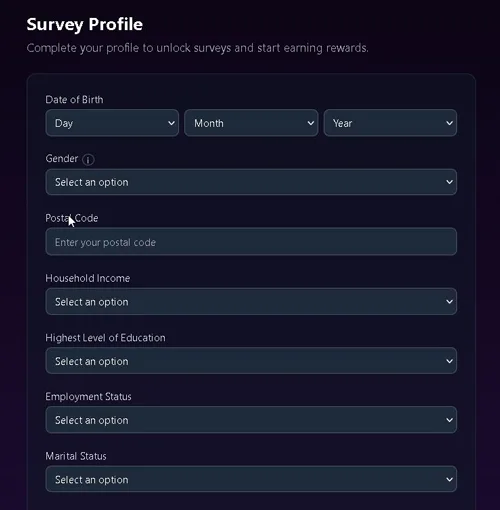
Earnopolis wants to know quite a lot about you before it pays you for your first survey. It all goes into your Survey Profile, and without it you don’t get to a single paid question. I expected to get away with a few simple questions, but the profile asks for:
- your date of birth and gender, which are permanent (according to Earnopolis)
- your postal code, meaning the area where you live
- your household income, whether you work and what you do
- your highest level of education and your marital status
- how many people live in your household, how many kids you have, whether you own your home
The profile won’t save unless you tick a box agreeing that your demographic data can go to outside companies so they can match you with surveys. This part worries me a little. Income, kids and postal code are fairly private details, and I don’t know which companies receive them.
And once you save, your answers stay locked for 90 days. The reason is fair. Earnopolis wants to stop people who would keep changing their details to game the system. But if you change jobs or stop renting, your old income, job and renting status stay in the profile for three full months.
Your account is then linked to four large market research networks outside the site: Prime Surveys, BitLabs Surveys, CPX Research and PureSpectrum. Through them you get questionnaires from brands that everyone knows and that want to find out what people buy.
And your country matters. People who live in the United States, the United Kingdom, Canada, Australia, Germany, France, Sweden, Norway, Denmark, Finland, Switzerland, the Netherlands, Belgium or Austria, meaning a Premium (Tier 1) country, get a lot more surveys, from more providers. Romania isn’t on the list.
After all that data about you, the money doesn’t come easily. Disqualifications are frequent, and your actual earnings often work out to under $2 an hour. It’s a shame to spend your time that way, especially since you’ve already paid your way in with the profile. The mobile games in the offerwall are a much safer use of your time.
If you still want surveys from other sites as well, I’ve written about Microworkers, InboxDollars, Marketagent, Tesco Home Panel, and Vocal Views.
Surveys on Earnopolis still make sense when you’re close to the payout threshold. With 800 points ($0.80) and a minimum withdrawal of $1, you need 200 more points, and for those a quick survey really is worth it. That’s all I ask of them.
Earnopolis Arena
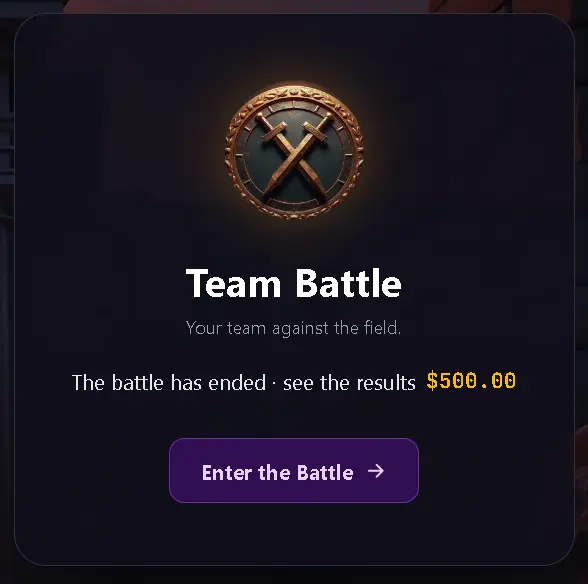
A leaderboard with money at the end makes you want to climb it. The Arena on Earnopolis is that kind of competition, set up like a game, where you compete against other users for cash prizes. The money from it comes on top of what you get for tasks anyway. There are two separate game modes. In Team Battle you play on a team, and in The Trials you play alone.
Team Battle is the simpler part. Users are split into large teams that compete for a shared $500 prize. You don’t have to do anything special to help your team, because every point earned on the site goes straight into the team’s live score, whether it comes from a finished game, an app installed on your phone, or a survey.
Only the top three teams get money. First place takes $250, half the prize, second takes $150 (30%), and third takes $100 (20%).
I thought a team’s money was split equally among its members. But each member gets paid based on how much they earned while the competition ran, and the more they earned, the bigger their share. I liked that. Someone who put in a lot of work doesn’t get the same as someone who earned a single point. But even someone who earned a single point gets something, because there’s no minimum payout. The only ones who get nothing are “struck-down” members, the ones who were banned or disqualified.
There’s also Ares’ Favor, a $25 bonus for a single person. It goes to the player who earned the most out of everyone on teams that didn’t make the top three. It’s a small consolation for someone who worked hard on a team that ended up without a prize.

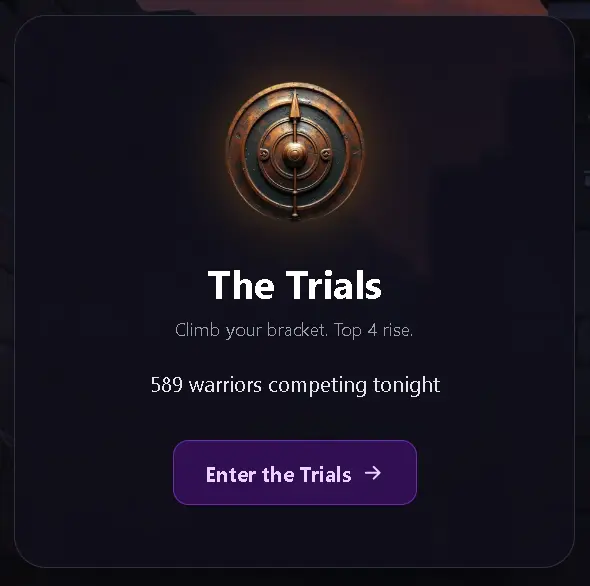
The Trials is more complicated. There, you’re placed in a group with a fixed number of players and compete for that group’s prizes. To move up to the next tier, you have to finish in the top 4. When I wrote this review, there were 844 players in the whole system, in 53 active groups across 5 tiers. My account showed the number of players and the maximum prize for each tier:
- Tier I: 550 players, up to $1
- Tier II: 147 players, up to $2
- Tier III: 74 players, up to $4
- Tier IV: 44 players, up to $6
- Tier V: 29 players, up to $10 (this is where I would have liked to get to)
The first tier is the one I looked at most. Out of 844 people, 550 are there, where you can get $1 at most. At Tier V the prize is 10 times bigger and there are only 29 players. But to get there you move up one tier at a time, 4 times, and each time you have to be in the top 4 of your group.
Getting into The Trials has a requirement too. You qualify through the “Earn to Qualify” button, which requires you to check off 2 of 4 things: account age, at least $1 earned in the last 30 days, a recent login, and an account in good standing. I was worried it would be hard to get in. But 2 of 4 is easy to check off if you use the site often.
This climb, one tier at a time, is exactly why I don’t go all out for the Arena. If you pick harder games, or ones that annoy you, just to collect points for the leaderboard, you’re putting time into a prize you might not get. Because nobody gives you that time back. You’re better off playing the free mobile games that pay well and consistently and that you actually enjoy. You get paid for those anyway. And if the points from them get you into the top 4 of a group or onto a winning team, the Arena gives you something extra.
For me, the Arena is a bonus that comes on its own, on top of the games I like.
Refer your friends
When you have a referral link, the first thought is to send it to family and close friends. On Earnopolis, they’re exactly the people you need least. They’re likely to give up fast or trigger the flag for accounts from the same household (household flag). And the second one is what I worry about more, because a flag on your account isn’t something you want over some referral money.
The link is personal, and you can give it to friends or to people who follow you online. Anyone who signs up through it is added to your referrals (that’s the site’s own term). Then it splits into 2 paths: the Standard Citizen plan, which you join automatically, and the Affiliate Program, which you join only if you apply.
I was hoping the welcome bonus was a good sign for the commission too. Your friend gets $1 instead of $0.50, which is what they’d get if they signed up without the link. The person who sends the link, though, is left with 5% of the money their referrals withdraw from the site. And that money takes its time. From the exact moment your friend withdraws, the commission sits in a safety period for 30 days, and only then does it move into your active balance.
There’s one more thing, and it bothers me more than the wait. If your friend doesn’t withdraw, you get nothing from their money. Let’s say 10 friends play enough on their phones for each of them to make $50, and together they earn $500. If 2 of them forget to withdraw, Standard Citizen only counts the money from the 8 who did, $400, and out of that you get $20, which comes in piece by piece, 30 days after each friend hits withdraw. It’s a shame about the $100 from the 2 who forgot. That money was earned through your link, and you don’t get any of it.
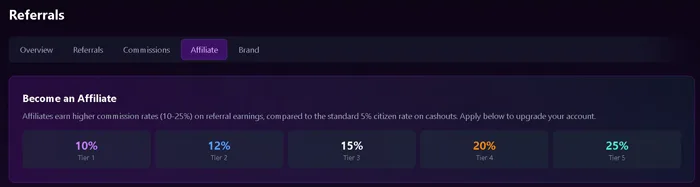
The Affiliate Program looks at something else. Affiliates are paid on what their referrals earn, even if some of them never withdraw anything. From the same $500, including the money from the 2 who forgot, Tier 1 gives you $50 and Tier 5 gives you $125. Commissions build up and are paid out automatically every Monday, after 2-3 weeks of processing.
The program is built for people who already have an audience, for example a YouTube channel, an X (Twitter) account, or a Reddit profile with a lot of followers. You get in through an application form on the site and become an Official Affiliate. Your tier depends on how many active referrals you bring in, and active referrals are the ones that have earned at least $1 in the last 30 days:
- Tier 1: 10%, from the moment your application is approved (double the automatic plan’s rate)
- Tier 2: 12%, starting at 25 active referrals
- Tier 3: 15%, starting at 100 active referrals
- Tier 4: 20%, starting at 300 active referrals
- Tier 5: 25%, starting at 1,000 active referrals
The automatic plan seems weak to me. The money from it is slow to add up at 5%, and it comes late, 30 days after each withdrawal. As passive income, referrals are only worth it if you’re an affiliate. If you make content or know how to keep a community active, this program is among the most generous of any rewards site, and up to 25% of what your people earn, received automatically every Monday, is serious money.
There’s no point staying at 5%. When you have a public channel or a social media link to show, you send in the form and your starting commission doubles to 10%. The best way to get active referrals is how-to content, TikToks, YouTube Shorts, or written guides where you show exactly how to complete the game offers that pay well.
For the tiers, only people who actually play count, and a good guide brings them in more often than a message sent to family.
How do you get paid?
In the end, all of us who collect points on sites like this want the same thing: to see the money come out of the account. Earnopolis turns your points into real money, cryptocurrency, or digital gift cards, and the PayPal minimum is $1. With a threshold that low, your first payout goes out quickly, and you don’t wait months on end saving up for a withdrawal. Anyone can write earning promises on the front page. The low threshold reassures me more, because my money won’t be stuck somewhere on the site.
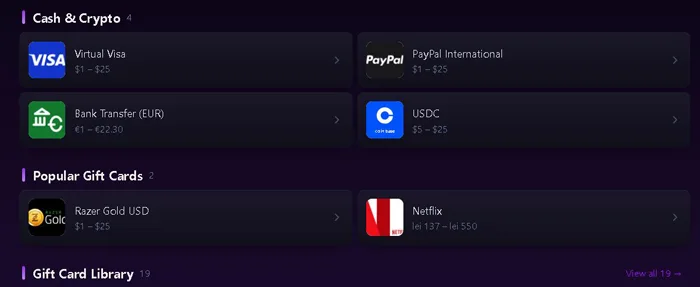
For cash directly, there are 4 methods, with limits on each withdrawal:
- PayPal International, with withdrawals between $1 and $25 per request.
- Virtual Visa, a prepaid digital card, with exactly the same limits as PayPal, between $1 and $25.
- Bank transfer, with the amounts kept in euros, from €1 up to €22.30.
- USDC through Coinbase, the cryptocurrency option. It requires a higher minimum, $5, and has the same $25 maximum per transaction. Your first payout only goes out after you collect a bit more.
$1 versus $5 doesn’t seem like a big difference. But at the start, when your balance is barely growing, you reach the first one much faster.
The gift cards come in two groups. The popular ones are Razer Gold USD, with gaming credit between $1 and $25, and Netflix, for streaming. The rest sit in a library of 19 options adapted to your region, including Roblox, PlayStation, or Uber Ride EUR. That’s the list I have. The options change depending on where you live, and you may have different ones than I do, maybe even more.
I’m afraid of keeping a big balance on the site, because an automated security filter can lock the account, and then weeks of work built up point by point are gone all at once. And the maximum is $25 per withdrawal anyway, so a big balance would still come out in pieces. The safest thing is to withdraw right when your balance reaches $5 or $10 and to stick with regular PayPal or Virtual Visa. Taking out small amounts often doesn’t protect you from a lock. But if it happens, you lose a lot less.
The rest of the system is simple and doesn’t need explaining. PayPal is my choice too. If you want other sites that pay the same way, with low thresholds, you can try Honeygain or EarnStar.
A dollar that actually leaves the account tells me more than any amount left on the site.
How much money can you make?
A puzzle game that pays $26.02 looks good in the offer list. Until you find out it can ask for 20 to 30 hours of play in total, spread over a month. I divided the amount by 30 hours and got about 87 cents an hour. Offers like this often keep you at a dollar an hour or less, and the hours add up much faster than the money.
But the hours aren’t the only problem. Progress in the game is reported by tracking networks that aren’t part of Earnopolis, and an error can show up at any time. If the network doesn’t record your levels, you play for 15 hours and end up with $0. Your money doesn’t go anywhere, but 15 hours spent for nothing is still a loss, even if it doesn’t show in your balance. That’s what I worry about most here.
I have 342 active offers in my account, and when I first saw them, I thought I had plenty to choose from. I found them grouped by how hard they are and how much they pay. At the top are complicated strategy or casino games, with payouts between $100 and $500 or even more, which take a lot of time or make you buy in-game items with your own money to get past the final levels. Me, paying real money so a game will pay me? I can’t bring myself to do it. I’m stingy even with smaller amounts.
Further down are the simple puzzle games, between $10 and $35, like Tile Hole Master at $33.54 or Free My Cat at $26.23. You have 30 days to get through a few specific levels, and you don’t pay anything. The smallest offers pay between $0.20 and $3 and are quick tasks (you install an app, set up a basic account, answer a short survey).
How many offers you get and how much they pay also depend on where you live, the devices you have, and how much time you have for mobile games or market research surveys. The companies paying for the ads spend the most on people from the United States, Canada, the UK, and Germany. In countries with smaller digital markets, there are fewer offers and they pay much less. Someone from India earned $5, someone from Chile $5.47. It seems unfair to me, but that’s how ads work.
If you log in now and then, the most you can realistically hope for is around $20 to $50 a month. That money won’t cover rent or a big bill. It’s enough for a video game or a few small digital purchases.
The tasks paying hundreds of dollars that ask for money out of your own pocket aren’t worth the time. Completely free games work better, even if they pay little, and so do short surveys you do while you’re waiting for something anyway. Because they’re short, if something goes wrong, you’ll lose minutes, not hours. You cash out to PayPal or gift cards as soon as your balance passes the $1 minimum threshold, so the money is safe.
A dollar that’s made it to PayPal is yours, while a dollar left in your balance still depends on those networks that sometimes fail.
Earnopolis Trustpilot
Most complaints about Earnopolis tell the same story. Someone builds up a larger balance, tries to withdraw it, and their account suddenly gets banned or restricted. Large withdrawals often go to manual review, and some of the people who earn a lot write that they lost their pending balance because of an automated fraud flag. The reason given for the ban is usually “multiple accounts” or “VPN use,” based on device fingerprinting.
That’s a shame, because a pending balance means offers already completed. And this part worries me more than any rating.
People who cash out small amounts have a different experience. They aren’t asked for documents (KYC verification), their payments arrive quickly, and they praise the modern interface, the $1 minimum through PayPal, and how fast the first withdrawals come through. I really liked that low threshold.
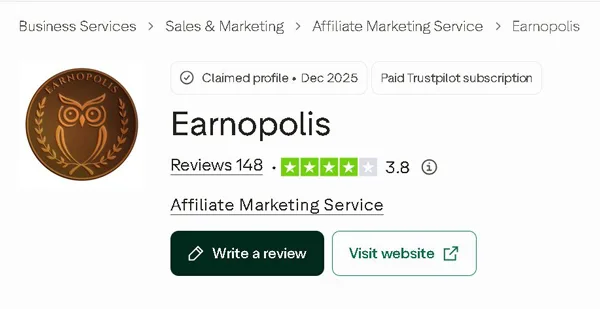
On Trustpilot I found 148 reviews from the last 12 months and a rating of 3.8 out of 5, which is fairly decent for a site that only opened to the public in mid-2026. But 148 people is still not many, and it’s too early to tell whether their opinion has changed over time. Still, the newer reviews include a cluster of disputes about bans.
New members face one more hurdle. Their offer credits stay pending longer, until the account moves up a level. Support helps some people right away when credits for an offer don’t show up, and others write that their tickets went unanswered.
I’m going to cash out small amounts often and not let my balance grow too much.
Red flags you should never ignore
When we collect points on sites like this, we usually worry that they don’t pay much for the time we put in. With Earnopolis, I worry about something else: the balance you can lose completely after you’ve built it up. Some of the risks are written right into their own rules, and others come from complaints on Trustpilot:
- The terms allow only one account per household (section 2), something confirmed by a single independent source. The site enforces the rule through device fingerprinting and, according to the privacy policy, people who use the same network can be wrongly flagged.
- Several users were banned for “multiple accounts” right after they requested a large withdrawal. The company answers them on Trustpilot by pointing to the same device fingerprinting and to fraud reversals from the offerwalls. There are enough of these cases to make a confirmed pattern of disputes.
- You lose the balance if you don’t use the account for a year (section 7.2).
- USDC payouts are often out of stock, some users write, but it’s an isolated complaint.
- Some say they were preemptively blocked from posting on the official Discord server the moment their account went into manual review. The claim is credible, even if I have no way to check it.
I liked the idea that they don’t ask you for ID, because they put it right on the homepage as an advantage. But the complaints show the other side too. If the fraud algorithm flags your account, how do you prove it’s you? You can’t. The people this happened to lost their entire balance, and it’s a shame about the work that went into it. Because the site doesn’t ask for ID on the way in, it has no way to ask for it on the way out either, right when you’d need it.
How do you ask for help?
When something goes wrong on a site like this, the first instinct is to write to support and wait. On Earnopolis, it matters a lot what exactly broke and where you write, because help comes from three different places: the tickets in your account, the official Discord server, and the frequently asked questions (FAQ) on the site.
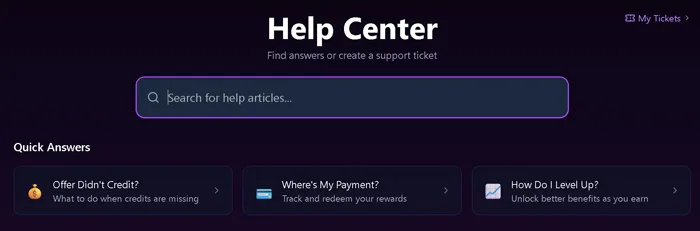
If the problem is on their side, things move fast. A bug on the site, a daily bonus that didn’t show up, or a payout that didn’t process because of them gets fixed quickly when you tell the moderators on Discord directly. Officially, you’re still supposed to open a ticket for general errors, but the team is much more responsive on the server. I like that the site itself sends you there when you want faster help. In the FAQ, the Discord is called “the heart of the Earnopolis community,” and the team is active there, in a support space where members also help each other.
To open a ticket, you log in to your account and go to the Help Center. The system won’t let you submit the request until you pick one of the 6 categories:
- Offer Not Credited, for an offer you finished that wasn’t paid
- Reward Reversed, when Laurels you already earned (the site’s currency) disappear from your balance
- Payout Issue, for withdrawals that failed, got stuck, or had errors
- Account Issue, for login, profile, or verification
- Technical Issue, for bugs and display errors
- Other Issue, for anything that doesn’t fit the others (a useful loophole)
The company promises a reply within 24-48 hours. I expected all tickets to move at roughly that pace. But not at all. If you don’t have an account yet, you have even fewer options, just a simple contact form (Contact Us), which you’ll find at the bottom of the homepage and on the FAQ page.
For games and apps that didn’t credit, the rule is simple. You wait 72 hours, open a ticket, and attach a screenshot of the end of the offer. People report, though, that the reply comes after 2 weeks, sometimes after more than a month, and that the request often just gets rejected. The gap between the promised 48 hours and more than a month of waiting is a big one.
And this is where the time adds up. Someone who plays for 15 hours on their phone to collect $50 and then sees that the points didn’t register has little chance of being rescued by support. They lose the money, but they also lose the hours. It’s the hours that annoy me more.
I get chills when I read what people write about suspensions. The official rule says that most bans can be appealed from the Contact Us page and that your balance stays frozen for as long as the review takes, without being permanently deleted. People flagged for a VPN switched on by mistake or for an offer-tracking mismatch say, though, that they got a generic, automated message confirming their account was permanently closed, without a person ever looking at their case. It looks like you have somewhere to appeal. It only looks that way.
What can you do, then, if support is this unreliable with missing credits? Not much, but what little there is matters. A single screenshot of the final screen usually isn’t enough. You need screenshots from sign-up, from the major milestones in the game, and from the completion message, because offerwalls often reject tickets that don’t show, step by step and in order, what you did. Then be patient for 72 hours after you finish the in-game objective. The system blocks or ignores requests sent earlier.
How you talk matters on Discord too. Active users say that if you complain aggressively or spam the team about delays caused by the offerwalls (companies separate from Earnopolis), you can get banned from the server. That leaves you without the shortest route to the site’s admins, which is exactly where problems get solved fast.
When the mistake is theirs, Earnopolis support helps you, and it does so quickly. When it’s an offer that didn’t credit, your own screenshots are still the most reliable help. I’m going to take mine from the first step, too.
Who can use Earnopolis?
I expected Earnopolis to ask me for an ID or a selfie before I cashed out. It doesn’t ask for any of that, because it doesn’t do identity verification (KYC). The company says it only collects an email address, a username, and payment details, and for me that’s the best part of the site. I feel much more at ease when my personal information stays with me.
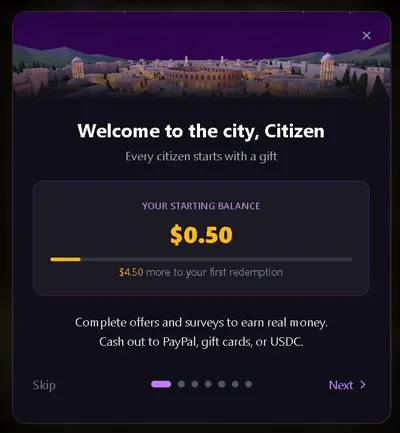
Signing up cost me nothing and took less than a minute. I had three options to choose from: my Google account, my Discord account, or an email address with a password I set myself. After that I already had $0.50 in my balance, around €0.42 once converted. It’s small change, but I didn’t do any work for it. At that same point, I got access to all the offerwalls, the contests, the progression system, and the mobile game offers, which are the best-paying ones on the site.
The minimum age is 16. If the law in your country sets a higher age limit for sites like this, the law is what counts, not the site. Anyone who’s 18 can sign up legally.
I’m worried about their rules, though, because they’re strict and one mistake costs you your whole balance. Earnopolis looks very closely at the device you log in from so it can catch anyone who cheats, and if you break a rule, it blocks your account and you lose everything you’ve earned up to that point. You only log in from your own home internet, with no VPN and no proxy, because anyone who hides their real location gets banned. One household is allowed a single account, for a single person, and nobody can create several accounts to earn more. And you do every task yourself, with no bots.
The one-account-per-household rule has a consequence you don’t see right away. A public Wi-Fi network can look like a connection used by a whole household, or like a proxy. It’s a shame to lose your whole balance over a public network when you can log in from home.
Earnopolis won’t bring you a big income. If you have free time and want a few dollars of pocket money from games, it’s one of the simplest sites you’ll find right now.
How many dollars you end up with also depends on the country you live in. The site works in over 75 countries, but the number of tasks depends entirely on where you live, and people in wealthy countries like the US, the UK, or Canada get many more well-paying offers than people in other regions. Signing up is just as simple wherever you live, but the good offers mostly reach a few countries.
Can you use it on your phone?
A phone is very convenient for surveys. You open them when you have a little free time and answer from anywhere. I’m more wary of the paid games, because with those you’re putting your time on the line and you have no guarantee it comes back to you as money.
It all stems from the fact that Earnopolis doesn’t have its own app on Google Play or the App Store. You go to earnopolis.com in your phone’s browser, for example Safari or Google Chrome, and the site looks good on the small screen and runs smoothly. But without an app to handle security and permissions, the games rely only on tracking links in the browser. And if a link doesn’t do its job, your hours of play go unpaid.
I said the site runs smoothly in the browser, and it does. But for games that isn’t enough: a few settings on the phone have to be changed too.
If you have an iPhone, go into Settings, turn off “Do Not Track” and allow the games you downloaded to track your activity across other apps. It seems backwards to me to let a game track you. But if you block tracking, Earnopolis has no way of seeing that you played.
With a VPN it’s more serious. If you have a VPN or privacy protection like Apple Private Relay turned on while you use the site in your phone’s browser, Earnopolis flags your account for fraud and bans you on the spot. You lose your whole account over a setting you forgot. Check your settings to make sure they’re off before you go to the site!
The site also has to be opened in a separate Safari or Chrome window. The browser inside other apps, like the one in the Discord mobile app, isn’t suitable for this.
And if you still go looking for Earnopolis on Google Play, you’ll come across apps like “Earnopolis Earn App Help” or “Earnopolis: Paid App Assist”. They don’t belong to the site. They’re guides or educational apps made by other people, with no connection to Earnopolis, and Google has already caught a few of them and removed them from the store. Don’t sign in to your account through them. The only official way is still the browser.
Is Earnopolis worth it?
There’s only one thing that worries me about Earnopolis, and that’s its automatic anti-fraud system. It’s very aggressive: it often blocks the accounts of people who earn a lot and of people who log in from a shared network, for “multiple accounts,” and the whole balance you’ve built up goes along with the account. And there’s no clear way to show who you are and ask for the account back. It’s a shame, because I thought it was a good thing that the site doesn’t ask for ID when you withdraw money. But when you do need to prove your identity, there’s nowhere to do it.
But Earnopolis is a trustworthy site. It’s a registered platform, and it pays people who use it now and then through PayPal, in small amounts. The minimum withdrawal is $1, and I’m happy even with that much, because a dollar you’ve cashed out is a dollar nobody can take from you anymore.
I also like how it looks. The interface is modern and designed like a game, and you can clearly see how long your points stay pending before you can withdraw them. There are quite a few ways to earn, and the pay is good.
However, most of the offers are games that take some time to finish. The money adds up little by little, but the time adds up too, much faster than the money.
Most of us use sites like this to make some money on the side. For someone who earns now and then and often cashes out small amounts, Earnopolis works very well as a secondary site, as long as they don’t expect too much from it. If you want to build up a lot, stay away from it. You run the risk of suddenly ending up with no account and no money.
Have you tried Earnopolis? Tell me in the comments, with questions, opinions, or whatever happened to you there!