
We’d all like some extra money, especially if we don’t have to pay anything out of pocket for it. And it’s possible. There are lots of sites where you earn bitcoin without investing a cent. An online rewards site really is a simple way to earn a little extra on the side. But one thing matters. The site has to be trustworthy, or you risk working for nothing.
adBTC is one of these sites, and it promises to reward you for small tasks you do online. But a promise is only a promise, and I want to know what’s behind it. Is adBTC a good option, or a scam you’re better off staying away from?
Because with a GPT site (Get-Paid-To, a site that pays you to do something), it isn’t just one thing that matters. There’s a lot to weigh before you sign up for a rewards portal.
In this review I go through all of these points one by one and give you a look inside adBTC, so you can easily decide whether to create an account or not. The decision is still yours. I’m only telling you what I found.
What is adBTC and how does it work?
Several sites have the same name, adBTC, and the only difference between them is the address. I tested adbtc.top and this review is about that one, so if you end up on a different address, you’re looking at a different site from the one I’m telling you about.
I also checked how long this address has existed, in the WHOIS records. The domain was registered on September 4, 2016, and the site has been online since September 2016. I liked seeing that a site that pays in Bitcoin has been around this long.
As I said above, adBTC is a GPT (Get-Paid-To) site that rewards you mostly for visiting other sites. And the BTC in the name does stand for Bitcoin, because the rewards come mainly in Bitcoin. Since I first tested it, they’ve added another payment method, but Bitcoin is still the main one. I’ll tell you about the new method further down.
But the site’s age and name don’t tell me anything about how much you can earn. That shows in the ways you collect rewards, and I’ll go through them one by one right after this. For me, the right address mattered first, and the money comes second.
Surf and earn bitcoin
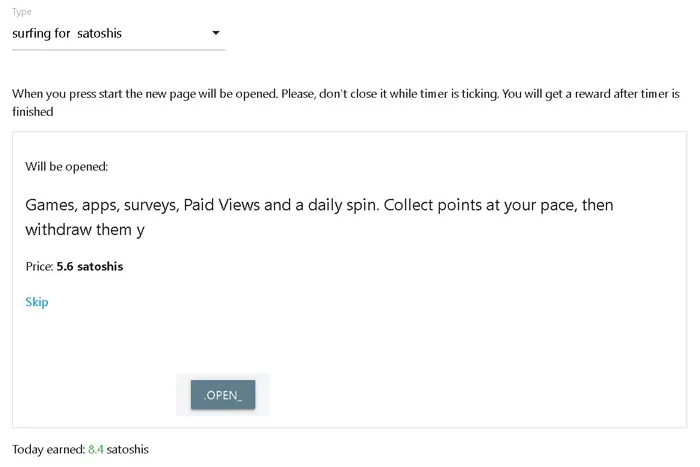
Surf ads is the part of AdBTC where I put in the least work. The ad opened in one tab, I switched to another one, and the reward showed up in my balance without me doing anything else.
Going by the name, I expected it to work the same way as on a Paid-To-Click site. It has something in common with them, but the difference is clear right away: you don’t have to look at the ad at all. You can stay in other windows and do something else, as long as the ad window stays open.
Getting from the start button to the reward goes like this:
- Go to the surf ads section and click start, and a new window opens with the ad.
- Read what it says there: a few lines about the site, the exact payment (for example “Price: 8.4 satoshis”) and, on some ads, a red “18+” badge as an age warning. I find it reassuring that you see the amount before you click, not after.
- Click the green “OPEN” button, which opens the advertiser’s site in a new tab.
- On the AdBTC tab you came from, a timer starts. A message asks you not to close the page until the end, because the reward only comes after the timer stops.
- At zero, the reward goes into your balance.
The steps repeat until there are no ads left. You’ll always see in your account how many are left and how many more rewards you can collect, and that was useful to me, because I knew when to stop.
AdBTC also has security checks, so that nobody can view the ads with automated programs (bots), and you can choose between 3 types. The mathematical expression gives you a simple calculation on a busy background, with a word like “SEVEN” and characters like “+” or “6”, and you type the result into the “The mathematical expression result” box. hCaptcha is the classic image test, where you click on every picture with a boat or a train. Turnstile is the newer system from Cloudflare, which does the check in the background, usually with a single click in a box, with no calculations and no pictures. If I had to count clicks, Turnstile asks for the fewest.
You can collect your rewards in your choice of 3 currencies. Satoshi is the smallest unit of a Bitcoin, and one satoshi is worth exactly 0.00000001 BTC. With the Russian ruble (₽), you collect fractions of a ruble, which people usually withdraw to Payeer, a digital payment processor. USDT means fractions of Tether, a cryptocurrency designed to always be worth one US dollar ($1.00). I find it the easiest to keep track of, because you always know what it’s worth.
The pay matches the effort. Most ads pay between 1.4 and 4 satoshis for 15 seconds. Some pay up to 15 satoshis, but they’re rare, and for those you wait out a much longer timer. I did the math on the best of them, and 15 satoshis comes to 0.00000015 BTC. Is that a small amount? It’s a very small amount. But I didn’t sit staring at the screen for it, and I didn’t give up anything else while the seconds went by. A small payout that asks almost nothing of me suits me.
If you’re interested in sites that pay more than AdBTC and have many more ways to earn, you can read my reviews of AskingCanadians, UserTesting, and Shopper Thoughts. Each one works differently from AdBTC and has different opportunities, and you can tell from the review whether it’s for you.
For money I don’t have to work for, I don’t ask any more of it.
Video Ads
I started the first video and switched to another tab, the way I would on Surf Ads, where the ad tab can sit in the background as long as you want. When I came back, the timer hadn’t moved. Video ads on AdBTC usually require the window to stay active and in the foreground, and if you leave it, the countdown stops or freezes until you come back. I was a little annoyed, because I was hoping to let the video play on its own while I did something else.
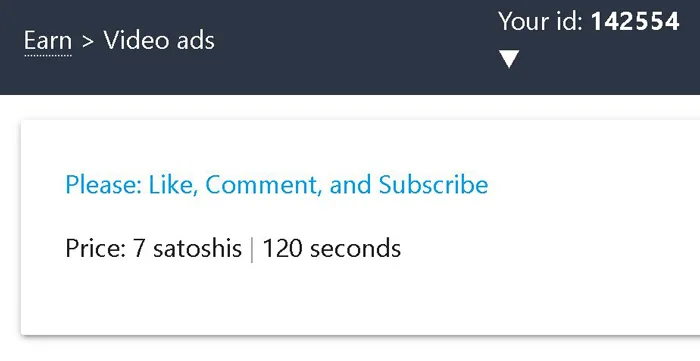
This is the second way to earn on the site. A company pays you to let its promotional video play for the number of seconds it asks for (often it’s a YouTube video embedded directly in the page). The offer, like the one in the image above, shows you what the company wants from you (“Please: Like, Comment, and Subscribe”), how much it pays (“Price: 7 satoshis”), and how long the video has to play. Here, it’s 120 seconds.
The rest works like this:
- You click the link and the video player opens.
- You press play, because the system’s countdown doesn’t start on its own.
- You keep the window active while the timer in the tab counts down (I learned this with the first video).
- After the 120 seconds, the system automatically checks how long the video played and updates your balance.
I liked that the money comes in right away, as soon as the timer hits zero, usually without any confirmation test. On Surf Ads, you have to solve a math problem or check a picture before every link. I’m more tied to the screen, but I don’t have to deal with the tests.
For this 120-second video, you get about half a US cent. The rate used is the one from October 20, 2026, $81,914 per bitcoin, and it will be different by the time you read this. Two minutes of keeping your eyes on the screen for half a cent.
I also did the math for one hour, in a hypothetical case where you’d watch 7-satoshi, 2-minute ads back to back, with no break at all. That makes 30 videos, and 30 videos at 7 satoshis each is 210 satoshis. At the current price, that hour is worth $0.17, 17 cents. And that’s the best hour possible.
Small change adds up little by little, I know that, but 17 cents doesn’t pay me for an hour when I’m not allowed to look anywhere else.
Autosurfing
I used Autosurfing on AdBTC.TOP for a long time, and I always found enough ads there. It’s the method where the site is supposed to work on its own for you and collect crypto without you doing anything. With regular surf ads, you click “Open” and solve a captcha for every site. Here you skip both, and that’s what I liked most, because a captcha on every site means minutes that add up.
The steps, when there are ads:
- You click the “Autosurfing” tab in your account
- The AdBTC script opens an ad and loads an outside advertiser’s site in your browser
- A timer starts counting down
- At zero, your balance updates quietly, without any message
- The page jumps right away to a new ad, and it all starts again without a single click from you
In theory, the tab can stay open in the background while you study, while you play games, or even when you’re no longer at your computer. But that only works as long as the platform has ads to run in autosurf.

When I wrote this review, I didn’t get a single ad. I opened the tab, and all that greeted me was the message: “We are waiting for new links, you should not close this page. The autosurf session will resume as soon as the advertisement appears. Today earned: 0 satoshis.”
What does the message mean? It means there’s no autosurf campaign for your profile anywhere in the network. Your computer isn’t to blame, and it’s not an error on your end. The platform simply doesn’t have enough ads to give out.
It’s a shame, because I was used to finding ads here. Maybe you’ll catch a few when you log in. Autosurfing is only convenient when advertisers have something to show you.
Refer a friend
I expected referrals on AdBTC to be the simplest part of the site: a link and a percentage of what the people you bring in earn. And they are, up to a point. But AdBTC also has something you rarely find, a marketplace where people are bought and sold for satoshi.
The site generates a unique profile link for you (in the form https://adbtc.top). You copy it, post it on social media or on forums, and every person who signs up through it can earn you money in two ways.
The 10% bonus comes from surfing. When the person you brought in clicks a regular ad for a website, watches a video ad, or starts an autosurf session, you instantly get 10% of their reward. And nothing is taken from them. AdBTC pays your bonus out of its own profit, as a reward for bringing a new person to the site. I’m glad it works this way, because it would have bothered me to know that someone I invited was earning less because of me.
The 5% bonus depends on something else. You only get it if the person you invited moves over to the side that pays for ads and deposits money to promote their website link or YouTube channel. Then you get 5% of the crypto they spend on campaigns. I wouldn’t count on it much, because not everyone who signs up here has something to promote.
The referral marketplace is meant for people who don’t know how to bring in real friends from social media. Instead of inviting someone, you pay from your crypto balance and buy active users from a public catalog (yes, you really are buying people). The person you buy stays yours forever, and you inherit their 10% surfing commission for life.
I looked through the catalog and filtered it by earning type (BTC or other options, such as rubles and USDT), by the confirmed email checkmark, which shows you the person is real and completed all the security steps during registration, and by price. The price range goes from 1 satoshi up to 1,000,000 satoshi, and you choose the minimum and the maximum.
You can sort the results by a few stats before you spend a satoshi:
- Sell time: how long their current owner has had them up for sale.
- Rating: an activity score calculated by the site, high for people who click very often.
- Registered and Last seen: the date they created their account and how many hours or days have passed since they were last active. This is where the most important rule in the whole catalog comes in. Someone last seen a few days or weeks ago has left the site and won’t bring you any commission, 0%, no matter how good the rest of their numbers look.
- Total earned and Today earned: how much they’ve made since they opened their account and how much they’ve made today, in satoshi, rubles, or USDT.
- Spent for advertising, Balance, and Price: whether they spend money on ads, how much crypto they have in their wallet right now, and how much the seller is asking to move them to your profile.
What do you get for that money? 10% from the clicks of someone you don’t know, for as long as they still feel like visiting the site. You pay the full price up front, from your balance, and if the person stops, the commission stops with them. I think it’s very easy to end up in the red.
I don’t put a single dollar of my own money into referrals bought there, and I wouldn’t tell you to either. If you want to use the system, your link posted on a blog or in a social media group does the same job for free.
However, I’m not saying you should avoid the marketplace altogether. I like browsing it like a game, because you get to see firsthand how a simple digital asset market works, with sellers, prices, and stats. But I don’t take it seriously as passive income.
My satoshi stay in my balance.
How do you get paid?
I was hoping that once I’d earned enough from the ads, I’d go into the “Withdraw” menu, type in the amount, and the money would go somewhere I could actually spend it. But before my first payout I had a few things to set up, and the order matters:
- I went into my profile settings and saved the crypto wallet addresses that match the payment methods.
- I got a security code from AdBTC, sent automatically to the email I signed up with, because that’s what happens every time you add or change an address. I copied the code back into the site, and only then did the address stay saved.
- I went to the main withdrawal menu and picked the button for the method where I wanted the money to end up.
- I typed in the amount and submitted the request (then I waited, because the payout is processed manually or in a queue, along with other payouts).
The email code reassured me. It’s an extra step, but this is the address my money goes to, and I’m glad it can’t be changed with a single click.
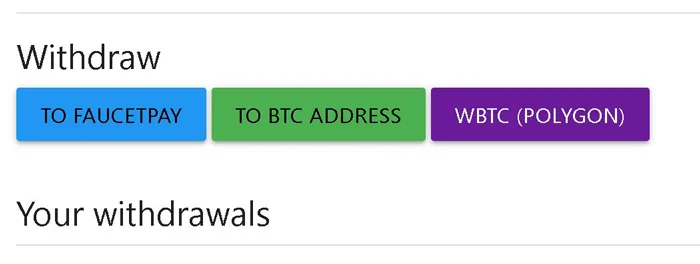
For the Bitcoin balance there are 3 buttons, and each one needs a different amount before it lets you withdraw. The blue one goes to FaucetPay, a small wallet from another company. That’s where you collect very small amounts of crypto from faucet sites, and you don’t pay the high network fees. It lets you withdraw starting at 100 satoshi, and the payment arrives within 3 business days.
The green one sends the Bitcoin directly on the blockchain to a main wallet, like your own hardware wallet or your account on a big platform such as Ledger, Binance, or Coinbase. For this one you need 10,000 satoshi. I’m glad the threshold has come down, because in past years the network was congested and the minimum was 50,000. Now, in 2026, it’s 10,000. And 10,000 satoshi is 0.0001 BTC, so with Bitcoin at $82,000, that comes to $8.20 you have to build up before the green button lets you withdraw. When you’re earning from ads, that’s a lot of ads.
The purple one sends Wrapped Bitcoin (WBTC) through Polygon, not through the main Bitcoin network. Polygon is a separate blockchain built for cheap, fast transfers. Here the threshold is 5,000 satoshi, about $4.10, half of what the green button needs. That’s still a lot when you put it next to the 100 satoshi for FaucetPay.
To me, the blue button is the only one worth using. With it, you get your money off the site at the lowest threshold, and you don’t leave it sitting in your balance while you build up enough for the other two. Small amounts add up little by little, but I feel calmer watching them add up when I know they can leave the site any time they go over 100 satoshi.
I’ve also tested other sites for making money online, like Microworkers, Marketagent, Ipsos iSay, and Benable, and I’ve written reviews of them. If you’re not familiar with them, you’ll find them among my articles.
With AdBTC, what I wanted to know most was whether the money actually leaves the site. Scam sites keep your balance locked forever or ask you to deposit money first so you can withdraw. AdBTC doesn’t do that. The transfers really do go out to wallets outside the site, and if you follow the rules and go over 100 satoshi, the money reaches your FaucetPay account.
adBTC on Trustpilot
One point in the AdBTC reviews makes me uneasy. Several people write that their account was locked or closed right after they asked for a withdrawal. These are other people’s stories, and I can’t judge each one individually. But they keep coming up, and for me that carries more weight than an isolated complaint.
I didn’t find any sudden shift in opinion tied to a specific event. People have been complaining about banned accounts and low pay since 2016, in the same way.
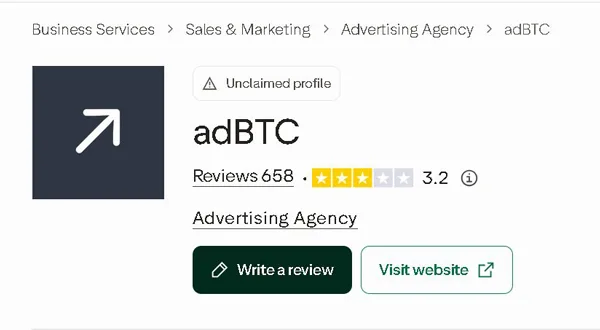
The main Trustpilot profile has 658 reviews and an average rating (TrustScore) of 3.2 out of 5. With a rating in the middle like that, I expected a lot of lukewarm opinions. Instead, I found two camps, and by my estimate about half of the reviews are positive.
People in the first camp say AdBTC has paid consistently since 2016 and that the auto-surf does what it promises. I liked that these are people who know from the start that a PTC site brings in very little. They take their money out through wallets made for small amounts and don’t expect more from the site than it can give.
The other camp feels misled. The people there complain most often about the high minimum for withdrawing directly to a Bitcoin wallet, and after that about accounts getting banned out of nowhere. For the minimum, the users themselves found a workaround, and they recommend it often. AdBTC allows very small withdrawals through external processors like FaucetPay, and with them the high minimum for direct Bitcoin withdrawals no longer matters.
There’s also a separate Trustpilot profile for the referral program’s subdomain (ref.adbtc.top). There the rating drops to 2.1 out of 5, and people are unhappy with the affiliate program. But there are only 23 reviews, not many compared to the 658, and I don’t give them the same weight.
Longtime members of crypto forums say AdBTC is a trustworthy site, good only for someone who accepts very, very low earnings per hour. And the hours are what’s at stake here. The small amounts add up bit by bit, but the hours put into them add up the same way. Whoever praises the site has already done that math and accepted it.
Red flags you should never ignore
All the work on AdBTC only shows up at withdrawal, and that’s exactly the step I’m afraid of. Several users who have no connection to each other write on Trustpilot and BitcoinTalk that their accounts were blocked right when they went to withdraw a larger balance. I have no way to verify this, and that’s why it stays an accusation. But it’s a credible accusation of unfair practice, because it comes from several places and describes the same moment every time.
The other problems are verified:
- The homepage shows low withdrawal thresholds, and anyone who stops there will think getting their money out is easy. Users have clarified, though, that these thresholds only work for certain micro-wallets. For a direct Bitcoin withdrawal, you need a much higher balance. That’s misleading interface design.
- Some ads in the site’s network lead, according to users, to phishing or scam sites. The risk comes from the ad model.
- The company doesn’t have a verifiable physical address, a registration number, or an accessible privacy policy.
- There are lots of unauthorized browser extensions built to automate surfing on the site, a sign that AdBTC is struggling with bot traffic.
And these extensions bring me back to the blocked accounts, because bot traffic can trigger their strict account-blocking algorithms. I don’t know whether that’s also where the withdrawal blocks come from. All I know is that the high Bitcoin threshold keeps your money in the account longer, and the bigger the balance gets, the more you have to lose if the account gets blocked at that point.
Is adBTC LEGIT or SCAM?
Earning on adBTC doesn’t ask anything of you. You click Start, wait for the timer to run out, and get Bitcoin for visiting a site or watching an ad. When something is this easy, I expect there to be a problem somewhere else. And here, there really is one.
The problem is with withdrawals. The limits for direct withdrawals mislead you, the site says very little about its rules, and it closes accounts quickly and harshly. And the thing I’m most afraid of happens often, because people get banned right when they want to cash out a larger amount. Then all the minutes spent in front of the timer go to waste.
But I don’t want to give the impression that the site doesn’t pay. It has been paying since 2016, steadily, in small amounts, as long as the money goes out through a micro-wallet from another company. That’s the loophole that keeps you clear of the security filters on withdrawals.
It’s worth creating an account if you want to collect Bitcoin and don’t mind small amounts. But it isn’t for everyone. You need lots and lots of patience, you need to know from the start that a crypto faucet pays very little, and you need to take your money out only through micro-payment processors. Small amounts don’t bother me, because they add up little by little. The only thing that scares me is a balance that disappears.
If you have questions or you’ve already been through adBTC, I’m looking forward to hearing from you in the comments!