
When I came across Prolific, I liked the idea right away. You take surveys, you get paid for them, and at the same time you help with academic research. As a scientist, I was really drawn to that combination.
And who doesn’t like some extra money? Well-paid surveys are one of the simplest ways to get it, because they’re quick and don’t take much effort. But it sounds almost too simple, and that makes me cautious.
This year I started taking surveys there. At first I didn’t know what to expect. Now, after a few studies, I’ve formed an opinion of the site.
And what do I get out of this review? Nothing. I’m not paid to write it, and I’m not paid for the people who sign up through me. What you’ll hear from me is exactly what I think, based on what I’ve experienced on the site.
If you’re thinking about creating an account, you probably want to know whether Prolific can be trusted and how much you can earn from their surveys. I’ll show you what the site offers and how it works, with everything I’ve seen there myself, so you can decide at the end whether to sign up or not.
What is Prolific and how does it work?
Prolific doesn’t let in everyone who wants to join. The official waitlist has over 1 million people on it, and a spot only opens up when your age, gender, or background is exactly what researchers are looking for.
I expected a site with over 350,000 active participants to be easier to get into, especially since it only counts people who have done a study in the last 90 days. But if you put the numbers side by side, there are almost three people in line for every active one. Patience alone isn’t enough.
There are two kinds of researchers. Some come from universities, with psychology or economics experiments. The others are tech companies training their artificial intelligence (AI), and they pay people on Prolific to rate text, images, and audio recordings so their models behave safely and answer correctly. This is also why it’s called an online crowdsourcing platform, which, in plain English, means a lot of real people each do a small piece of someone else’s work.
The link to universities goes back to the start. Ekaterina Damer and Phelim Bradley founded Prolific in 2014, and the site grew out of the University of Oxford’s startup incubator program.
I’m glad I can say plainly that it’s a trustworthy site, because you really do get paid here. Trust doesn’t tell me anything about how good the earnings are, though, so for that I go on to look at each way to earn, how good it is, and how much time and effort it takes.
Because if a study takes me a long time for not much money, I still come out behind, even if the money makes it to PayPal.
Prolific surveys and studies
I liked that on Prolific I find out everything that matters about a study in advance. Its card shows me what it’s about, which device I need to do it on, how much I get paid, and how long it should take, under Estimated Completion Time. Because I can see the amount next to the minutes, I can decide on the spot whether the study is worth it, before I start.
The card isn’t shown to everyone. It only appears in your account if your demographic profile matches what the researcher is looking for, because researchers have to set Prolific’s filters before they launch the study. I think that’s a big difference from GrapeData, Prime Opinion, Mindswarms, Zoombucks, and other regular survey sites, where you can spend 15 minutes answering questions and only see the message “Sorry, you do not qualify” at the very end (I’ve also written on the blog about many other survey sites, and I recommend those reviews if you’re interested). Prolific bans this practice. And even if a researcher forgets about the filters and screens you out of their survey by mistake, the official rule requires them to pay you partial compensation. Nobody paid you for those minutes on the other sites.
If you’re 18 and want some extra money on the side, you won’t find anything better among online survey sites than the paid studies on Prolific. But it matters what you expect going in. They’re a bonus you pick up now and then, and they won’t turn into a regular income.
The money comes from university researchers and tech companies that need data from real people. Their surveys aren’t hosted on Prolific (Prolific calls them studies, but most of the time they’re still surveys). All you get from Prolific is the link, and you do the study on a separate survey platform, such as Qualtrics.
A study goes through 4 steps, always in this order:
- You get the invitation as a card that appears in your account, if you pass the filters.
- You check the amount, the device, and the Estimated Completion Time on the card and decide whether to take the study.
- You click the link, leave Prolific, and complete the survey on the survey platform. At the end, the researcher gives you a special phrase, called the Completion Code.
- You paste the code back into Prolific as proof that you finished, and the study’s status changes to Awaiting Review. The code is the only proof that you made it to the end, so don’t close the survey page until you’ve copied it.
The estimated time on the card isn’t your limit. Every study has a hidden timer, set so that no one holds on to a spot for too long. Prolific starts from the estimated time the researcher set and works out a much longer maximum limit on its own. For a 10-minute survey, the limit can be 45 minutes. That’s 35 extra minutes, enough to finish without rushing, as long as you stay on the study.
And yet it happens. You get up to grab a snack or something else distracts you, you go past the limit, and the study is immediately marked Timed Out, with a payment of $0, and your spot goes to someone else. It’s a shame about the time you’ve already put in, but nothing happens to your account. A Timed Out doesn’t hurt your reputation or your account’s standing.
A study that doesn’t work is a different story. If you realize halfway through that your webcam isn’t working, or a technical error won’t let you get past “Next”, you have two options. You can submit the study as it is, or you can click Return Study. Users are clear that you should choose Return Study, which cancels the study safely. A study submitted in a broken state gets a Rejection from the researcher, and a few rejections piling up lower your internal score and can lead to your account being closed permanently.
I’d be really frustrated to lose my account over a study that didn’t work anyway.
AI taskers group
The most expensive mistake you can make in the AI Taskers group is having a chatbot, like ChatGPT, write your explanations. Prolific’s automated security checks catch the pattern right away and permanently close your entire account, so you lose the regular academic studies too, not just the AI tasks. I think it’s fair for them to be this strict. Because the explanations are the actual work they pay you for.

For example, you get two paragraphs written by an AI, pick the more accurate one, and explain in detail why the other one “hallucinated.” I found the word funny (a program that has hallucinations), but it simply means the AI made up facts.
This is completely different from the regular academic surveys, where you share, say, how you feel about a brand. There, they’re asking you. Here, you’re checking an AI. The group is small, and Prolific chooses the people itself: people who check, train, and test AI models.
And this work is really tiring. You might get a task where you compare two essays of 1,000 words each and look up every sentence on Google to see if the AI lied. I’m afraid that somewhere around the middle of the second essay your attention starts to slip, and that’s when you risk getting the task rejected. I’d find it hard to do something like that with the TV on or on a noisy bus, and I think it’s hard for anyone whose mind is somewhere else. Doing a task well means reading the instructions, following them exactly as written, double-checking every fact, and not rushing, even if you’re tempted to finish faster.
But the pay reflects that. The test unlocks the best-paying tasks on the dashboard. If you’re 18 and want to make as much as you can from online side income, passing it should be your main goal on Prolific. For me, that’s a fair trade.
I thought you could join the group whenever you wanted, through an account setting. That’s not how it works, because everything goes through Prolific’s internal system. The system automatically scans all participants and looks for a high approval rate (the one that shows you don’t rush and that you gave very good answers on earlier studies) and good results in general. If you’re a match, you get the AI Task Assessment, a two-part test that checks your logic, how well you follow very precise instructions, and your attention to detail. When you pass the test, your account gets a special internal tag, and AI training tasks start showing up on your regular dashboard, clearly marked with the AI Tasker label.
And the invitation doesn’t reach everyone at once. Prolific is rolling the feature out gradually, in small stages, and many users with a 100% approval rate say they’re still waiting for it. It’s a shame for the people who do flawless work and get nothing, but for now there’s nothing you can do except wait.
The test isn’t mandatory. If you fail it or skip it, your Prolific account stays safe and you keep getting the regular academic studies. I like that a failed test leaves no mark on your account.
How do you get paid?
When I finished my first studies on Prolific, I thought the money was already mine. It wasn’t. The amount sat under “Pending,” because the researcher who ran the study has up to 22 days to approve it, and only after approval does it move into the balance you can withdraw. When my approved balance went over $6, the “Cash Out” button on the balance page lit up, I pressed it, and I waited again, because my account was new and the first withdrawals go through a 72-hour security hold, during which the money doesn’t move at all.
Instant withdrawal unlocks permanently after the first 4 withdrawals made manually and completed successfully. Since then, the money has reached my PayPal wallet in a few seconds. Prolific doesn’t take any hidden fee on withdrawals, and I’ve had nothing to calculate. And that matters to me. I’m stingy with small change, and on amounts of a few dollars I’d have hated paying any fee, however small.
Before you can press the button, a few conditions have to be met:
- You need an active personal PayPal account, linked to your Prolific account and in the same name as that account and as your official ID. A friend’s or a parent’s PayPal isn’t accepted, however convenient it might be. This rule reassures me, because the money only goes to the person who did the studies.
- The approved balance has to reach at least 6 US dollars or 6 pounds sterling.
- Studies pay in dollars ($ USD) or pounds (£ GBP), depending on which country the researcher is from, and the two amounts are kept separate on the balance page. When you withdraw, though, Prolific takes both and sends them to PayPal together.
- You can withdraw only once every 24 hours. The system clock resets every day at midnight UTC (Coordinated Universal Time).
The last condition isn’t about money but about where you are. You have to be physically in your own country when you press the button. If you go on vacation abroad, or have a VPN running on your phone, and you try to withdraw, the system shows a serious security error, PEC-U-0001, and blocks your transaction. I’m not someone who expects the worst, but a security error on the account where my money sits scares me. The withdrawal can wait until you get home. And the VPN on your phone has to be turned off first.
Of all the online task sites, Prolific has the most secure and most reliable withdrawal system. But that doesn’t mean the money should be left there. It’s worth taking it out every day the balance goes over $6, because Prolific isn’t a bank account to save up hundreds of dollars in. I waited enough on my first withdrawals that I don’t leave money sitting idle on the site anymore.
How much money can you make?
Anyone who makes money from surveys is more afraid of giving away minutes for nothing than of a small payout. That’s what I was afraid of too. Two things about Prolific reassure me. Once you’ve started a study, you can’t be removed from it because your profile doesn’t fit. And if the study takes longer than the researcher estimated, you’re not the one who loses the difference.
Let’s say a researcher estimates 10 minutes for a study, but the data shows a median of 20 minutes. Then the hourly pay automatically drops below $8, which is the minimum. Who covers the difference? The researcher. The system makes them pay an adjustment bonus and top up the earnings of everyone who finished the study.
This minimum is part of the ethical rules Prolific uses to keep pay under control, so it isn’t left at the mercy of the market. A study that pays less than $8 (or £6) an hour can’t be published at all, and for regular studies the platform’s official recommendation to researchers is $12 (or £9) an hour. A short survey won’t bring you $8 or $12, though. It usually pays between $1 and $4, depending on how long it is. If I divide by the minimum, a $4 survey should be done in 30 minutes at most, and a $1 survey in about 7 and a half minutes. Complex tasks and niche studies, like programming or testing artificial intelligence (AI) bots, often reach $20 or $40 an hour.
But a good hourly rate doesn’t help you if you don’t get any studies. Prolific has strict screening filters. Researchers can choose from over 300 demographic criteria (age, job, hobbies), and only the people who match 100% of them see a study. Depending on your profile, on a quiet day you’ll see between 0 and 5 studies, on a busy weekday you’ll have 10-20 or even more, and on Saturdays and Sundays the number drops a lot, because university researchers don’t post new projects on the weekend.
When a good study shows up, everything moves fast. It might have 50 spots in total, for people from all over the world, while hundreds of participants who fit are watching their studies page. The sought-after ones fill up and disappear in 5-10 seconds. It’s a shame, because in that many seconds you barely have time to click.
The total at the end of the month depends on how long you keep Prolific open. If you check it now and then on your phone or computer, about 1-2 hours a day, as a habit, it’ll come to $50-150 a month. With the studies page open all day in a background tab while you’re studying or playing games at home, it realistically adds up to $200-400. The only people who go higher are those who pass the advanced AI evaluation tests and get into the special data labeling groups. There, AI training tasks given out in large volumes can take earnings to $800-1,200 or more in a single, very active month. The difference between $150 and $1,200 is big, but the time you put in is completely different too.
Prolific isn’t meant for full-time work, and it won’t make you rich. It’s a source of extra money, and I don’t think any other survey platform open to everyone pays better per hour.
And my minutes there get paid, including the extra ones.
Prolific Trustpilot Reviews: What Do Users Say?
Anyone who has made small amounts of money on commercial market research panels knows what endless disqualifications look like. This site is seen specifically as an ethical alternative to them, and it has a good reputation in academic circles and among people in the “beermoney” space (people who make small amounts of money online).
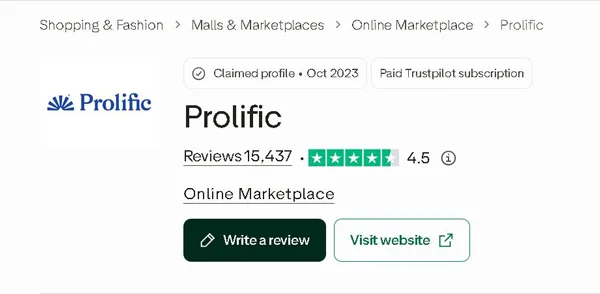
On Trustpilot, it has 15,437 reviews and an overall rating of 4.5 out of 5. Of those, 8,995 came in over the last 12 months, more than half. The rating reflects the site as it is now.
With that many reviews, I expected to come across some staged ones too, with waves of 5-star reviews posted all at once or praise written to the same template. I didn’t. Each person describes what happened to them in their own words.
Most of them praise the fact that the site is simple, that the academic studies and AI training tasks are interesting, that payments reach PayPal quickly, and that they’re paid fairly compared to the usual marketing survey sites. Trustpilot’s analysis of recent reviews also shows that the vast majority are happy with how the site works, how fast payments are, and how much they get for their time. I liked that last point most, because I also weigh the money against the time I spend earning it.
Payments also get very good ratings for reliability: the money arrives. Support, on the other hand, gets harsh criticism, especially from people whose accounts were suspended.
The negative reviews cluster around the same things:
- Technical errors that stop a study halfway through. This is the most common complaint, and the person gets nothing at all for the time spent up to that point. It’s a shame to lose that time.
- Sudden account suspensions, which are where most of the grievances start.
- Incorrect flags from the algorithm, for “speeding” (answers given too quickly) or for fraud.
- Researchers rejecting a completed study, with nowhere for the person to dispute it.
- Suspension appeals, where banned users say support only sent them generic, copy-pasted replies.
If a study froze on me, I’d lose time. If a completed one got rejected or my account got suspended, I’d also lose the pay for work I’d already done, with no one to explain myself to. I have no way to check how many of the suspensions were unfair. I only know what the people who got them describe, and going by their stories, the risk on the site lies with the account, because payment, once approved, does arrive.
Red flags you should never ignore
The smallest risk here is a study that times out or gets stuck because of a technical error (2 reports on Trustpilot). You lose the minutes you put into it, and nobody pays you for them. It’s a shame to lose them, because time is money too.
Rejection hurts more. After you finish a study, the researcher can reject your work, and then you don’t get paid for it and your reputation on the site drops (4 reports). You put in time and effort, and you come out behind twice, on the money and on your reputation.
And sometimes a rejection automatically triggers a ban. I found 6 independent reports of accounts closed permanently or put “On Hold” without a clear explanation and without a human looking at the case. Can you appeal? Judging by what people write, no. In 4 other reports, users say an automated system wrongly flagged them and removed them from the site, even though they were honest. I find it hard to read something like that calmly, because a program can kick you out and there’s nowhere you can complain. These are accusations from users, and I can’t verify them myself. But I believe them, because they come from several people, independently of each other, and to me that makes them credible accusations.
There’s also the ID card and driver’s license verification. Some users think it’s too much for a survey site (I found a single report), and I get a little wary myself when a site asks for my documents. As for the company, on the other hand, I found no fine from any regulator and no action by the ICO against Prolific Academic Ltd.
That reassures me a little. But it doesn’t help me at all if a program makes a mistake and closes my account.
Who can use Prolific?
Signing up for Prolific doesn’t cost anything, and I liked that from the start, because I don’t spend a cent to find out if the site is for me. You pay with time. You fill out a 7-step form and then wait for an invitation that can come after a few hours or after a few months. But even that time isn’t completely lost, because there’s nothing for you to do while you wait.
Where you live matters. Prolific only accepts people from the countries they’ve approved, most of them OECD members (Organisation for Economic Co-operation and Development), and they group them by region:
- North America includes the United States, Canada, and Mexico, but not Costa Rica.
- Europe has the most accepted countries: the United Kingdom, Germany, France, Italy, Spain, the Netherlands, Belgium, Austria, Finland, Norway, Sweden, Denmark, Ireland, Poland, Portugal, Switzerland, Greece, Hungary, the Czech Republic, Slovakia, Slovenia, Croatia, Latvia, Estonia, Romania, Bulgaria, Cyprus, Malta, Iceland, and Luxembourg. Lithuania shows up in some older help guides as a country with few active users. But the current pages with the sign-up rules clearly block it, and what they say now is what counts.
- From Asia and the Middle East, they accept Japan, South Korea, Singapore, Taiwan, Hong Kong, India, Indonesia, Israel, Saudi Arabia, the United Arab Emirates, Qatar, and Bahrain. Turkey isn’t on the list.
- The other regions include Australia, New Zealand, South Africa, Brazil, and Chile, but not Colombia.
The rest of the requirements have to do with you. You have to be at least 18 (children can’t take part in studies) and have a valid government-issued ID, which can be an ID card, a passport, or a driver’s license. You also need a real mobile number, because virtual or internet-based (VOIP) numbers aren’t accepted, and a verified PayPal account. That account matters, because it’s where your money is sent, and without it the payment has nowhere to go. And if you check all of these boxes, have a good internet connection, and want some extra money without leaving your desk, I think it’s worth getting on the waitlist.

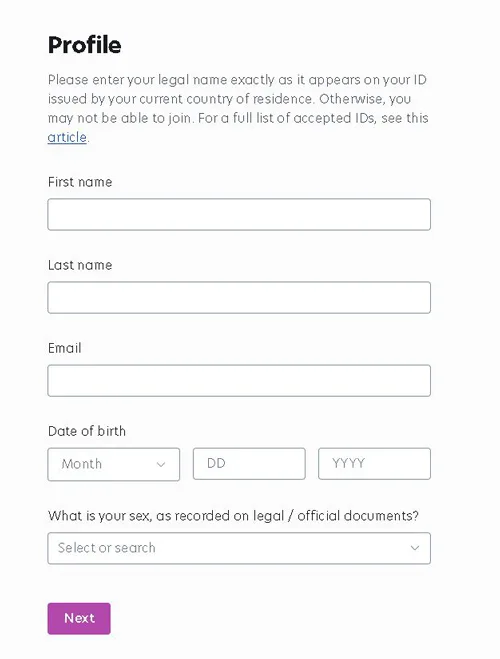
There are two sign-up buttons, both in the top right corner. “Get paid to participate” sends you to one more button, “Start earning today,” and “Get started for free” asks you to choose “Take studies.” You end up in the same place, so you can click either one. The form’s steps come in this order:
- Your first name, last name, email, date of birth, and gender, as the basic details about you.
- Your country of residence, the country and place where you were born, and your ethnic group.
- Your first language, the other languages you speak fluently, and your regional dialect.
- Education, where you enter the highest level of education you’ve completed.
- Work experience, with your employment status, the work you’ve done so far, and other details.
- A short text about yourself, where you list any less common skills, experiences, or qualifications you bring, along with your LinkedIn profile.
- Rereading and confirming the previous 6 steps. There’s an “Edit” button next to each section, so you can fill in details later too (useful if something comes to mind only after you’ve submitted).
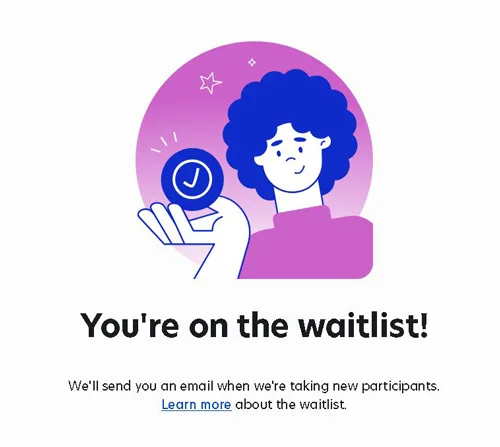
When you’re done, Prolific has you confirm your email address. Some people are accepted right away and go straight into their account. The others get a message that they’re on the waitlist and find out by email when they’ve been accepted. Prolific keeps this list so studies aren’t split among too many people. It’s a shame you can’t start right away. But at least this way you have a better chance of finding something to do when you get in.
Invitations don’t go out in the order people signed up. Prolific chooses based on what researchers need at that moment, by age, gender, or your profile, and emails the official invitation to the people who match. Once you get it, you also upload a photo of your ID and do a quick face scan, so Prolific knows there’s a real person behind the account. It gives me confidence when a site looks this closely at who’s getting in.
Can you use it on your phone?
When you hear about a new site, it’s natural to look for it in the app store first. With Prolific, that search can cost you your account. Prolific doesn’t have any official mobile app, so any “Prolific App” you find on Google Play or the App Store isn’t theirs. The company warns that these apps are fake and unsafe, and that if you use them, your account can be banned. It annoys me to think how easily you can lose an account just because you tapped “Install” on the wrong app.
On my phone, I use the browser, Safari or Google Chrome, and go straight to the official login page. There I find everything related to my account: I see the available studies, change my profile details, and cash out. For the account, it works very well. For studies, less so.
Each study comes from an independent researcher, and that researcher decides which devices it can be done on: desktop, mobile, or tablet. Your phone shows you all the studies, with an icon next to each one that tells you whether it works on mobile or whether you need a computer. I expected the mobile icon to be almost everywhere. It isn’t. Only 30-40% of studies are marked as suitable for phones, so out of 10 studies, about 6-7 aren’t meant for one. And that makes sense, because many researchers ask you for long, typed answers or require demanding software that only runs on a computer.
That icon isn’t just a suggestion. If you open a “Desktop Only” study on your phone anyway, the researcher has the legal right to reject your work, and you get $0 for all the time you put into it. But a rejection doesn’t stop at the lost money. When too many add up, Prolific closes your account permanently. You’re basically putting your whole account on the line for a study you couldn’t do properly on your phone anyway. It’s not worth it.
There’s one more difference between a phone and a computer, and it has to do with speed. Prolific Assistant is an official, free tool for the browser on your computer. It plays a loud sound and shows you a flashing notification the second a new study appears. It doesn’t work in mobile browsers, so on your phone you refresh the page by hand and hope. I’ve sat there with my finger on refresh too, and I’ve missed quite a few good studies that way, because studies fill up in a few seconds and the well-paid ones go to the people who heard the sound first.
Your phone helps you earn some money on Prolific, and it’s very convenient for handling your account. If it’s your only device, you’ll be left out of most studies, and you’ll get to the well-paid ones after others have taken them.
Is Prolific LEGIT or SCAM?
Regular survey sites don’t really look after the people who answer them. I expected something similar on Prolific too, but that wasn’t the case. Participants are treated fairly, there’s a focus on quality, and you can see that in what other people write as well. Prolific has a TrustScore of 4.5 out of 5 from over 15,000 reviews, and a rating that high from that many people carries a lot of weight.
The money comes through, too. The company has a solid record as a registered business and the payment system is secure, so I’m not on pins and needles when I request a payout.
What I am afraid of is getting suspended. An automated system can block your account without you getting a clear reason why, and if a researcher flags you or rejects your submission, there’s no human you can explain what happened to. It’s a shame, especially on a site that otherwise looks after its participants.
Prolific is worth it for steady extra money from academic studies and AI training tasks. Except it comes with strict rules, monitored by an algorithm, and you have to accept them from the start. For me, knowing the money is safe outweighs the fear of an algorithm that’s too strict.
How did you get along with Prolific? Let me know in the comments, along with any questions you have!