
If you’ve ever looked for a little extra money online, from surveys or small tasks, you may have come across ZoomBucks too. The site says you can make money there for free, easily and quickly.
It’s not the only one promising that. Many apps give you money or other rewards for quizzes, surveys and reviews, and all of them (or almost all) say there’s nothing hard about it.
So does ZoomBucks really pay, or is it a site you’re better off staying away from?
To find out, I opened an account there, used it, and then put it side by side with many other Get-Paid-To and survey sites I’ve tested, and saw where it stands next to them.
It has potential. But it also comes with a few big downsides, and those are worth knowing about before you sign up.
Below, I’ll show you everything I found, the good and the bad, so you know what to expect going in and can judge whether it’s worth it for you or not.
What is Zoombucks and how does it work?
On ZoomBucks.com, you earn money in several ways, which is where the GPT (Get-Paid-To) site label comes from. It’s similar to other reliable GPT sites, like FireFaucet or Earnopolis.
This isn’t its first time around. It ran for a long time, then disappeared for four years and didn’t come back until November 2018. That gap kind of scared me, because nobody promises you it won’t disappear again. I still don’t have any guarantee.
I went ahead when I found out who runs it: the same company that also owns GrabPoints, Reward Holdings Limited (based in Hong Kong). That outweighed the gap and got me to try it.
I have a soft spot for GPT sites. There are also a lot of weak ones among them, though, and you don’t see which category each one falls into until you look at what it actually offers. That’s what I do with ZoomBucks below, so you can decide for yourself whether it’s useful to you.
When I logged into my ZoomBucks account, 167 surveys were waiting for me in the surveys section (your number will probably be different, maybe higher, maybe lower). The shortest ones took 1 minute and the longest about 30 minutes, but most of them needed between 3 and 7 minutes.
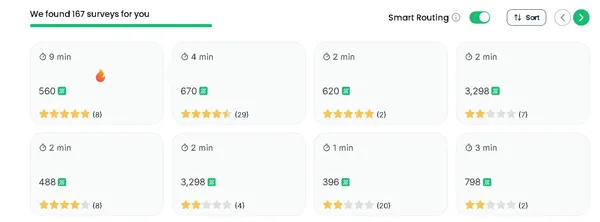
The surveys aren’t made by ZoomBucks. They come through survey routers like CPX Research, CINT, and TheoremReach, which often give you access to a lot of surveys at once. Until a while ago there was also a separate section named after the site, but they removed it, and nothing was lost, because the surveys there came from the routers too.
In my experience, routers are a good thing for anyone who wants to earn money from surveys, and on ZoomBucks I found quite a few of them, with better pay than on other similar sites. The downside is qualifying. With routers you very often don’t qualify, and that isn’t because of ZoomBucks but because of how routers work on any site. With patience, you eventually find enough that you can get into.
Here are a few of them, so you can see how differently they pay:
- A 1-minute verification question that adds 20 points ($0.02) to your balance.
- A profile survey, also 1 minute, for 818 points, around $0.82.
- A 6-minute survey for 112 points, about $0.11. Broken down per minute, that comes to under 20 points a minute, less than the verification question above, which takes 6 times less time (I’d skip this one).
- A top survey of 2 or 4 minutes that pays 3,298 points, which is $3.298.
However, the surveys that tempt us with a lot of money for a few minutes are also the ones you get kicked out of most often, almost right away. You spend a few minutes answering the screening questions, then the router sends you back because you’re not an exact match for the consumer group it’s looking for (this is called screening out). It annoys me every time to lose minutes like that.
When I go through the surveys in my account, I look at the star ratings. I skip the cards with high pay and a low rating and pick the surveys with 4 stars or more, because on those the points come in more reliably.
The tip I’d put ahead of all the others is a different one. Don’t let large amounts build up in your account.
You only take surveys after you log into your account, and from the moment you sign up, emails with invitations and reminders start coming in too. For me they’re useful, even if ZoomBucks overdoes it a little and fewer would be enough for me, though everyone feels differently about this.
If you have time to read more, I’ve also written reviews of Marketagent, Triaba, and OpiDay, so you can put them side by side with ZoomBucks and compare them.
Watch videos and earn money
For videos, ZoomBucks sends you to LootTV and HideoutTV, and the rule is the same as on most GPT sites. You watch 3 videos, each with its own ad before or after, and only then do the points come in. A video runs about 2 minutes, the ads around 30-45 seconds, and for all of that you get 7 points.
Those 7 points are worth $0.007, and you collect them in roughly 10 minutes. For a single dollar, you spend more than 23 hours watching videos and ads. The pay is very low, far below what our time should be worth, no matter how small the earnings we’re after on sites like this.
The video page says the points are unlimited. And they really are, but at 7 points every 10 minutes, unlimited can’t also mean serious money.
There’s still the option of letting the videos play on their own, on a screen you never look at. At this rate, the electricity probably costs you more than the points bring in.
As for topics, you get videos about cooking, gaming, and celebrity gossip, along with music videos and movie trailers, enough for anyone to find something they like. But only the titles look like YouTube. The content is recycled, made cheaply by independent producers and repeated over and over, put there to hold space for the ads (nothing premium, nothing viral).
And you only see them if you’re accessing the site from a Tier-1 country, mainly the United States, Canada, the UK, or Australia, because the companies that advertise through videos pay separately for each country. Everywhere else, the video tab is empty, throws an error, or doesn’t give you any points. From another country, you most likely won’t find any videos, or you’ll be greeted right away by the message “no inventory available”.
The videos can entertain you a little. As a way to make money, they’re time thrown away.
Refer a friend
Many GPT sites pay you for new people you bring in through your link, and that’s how they get us to promote them to our friends. ZoomBucks does the same. If you know a few people who would be interested, you might get a small amount on top of what you earn on your own.
The program has changed since I first tried it. Back then you got a one-time reward for each person you invited, and it was so small you barely noticed it. Now you get an ongoing commission of 7% of what the people you bring in earn, although ZoomBucks’ main marketing message talks about “up to 10%” for anyone you bring in.
7% sounds like something until you put the numbers side by side. A friend who spends an hour on a hard 1,000-point survey brings you 70 points, about $0.07. For an hour of their time, you get next to nothing.
Compared with the referral programs of other big sites, ZoomBucks falls behind on almost everything:
- Swagbucks gives 10% for life and 300 SB ($3) when your friend reaches 300 SB in their first month, with withdrawals from $1 to $5, depending on the reward.
- ySense gives between 20% and 30%, based on activity tiers, plus $0.10 or $0.30 for your friend’s signup and a $2 bonus when they pass their first $5. Withdrawals start at $5 for Skrill or Amazon and at $10 for PayPal (the highest threshold on the whole list).
- Freecash goes from 5% up to 30% in tiers, based on how much the people you bring in have earned in total. The bonus is a free “Case Opening” with a chance to win between $0.05 and $250, and you can cash out from $5 (for crypto, from $0.50).
- ZoomBucks gives 7-10%, a one-time 25-1,000 points ($0.02-$1.00, depending on your friend’s country), and withdrawals from $3, which is 3,000 points.
The withdrawal threshold is the only place where ZoomBucks doesn’t come out badly. Its commission at most matches what Swagbucks gives anyway, and the starting bonus, 25 cents at most, is far below Swagbucks’ $3.
If you still want to try it, send the link only to people who will actually start doing surveys. It’s better not to share it with people in the same household or on the same Wi-Fi, because an automated system can suspend your account by mistake.
The program’s rules are clear and stated upfront. It’s only the limits that are very low. I think it’s better to treat it as a small extra that comes on top, not as a source of income that runs on its own.
How do you get paid?
The first time I requested my money from ZoomBucks, it didn’t arrive right away. The first withdrawal on any account is reviewed by a person on their team to make sure it isn’t some kind of fraud, and that review takes 1-2 business days.
After that, the wait is shorter. For a verified account, Tremendous emails you the reward link within 24-48 hours, and once you click it, everything depends on what you picked, because on PayPal the money arrives in a few minutes, while a virtual Visa card needs 1-3 business days to be assigned a card number.
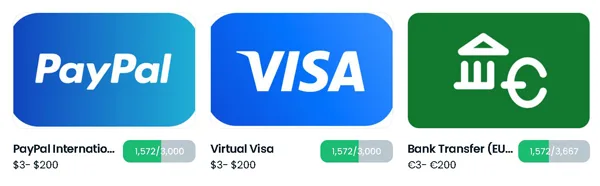
Everything you earn on the site adds up in points, at a simple rate: 1,000 points for $1. What a point was worth used to depend on the reward you chose, but they’ve simplified the rule. Now you can see at a glance how much you’ve collected and how much you need before you can cash out, and I liked that a lot.
What you get in return comes down to two routes, cash payouts or gift cards, and each option has its own threshold:
- PayPal, the standard option, which suits most needs, starting at 3,000 points ($3).
- The prepaid virtual Visa card, a digital debit card you can use to pay online as if you had cash in hand, which in many cases requires 5,000 points ($5).
- Skrill and Venmo, secondary options you’ll only find in certain countries.
- Gift cards for Amazon, Walmart, Netflix, Roblox, Steam, and Spotify. Low-value Amazon cards also start at 3,000 points, but a few high-demand local cards sometimes list their own threshold, which goes as high as 5,150 points ($5.15, 15 cents over $5).
Can you cash out every option starting at $3? Not quite. For the Visa card, for example, you need 2,000 more points than for PayPal.
On the other end, the cap is strict: 100,000 points per 24 hours, which is $100.
From Europe, the catalog looks much more limited. ZoomBucks sorts countries into tiers based on the advertising budgets of the big companies in each region, and the tier decides what you find in the rewards store. The United States, the UK, Canada, and Australia are in Tier 1, with the full catalog and hundreds of gift cards from stores there (Target, Walmart, and others), which you can cash out at thresholds of $1-3. Europe falls into Tiers 2 and 3, where cards from strictly local stores don’t show up at all, and the difference is easy to see. What’s left is mostly PayPal, virtual Visa cards, and global digital brands like Steam, Roblox, or global Amazon vouchers. The amounts are shown in your local currency, converted automatically at the market rate at that moment.
When it comes to payments, ZoomBucks is reliable. The money arrives, nobody runs off with it, and a $3 threshold is really good. They do pay, but withdrawals go through very sensitive automated anti-fraud software, which can block even a clean account by mistake. I don’t like knowing I could lose what I’ve collected without having done anything wrong.
I don’t let my points pile up. As soon as my balance passes 3,000 or 5,000 points, I request the transfer to PayPal or to the virtual Visa card, and if the software still blocks my account, I’m out a few dollars, not everything I had.
How much money can you make?
Let’s say you go on ZoomBucks from Europe and spend an hour a day on surveys, click after click. You make between $1 and $4. That’s it.
This money won’t cover your rent, you can’t live on it, and you won’t quit your job over it. The site wasn’t even built for that. It was built to give you a little spare change for the hours you have free. How much you end up with depends on the country you log in from, your demographic profile, and how much unpaid time you’re willing to lose.
In continental Europe and the rest of the world, companies put far less money into advertising, so right now, in 2026, an account from here, in the second tier, sees around 100-200 surveys matched to its profile, the best local surveys top out at around 3,300 points (about $3.30), and a daily task gives you between 200 and 800 points.
The homepage shown to Americans, Brits, Canadians, and Australians, people in the first-tier countries, reads differently. There it says you can get up to $7 per survey and that the average user earned $12 yesterday. And they have far more surveys, often over 1,000 active at the same time. Even there, someone who puts in serious work, 1-2 hours a day, makes $5-15 a day (so not even every American gets yesterday’s $12).
Put $7 next to $3.30 and the best survey here doesn’t even come to half of what they’re promised.
Anyone can join. But when you put the hours of clicking side by side with the dollars you get, I think it adds up to very poorly paid work.
Zoombucks Trustpilot Reviews: What Users Really Say
The complaint I found most often, on every review site, is about surveys. You spend a lot of time on a long one, answer almost everything, and right at the end they kick you out, without getting anything for the time you put in. Screenouts are normal on GPT sites, but here people don’t overlook them anymore, because by the time they kick you out, you’ve already left a good chunk of time there.
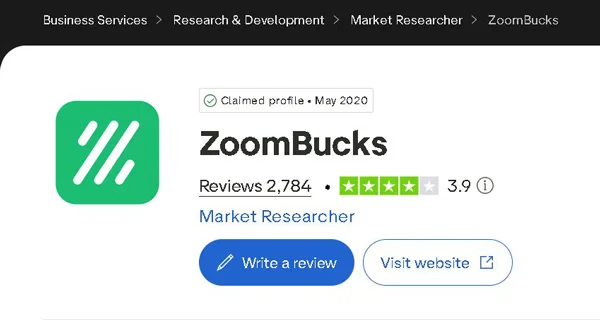
On Trustpilot I found 2,784 reviews and an average of 3.9 out of 5. On Google Play, 415 reviews and an average of 2.2 out of 5.
The better rating comes from people who got through the payout without hitting a snag. They praise the phone app, which is simple. They say they have a very wide choice of rewards, and that PayPal or gift card withdrawals, when they do go through, arrive fast, many of them within 24-48 hours.
On Google Play, the rating is dragged down by technical errors, missing points, and suspended accounts. Many write that after finishing a survey, the balance in their account disappeared or went down, and the app’s team replies almost every time that the missing points are on the companies the surveys come from. People who then wanted to get their points back or unblock their account say, on both sites, that support didn’t help them or wrote back late. Some didn’t even get that.
I also looked for signs that someone might be inflating the ratings, like a lot of 5-star reviews all coming in at once, and didn’t find any. However, Trustpilot says the company doesn’t ask its customers for reviews, so the people who write are mostly those with a strong reason to (meaning very happy or very upset), which pushes the ratings toward the extremes.
For people who got their money, the site works, even if it’s boring. People who reach the withdrawal threshold and run into trouble say something else: that their frustration comes from the way the whole thing is set up, and that the site is built so the balance never reaches them.
That moment scares me more than any failed survey, because with a survey you lose the time you put into it, while at withdrawal you lose everything you’ve built up until then.
The complaint about getting banned at withdrawal shows up the same way in reviews written over the past few years. At this point it’s hard to keep believing it’s a temporary glitch. It comes down to how the site works at its core, and nobody has fixed it.
Red flags you should never ignore
I haven’t found any evidence that ZoomBucks spreads viruses, steals card details, or doesn’t pay the people who make it to the compliance check and pass it. The danger comes earlier, on the way there.
On Google Play and Trustpilot, people who don’t know each other tell the same story: you request a withdrawal, your account gets suspended on the spot, and the reason is a vague “violation of the Terms” that nobody shows you. Many of them are convinced this is how the site gets rid of people’s balances. I can’t prove that, but what I read in the Terms afterward didn’t reassure me.
ZoomBucks reserves the right to freeze your points or close your account as it sees fit, whenever it believes you’ve broken the rules. It doesn’t say how you can dispute that. Or what evidence they need. When the same company is both the accuser and the judge, your points hang on a single person behind a screen.
Then there’s the time you spend on surveys. You’ll often answer everything carefully, all the way to the last question, and only find out at that point that you don’t qualify (meaning you got nothing for that time).
The data side is a familiar story. The Privacy Policy lets them send your demographic and personal information to advertising companies and market research firms. That’s what almost every site like this does, though there’s nothing here for anyone set on staying anonymous.
Also in the Privacy Policy, in the part about GDPR, the name GrabPoints.com shows up. Someone copied the text from a template, and nobody who knows legal paperwork read it after that. For the document that tells you what happens to your data, I think that’s very careless.
Who can use Zoombucks?
Anyone who has turned 13 and has their parents’ permission can join ZoomBucks from almost anywhere: North or Latin America, Europe, or Asia. The homepage is available in several dozen languages, from English, Spanish, German, and French to Romanian.
Even though they accept you from all over, the opportunities aren’t the same in every country. How many you get depends a lot on where you live.
Signing up itself is simple and quick, and the promised $1 bonus does actually show up in your account. Your account can get messed up, though, by the settings you have on when you visit the site. I turned off my ad blocker, anti-tracking protections, and VPN before I opened the first page, because any one of them can set off their anti-fraud checks.
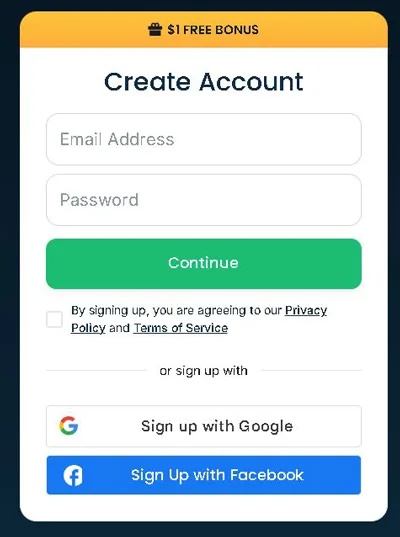
The sign-up form is right on the homepage. You can also get to it from the “Sign Up” button at the top right. You create your account with an email and a password or, more simply, with Google or Facebook. For the email, I’d use an address made just for sites like this, not your personal one (offerwalls from other companies will fill your inbox with promotions).
Your account starts at 0 points. They give you the first dollar (1,000 points) for free, but only after you fill in your details in the “About Me” profile, meaning your gender, age, whether you have a job, and your postal code. Market research companies use this profile to choose which surveys to send you.
Your real name, exact date of birth, and home address, the permanent one, also go there. This matters a lot, because when you cash out, these details are checked against the ones in your PayPal account or on your photo ID. If they don’t match, they confiscate your points. All of them, no matter how many you’ve collected by then, and for good.
Can you use it on your phone?
When a GPT site or a survey site can be used on a phone, you can make money on the go too, and for me that matters a lot with a site like this. On ZoomBucks, you can.
Still, you can tell from the first few screens that ZoomBucks was built for a computer. In the phone’s browser everything works, but the buttons are crammed together, and the descriptions of the survey offers often show up cut off or don’t fit properly on a smaller screen, so it takes a bit of fiddling to tap what you want. You have access to everything. It’s just a lot better on a computer.
They only have an official app for Android. It’s on Google Play, published by Reward Holdings Limited, and it has over 50,000 downloads, with a rating of 2.2 stars (and for good reason, since the app is buggy). There’s no app at all for iPhone. ZoomBucks sends iPhone users to Safari, where they can add the site to their phone’s screen as a shortcut, through “Add to Home Screen.” I’d stick with the browser on any phone, Chrome or Safari, and I wouldn’t install the Android app.
With offers that ask you to install apps on your phone, I’d be careful not to count on them too much. Their tracking often runs into errors, and then you do everything you’re asked, but the points never make it to your account.
Earning on the go has its limits, too. I’d only take surveys at home, on stable Wi-Fi. If you fill them out in the car or while your phone switches from one mobile network to another, you can end up with your account suspended by their security checks, even though you haven’t broken any rules. For a survey taken on the way somewhere, I wouldn’t put my account on the line.
Is Zoombucks LEGIT or SCAM?
I’m done with ZoomBucks.
When I had a problem and asked for help, I never heard back from support. On a site where accounts get suspended right at the moment people request a withdrawal (and this is a confirmed pattern, not an isolated complaint), having no one to write to really scares me.
I don’t have a reason to go back, either, because the same company has another site, GrabPoints. On GrabPoints you’ll find pretty much everything you’d find on ZoomBucks. It looks almost the same, and even the terms seem copy-pasted from ZoomBucks. But GrabPoints has more options. Two accounts with the same owner, for the same things, don’t make sense, and if I had to pick one, I think GrabPoints is better.
Even though I’m leaving, the site is completely legitimate. It’s been around for 16 years, Reward Holdings Limited is behind it, and it has paid many people their money through PayPal or gift cards. Some of the ways to earn are genuinely good.
But for someone who just wants to make some money in their spare time, there are a lot of obstacles along the way: you start a survey, answer the questions, then it kicks you out as not a good fit, and the time you put in is gone. And when you’ve finally collected enough to request a payout, you risk losing your account. That’s the hard part.
If you see sites like this as small, unreliable income and you can accept that you might find your account closed at any moment, you can give ZoomBucks a try. If you want money you can count on, or you don’t want to give your demographic data to just anyone, I don’t recommend it.
If you’ve tried ZoomBucks, whether you got paid or lost your account, or if you have any questions about it, tell me below in the comments.