

I came across Hagen Sinclair while I was looking for paid survey sites, which is probably exactly where you end up too if you’ve ever thought about making a little extra money without leaving home.
It’s a market research site, and it promises money for taking part in all kinds of market research activities (the address is www.hagensinclair.com). It caught my interest from the start, because it sounded more “academic” to me than the other survey sites I keep running into. The name sounds more like an institute than a place where you collect points.
That’s when I asked myself what anyone asks when looking at a site like this. Does it really pay you for your opinion, or is it a scam you should stay away from?
I’ll give you the answer now, so you don’t have to look for it all the way to the end. Hagen Sinclair is trustworthy.
But that doesn’t mean you’re done. It’s one thing for a site to be honest and another for it to be worth joining.
In this review, I’ve put together everything you need to know about Hagen Sinclair and exactly what you get as a member, and at the end, you can decide for yourself whether it’s the right survey site for you.
What is Hagen Sinclair and how does it work?
On Hagen Sinclair, you join different market research studies and get paid for them. It’s the market research site I’ve already mentioned, simple and with nothing extra on top.
That’s also where its only limitation comes from. If you’re hoping to combine several ways of earning, you can’t, because the money comes from a single place (the studies, and that’s about it).
How long it’s been around, on the other hand, makes me trust them. The company has existed since 2001, and a research company that has been paying people since then and keeps its promises can’t really be a scam.
I looked up their domain in RDAP anyway, where I found the registration date, January 5, 2002; the registrar, GoDaddy.com, LLC; and the company that keeps the owner’s details hidden, Domains By Proxy, LLC. That date matches what Hagen Sinclair states in its BBB profiles, where the founding year is listed as 2001 or 2002. No mismatch.
How much you make here, though, depends on how their earning opportunities work, and I go through them one by one below.
Research studies
With Hagen Sinclair, you don’t visit the site to look for projects. They come to you, by email. On most sites like this, you log in and find all the surveys you can take part in on a member page, but here that page doesn’t exist. So the only place you hear about a new project is your email, and you have to check it every now and then so you don’t miss anything. For anyone who’s bothered by messages like these, Hagen Sinclair isn’t a good fit.
Other than that, the site is as simple as I said. You sign up, and from there you can apply for research projects. When you get an invitation, apply quickly, because a project only has a few spots.
You don’t fill out automated questionnaires where you pick one of a few answers. The official site says the projects can be:
- Remote online studies, with chat, a video interview, or an online forum (bulletin board), where they want opinions from people all over the country.
- Research diaries, where you log in every day, for a few days or a few weeks, and write about what you did, what you thought about, or what technology you used.
- In-person meetings: regular focus groups, interviews, “shop-alongs” (a researcher goes shopping with you and watches every step you take through the store).
- Ethnographies and visits, with interviews where you live or work, at home or at the office, in your “natural habitat.”
A diary kept for weeks on end or a researcher coming to your home asks a lot more of you than a chat, and that shows in the pay. The pay depends on the project, the time you put in, and how much skill it requires. You usually get between $45 and $500 for a study you complete, and some even go above $500. At least you know from the start how much you’ll get.
Even though you can get a few invitations in a month, the studies you actually get into over a year are few enough to count on your fingers. So it’s not a job. Companies pay Hagen Sinclair to find them very small, very specific groups of people, for example people who use a particular POS terminal, or people who are between 18 and 24, no older and no younger, and use an AI app that hasn’t come out yet. To see whether you’re one of them, you fill out a lot of short, unpaid questionnaires, and most of the time you find out at the end that you’re not the person they’re looking for.
How do you get paid?
Each study at Hagen Sinclair is a separate deal, with the amount set in advance. The point is to earn some money from your opinion, and that money doesn’t build up in an account or come as points. If your study is worth $155, you get $155, through the method you chose, when the project ends.
They have no minimum payout threshold. You don’t need to have $10 or $20 built up before you can ask for anything, because you don’t have a balance to take it out of. For someone who wants to try a single study, I think that’s very convenient. Without studies, though, you’re left with zero.
You can get the money through PayPal, on a prepaid Visa or American Express card, as an Amazon voucher or a gift card for another online store, by paper check, which is also their official option when no digital payment was set for the project, or you can give all of it to a charity you choose.
The amount goes up with the length of the interview or task and with how complex it is for someone in your line of work. A few examples, meant only as a reference:
- For an in-person interview at your home with someone from your area, about a home project, you spend 45 minutes and get $150, through PayPal or by check.
- A focus group on social media, between $200 and $300, depending on the demographic group you fall into.
- A diary on your phone about technology, filled in for 15 minutes a day, 2 weeks in a row. You get the $155 payment from Dscout, either as a gift card or as a digital token. It seems better paid than the interview above, although if you add up the minutes, you work almost five times as much for only $5 more.
- An in-home interview about the place where you work pays $260 ($225 for the session and $35 for the homework), with the check mailed to your address on file.
You don’t pay any fees, and the hourly rates are very high, from $45 up to over $500, paid in cash or gift cards.
They pay well. Late, though.
The money arrives a month or two after the study, like savings that show up late. If you’ve got your eye on a ticket for a concert next weekend, don’t count on a study you do now to pay for it.
How much money can you make?
You start most surveys on Hagen Sinclair and never get to finish them. You answer the screening questions at the beginning, and if you’re not exactly the person the client is looking for, the survey closes on the spot and the time you put in earns you $0, which bugs me. That happens on about 90% of your attempts.
This strict screening comes from what clients ask for. Companies pay Hagen Sinclair to find people in very small niches, for example “Amazon sellers with a specific sales volume” or “people who deal with infections in hospitals,” and the site carefully checks everyone who seems like a fit until only the people who match perfectly are left.
Invitations come rarely. Most members say so, and one invitation a month would already count as lucky. How many you get depends a lot on where you live and on your profile. In a big city you get a few more (it goes up a little, that’s all), because local focus groups are held there too, and you attend those in person.
When you do get past the screening, even if it doesn’t happen often, the money is completely different. Hagen Sinclair isn’t a regular survey site where you click through options on automated forms for a few dollars an hour, and it doesn’t give you a steady stream of money either. They do qualitative market research, so you write detailed answers, take part in face-to-face video discussions, or do phone interviews, and each project pays very well for that. Like I always do, I’ll get into the details. Here’s what a few projects on the site look like, with how long they take and what they pay:
- General-topic focus groups. Group video calls or online forums, between 90 minutes and 2 hours, for $225.
- Online interview about how easy a technical platform is to use. You talk for 60-90 minutes on an online call about certain user-facing apps and get $150-175.
- Session for sellers on a marketplace for businesses. It lasts 60-90 minutes, done remotely, with very carefully selected people, and in it you show where things get stuck on the platform, for $250.
- Diary kept on your phone for several weeks in a row. You upload photos and short notes from your phone for the whole length of the study, and you can get up to $350 or more. It’s the highest amount here and the only project that stretches over weeks.
With the platform interview, even in the lower-paying version, $150 for 90 minutes, it works out to $100 for every hour. On a regular survey site you don’t get anywhere close to that. Whatever kind of project comes your way, if you qualify, I’d take it.
But a good payout every now and then doesn’t add up to an income. How much money can you build up from one invitation a month, when you don’t even get past the screening on most surveys? Not much. With invitations this rare, don’t expect to earn much here.
For steadier, fairly decent money, I’d send you to Earnopolis or Timebucks, which are among the best survey sites.
Hagen Sinclair Trustpilot Reviews: What Users Really Say
When a study goes the way it should, people don’t have much to complain about. The 2018 reviews on PissedConsumer mention recruiters who know what they’re doing, clean rooms for focus groups, and sessions that run on time. People like that the focus groups are real and that you get a nice base payment just for taking part.
The problems show up before the study and after it. Invitations are very rare, a few recruiters push people harder than they should, and lately the payments have started running late too.
The clearest case is from 2026. Someone who took part in a study paid for by Meta wrote about it on both Trustpilot and PissedConsumer. They waited a long time for the money, then the company promised them an extra $25 as an apology for the delay, but when the Visa card arrived (a physical gift card), the promised amount wasn’t on it.
I’d have been more upset by the apology that never came through than by the delay itself.
Anyone who gets removed from a study leaves with nothing. In 2013, someone wrote on BBB that they were stopped halfway through a study and never got the $100. The CEO then replied publicly that the person had exaggerated their technical skills and that the client no longer wanted to pay. The rule is clear, even if it sounds harsh. No qualification, no payment.
For studies that run to the end, the money usually arrives. Support is a different story. Some complaints on BBB even get a reply from people in management, but emails sent directly about amounts that don’t match what was promised get no reply at all.
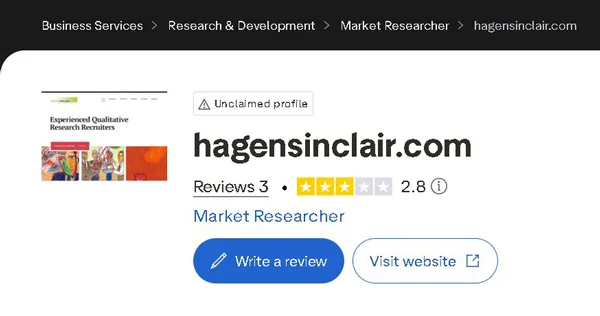
I got all of this from 6 independent reviews, 3 each from Trustpilot and PissedConsumer (I left affiliate blogs out). Of these, 2 are positive and 4 are negative, roughly 33% versus 67%. I didn’t find any signs that someone had written fake reviews, either to praise the company or to badmouth it.
So few reviews can’t tell the whole story. Still, they show a reliable company that sticks to its own rules, and the people who leave upset are almost always the ones who were counting on a bonus or on qualifying.
Red flags you should never ignore
There are no formal terms of use on the site. The FAQ says your data doesn’t go to anyone else without your consent, and so far that sounds fine. But in a 2013 reply on BBB, the CEO personally confirms a rule that, without terms, you have nowhere to read in advance: if screening decides you “misrepresented” yourself, they don’t pay you for the time you put in, not even when it’s the client who stops the study, not you. Time put in, zero pay.
On data, there’s even less clarity. They have no privacy policy, they don’t ask for your consent to cookies, and they don’t say how long they keep what you give them (I’d give as little as possible). If you live somewhere with a strict personal data law, the site may not comply with it.
Complaints about money are few. I came across just one, a verified complaint from 2026 on Trustpilot and PissedConsumer, about a late payment for a Meta study and a bonus the person never received.
Claims that the company can’t be trusted are isolated, and they come from PissedConsumer and date from 2015. The accusation seems credible, even though it isn’t about fraud but about aggressive recruiting, with repeated calls from personal phone numbers. Annoying, but not theft.
Who can use Hagen Sinclair?
To join the Hagen Sinclair panel, you need to be at least 18 and live in the US, because it’s an American recruitment panel. You can’t sign up from another country.
They tell their clients, the companies that commission studies, that their methods find people from all over the US, and even from around the world. The database, though, is almost entirely American. Every now and then an international project comes up, run through partner platforms, like an English test in 2023 that Americans and Indians were invited to, but these projects show up sporadically, one here, one there, and there’s no way to rely on them from abroad. For the rest of the world, the panel is tiny.
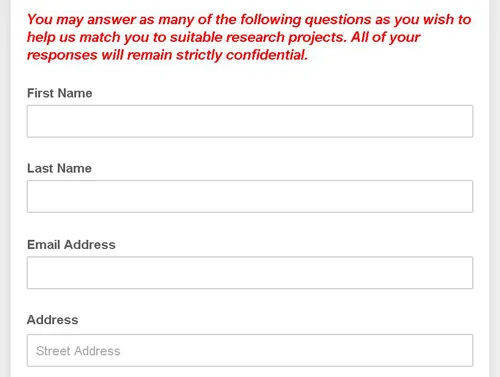
If you live in the US, you create your account with a single form. I clicked the big red button that says “Participate in our studies” and got to a form that surprised me with how much it wanted to know about me:
- first name, last name, email, mobile number, and a second phone number
- address, state, and the nearest major metropolitan area
- a different area if yours isn’t on the list, plus how you’d describe where you live
- date of birth (MM/DD/YYYY), gender, ethnicity, and country of birth
- primary language, and a secondary one if you speak two
- education, marital status, children in the household, and type of housing
- annual household income and political party (yes, that too)
- industry, occupation, job title, and company name
- sign-up date and a few others
On Verasight Surveys, Pulse Voices, or other similar sites, you only find many of these questions in your profile, after the account already exists, and they’re much less detailed. Hagen Sinclair asks them right at sign-up. All of them, before the account is created.
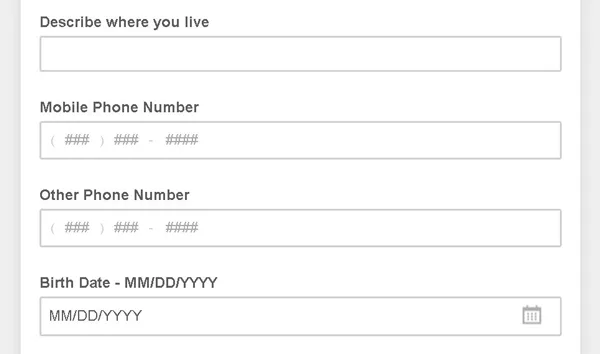
Every answer matters, because they use your answers to decide which surveys you qualify for, so it’s best to leave as few boxes empty as possible. Exaggerating your answers to get into more studies isn’t a good idea. Hagen Sinclair is strict about accurate data, and on the verification call, done live by a recruiter, anything you made up can be found out. When that happens, they remove you from the panel on the spot and don’t even pay you the money you’ve already earned. It gives me chills to think you can work for money you then never see.
What decides it in the end is how much you like telling a company about yourself. If you live in the US and you’re comfortable giving a legitimate market research company in-depth data about your life (your income, what tech you have around the house, how you spend your day), signing up costs you nothing, and the rewards can be big. A risk, but a free one. If, however, you don’t like seeing your personal life described in an online database, or you don’t live in the US, skip this platform altogether.
To leave the panel, you also send the request to them, through the Contact Us page.
Can you use it on your phone?
Your phone is all you need for Hagen Sinclair studies, but you don’t go through an app store. You sign up in your browser, on their website, which looks good on a small screen too.
There’s no official Hagen Sinclair app in the App Store or on Google Play. If you search for one anyway, you get apps from restaurants, gas stations, or heating and air conditioning companies. None of them are theirs.
You don’t log in anywhere on the site to see what studies there are. They come to you through invitations, and each project says in its invitation whether you can also do it on mobile or not (so there’s no way to find that out before the invitation arrives). Some work and others might not, depending on the project.
When the invitation says it also works on mobile, you do it on your phone, in the same browser you signed up in.
Is Hagen Sinclair LEGIT or SCAM?
At Hagen Sinclair, a single completed project earns you good money. The problem is that these projects come up very rarely, and with so few invitations you won’t end up earning a lot, no matter how well each one pays on its own.
That doesn’t mean you’re dealing with a scam. The company has been doing market research for a long time, has physical offices in the US, a track record you can check, and a high base pay for every study you complete. Anyone who gets through the screening finds a place there they can count on, with focus groups that pay real money.
Things look worse on the personal data side. On the site you won’t find a privacy policy, a terms of use document, or even a cookie prompt. When I give a company answers about myself, I want to know what it does with them (at least in a few lines written in plain language).
You can also lose money you thought you had already earned. If the client concludes that you inflated your skills during screening, they disqualify you and you get nothing. In more recent complaints, people write about both late payments and bonuses that never showed up.
All of this only matters if you live in the US, though. You can’t create an account from another country. Opportunities also show up on their Facebook page, with rewards just as good, but only for a few US cities.

I think it’s a good site for someone who lives there, works in a specific field or is just a consumer, sees market research as occasional money on top of their main income, and doesn’t mind strict screening.
As a reliable income, no.
If you want steady, decent money with surveys that don’t run out, take a look at the list of the 7 best survey apps instead. You’re sure to find something there you can use, no matter which country you live in.
If you’ve worked with Hagen Sinclair, have questions, or have something to add, leave me a comment below.