
If someone promises you $50 for a 20-minute video survey, it’s hard not to look for the catch.
That’s what Mindswarms does. It pays you when you take part in online studies and share your thoughts and opinions in a video, and at $2.50 per minute, that seems like a lot of money to me for an opinion said out loud.
I’ve tested the site, and it’s trustworthy, not a scam.
But it also has a catch, and you need to know about it before you sign up. In this review, I’ll tell you everything you’ll find there and what to expect, so you can decide if it’s for you and not end up disappointed afterward.
The catch you’re looking for does exist, it just isn’t a scam!
What is Mindswarms and how does it work?
Market research is very important for companies, and the cheapest way to collect the data is still a series of simple online surveys.
But sometimes a form isn’t enough. The company wants to see the person, as in a face-to-face conversation, with their emotions and spontaneity, because those give it a better idea of what the person actually thinks about a product or service.
Mindswarms is a site that promises rewards for your opinion, except that on its surveys you don’t fill out a questionnaire, as you do on many other survey sites, but answer in a video.
To me, that seems like a bigger step than checking a box, because the company sees your face and hears your voice.
Below, I’ll show you step by step how the money from these videos gets to you.
Mindswarms paid surveys
It was only after I filled out my profile, which I’ll tell you about below, that the member page opened up for me. There, it only showed me the surveys I already qualified for. I applied to each one separately. I answered a few multiple-choice questions, submitted them, and a researcher reviewed them, usually within 24 hours. And you only get one application per survey.
On plenty of survey sites you start answering right away, but here you go through the application, wait for the review, and only get into the survey if your application is approved. The application isn’t paid. Neither is the time you put into it. You only get paid for the survey itself, and if you apply often and your applications don’t get approved, that time, added up from one application to the next, ends up costing more than it seems.
When an application goes through, the survey has either a single question or up to 7, and the ones with more questions pay better, and everything is paid in cash.
You give your answers on video, so you need a camera and a microphone. On a phone, they’re already built in, and on a computer you need a webcam and a microphone, although most laptops come with them now, so you probably have everything you need, whatever device you’re using. Mindswarms also has an app you can download that makes recording easier, but I’ll cover it separately below.
For anyone who’s comfortable on camera, it’s a different kind of survey, even a fun one, but if you don’t like being on camera, it might feel uncomfortable, and then it’s a personal choice.
Before each answer, read the question carefully and keep the product you’ll be talking about close by, because most surveys ask you to. When you’re done, the clips get queued up and uploaded to the Mindswarms database.
Payment comes after someone at Mindswarms watches your recording from start to finish and checks the lighting, how quiet the room is, your voice, which shouldn’t break up, and your answer, which has to actually address the question, not be talk just to fill the time. The money comes only after that review, at the end of a process that started with the multiple-choice questions in the application.
Refer a friend
In “Refer Friends,” an option in the participant web portal menu, you enter a friend’s email address, and they get an automated email with your first name, your last initial, and an invitation to sign up for a specific active study.
You don’t make any money from this. Mindswarms doesn’t have a paid referral program or an affiliate commission, so for inviting a friend you get zero, in cash or in any other form.
Nobody pays for the messages to friends, the explanations about the site, or the nagging. I save my time on Mindswarms for the profile video and for the study notifications sent directly to me, since that’s the only place the money comes from.
For passive income from referral codes, new banking apps, cashback sites, and the big gig apps are a better fit, where the affiliate rewards are verified.
“Refer Friends” remains a helping hand for researchers when they need people from rare demographic groups on short notice, and it’s something you use willingly, with nothing in return, not as an affiliate system.
How do you get paid?
Every survey here is a video, and before any money reaches you, the video goes through a team of people who check that you didn’t look away, didn’t mumble, and that the camera wasn’t out of focus.
If the video passes the check, whether with the quality team or with the researcher who commissioned the survey, the money is sent automatically from the company’s account to your PayPal. The payment goes out within 24-48 business hours of finishing the survey. You don’t have a withdrawal button, or a balance waiting for you in some virtual wallet. You get the exact amount the survey pays, not points or coins you then have to turn into money.
All payments go through PayPal.
Your account there has to be active and verified, and you link it to Mindswarms right when you sign up, so if you don’t have one, you set it up beforehand. The email address on PayPal doesn’t have to be the same as your login email. It just has to work.
There’s no minimum withdrawal threshold. You don’t have to build up a set amount, like $10 or $20, before you can touch your money. You finish a survey and you get paid for it.
For anyone who just wants some extra income, it’s one of the most convenient payment systems on sites that pay for small online tasks, precisely because it doesn’t require a minimum balance and doesn’t bother with points.
I liked that even the smallest payment doesn’t sit forgotten below some threshold.
How much money can you make?
For a long video survey, which usually has 7-10 questions, you get $50. On the short ones you get $10 per question, so on the long ones each question works out to less, around $5-7. The amount is fixed per survey, not per hour, and you only get it for surveys that are completed and pass the quality check. Once a person on their team approves them, the money reaches your PayPal within 24-48 hours.
Compared to sites where you answer in writing, the pay is very good.
In theory, an hour of work would come out to $150-200, because a 10-question survey takes about 15-20 minutes to record. To me, that number means nothing. There’s no way you’ll get a full hour of surveys here.
The ones paying are mostly big brands that want to know what shoppers in the United States, Canada, the UK, and Australia think. Anyone who signs up from somewhere else ends up earning almost $0, and people in Europe, Asia, or South America say they went months without a single screener survey showing up in their account. Mindswarms says it has over 250,000 people from all over the world, and hundreds of thousands of them are fighting over very few studies.
A month brings in between $0 and $50. Most people, including those in the United States, say a typical month brings them $0. When things go well, they pick up a single survey and make $50. More than $100 in a month is very rare, and only people with a narrow luxury or professional-niche profile that clients specifically look for make that much. What good is a high payout per survey if you don’t know when the next one is coming? Earnings are hard to predict, and most of the time they stay close to zero.
Mindswarms can’t replace a job, or income you can rely on. If you want to use this money for gas, to pay your phone bill, or to put some aside, it’ll frustrate you. I’d install the app, fill in what it asks for at the start, and leave it there. For money that comes in every week, I’d look at sites with lots of tasks per day, like UserTesting, Timebucks, or Prolific.
If the app tells you there’s a survey and you qualify, the $50 is welcome. Just don’t build it into your budget.
How do you ask for help?
You can only communicate with Mindswarms support in writing, either through a ticket submitted via the “Contact” form or through an email sent directly to their support address, and that’s the only route you have when a video won’t upload or a payment is late.
They don’t have live chat, a phone line, or chatbots that write to you automatically, and your messages wait their turn in an email queue, with no guarantee that you’ll get a reply right away.
Communication with them is okay, though slow, and when you’re waiting on a payment that’s running late, that slowness is hard to put up with. They pay very well for studies you complete. For participants who get stuck partway through, though, they have little in place.
If the app freezes or the video stops uploading halfway through the survey, I’m afraid the study is lost, because no one from support will save it for you manually before the deadline set by the researcher passes.
I recorded my videos with very good light in the room and on a strong Wi-Fi connection, and I didn’t switch to other apps on my phone until the upload had finished. Whatever technical problems you can fix, you’re better off fixing yourself. Their help doesn’t come in time.
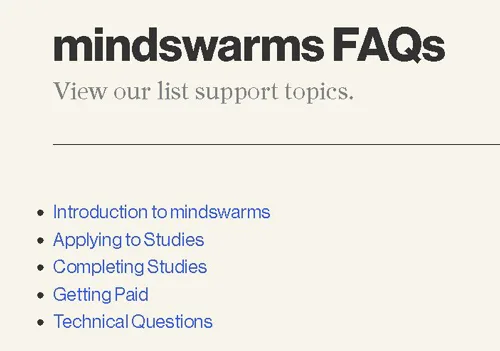
For everything else, you have the FAQ, with ready-written answers in 5 categories: Introduction to mindswarms, Applying to Studies, Completing Studies, Getting Paid, and Technical Questions.
Mindswarms Trustpilot Reviews: What Do Users Say?
People who take surveys here complain on review sites about frequent disqualifications after a long screener, about money that goes missing or doesn’t arrive in full, and about support where nobody answers. When a long screener ends in a disqualification, you come out behind.
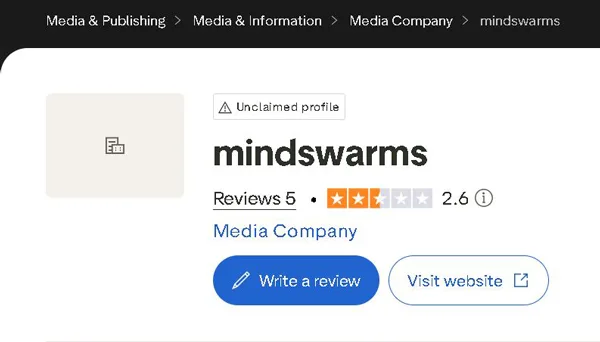
The ratings differ from one site to another:
- Google Play: 2.8 stars from over 935 reviews, with over 100,000 downloads. People praise the notifications, which bring them invitations only to studies they qualify for, but they often write about the app freezing, about system errors after which only part of the payment came through, and about support they can’t reach.
- SurveyPolice: an average of 1.0 from 19 reviews, with 11 one-star ratings (57.9%). People there complain about time lost on long screeners with no survey at the end, and about payments that never arrived.
- Trustpilot: 2.6 stars from 5 reviews. The people who wrote them say they never qualified, even though their profiles were complete, and that after the work they’d done, support never got back to them.
- App Store: 4.3 stars, but from only 7 ratings. With so few, I can’t draw a conclusion about the iOS app.
For companies, things are different.
Clients who run their studies here are happy, and on G2 and FeaturedCustomers they write that they like the clean interface and the automatic transcripts, as well as how fast they get to qualitative results. But they’re the ones who pay, not the ones who go through the screeners.
Red flags you should never ignore
The money for a video response isn’t guaranteed even after it’s submitted. Researchers can flag it for a small issue, such as too little detail, and if you don’t fix it within 24 hours, you can lose the payment and the time you put into it, which is what happened to several users.
When there’s a payment error, support stays silent, people say in independent reviews on Trustpilot, SurveyPolice, and Google Play. The terms cap the site’s liability to participants at $100 and send any dispute to mandatory arbitration in San Francisco.
The privacy policy leaves out the data protection officer, the EU representative, retention periods, and explicit transfer mechanisms, a GDPR compliance gap that’s visible in the document itself.
The part about the videos gives me chills. In the data safety section, Google Play shows “Data isn’t encrypted,” a serious risk for a site that collects video recordings and sensitive demographic data, and under the terms, the site gets the irrevocable right, for life, to use your voice, likeness, and image in marketing or for another legal purpose.
Once submitted, the video isn’t yours anymore.
Who can use Mindswarms?
I created a free account, and signing up took me under 15 minutes.
Anyone who has turned 18, from any country, can have an account. Those between 13 and 18 can join only with the consent of a parent or guardian, and the terms of use are accepted by the adult, who also has to be at least 18.
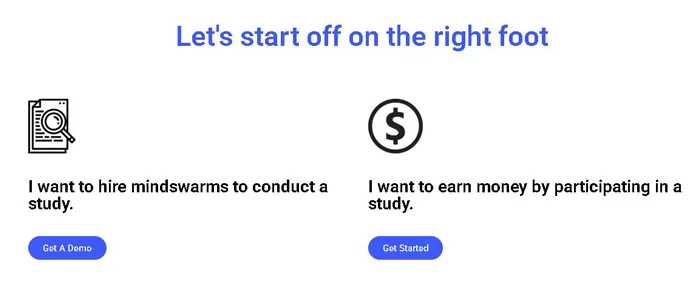
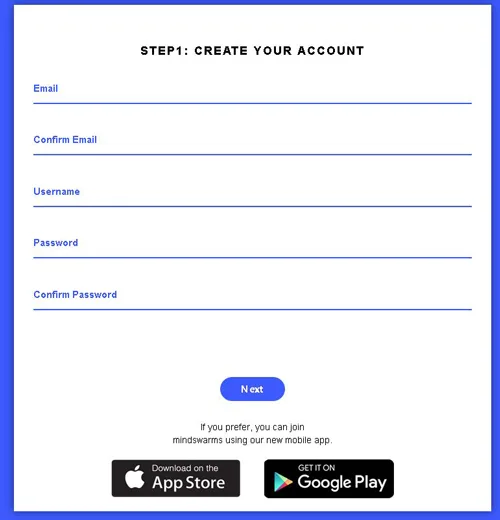
At the start, the site asked me what I wanted from it. “I want to hire Mindswarms to conduct a study” is for people who commission studies, so I picked “I want to earn money by participating in a study” and got to the form. The first step asked me for an email, a username, and a password. Then came the profile, with first name, last name, age, gender, country, city, street, postal code, phone number, and PayPal address, where you check “Same as Mindswarms email” if it’s the same as the one on your account. The street and the phone number seemed like a lot of data for a few studies, but I filled them in.
The profile ends with a video clip. How many surveys you qualify for depends on it, and a clip where you say what matters about you opens up more of them.
Since everything is sent by video, you need:
- an internet connection of at least 384 kb/s, on a computer, laptop, or phone
- a webcam and microphone on a computer or laptop (a webcam with a built-in microphone is enough)
- Chrome 60+ or Firefox 52+
- the latest version of Adobe Flash Player
The account only becomes active once they approve your profile clip. From that point you’re a member, one of the 250,000 in their database, and your complete profile keeps you there, visible.
The money here doesn’t come often. About once or twice a year, for around $50. It won’t cover food or gas every week, and for that you need another site. For a free account you set up just once, it still seems like a good trade to me.
When you get an email invitation that matches your age, country, and the rest of your profile, you accept it.
Can you use it on your phone?
Everything is done from your phone, and that’s exactly how Mindswarms was designed from the start, as a mobile video survey site, because companies want to use the front camera to capture how you react on the spot, unfiltered.
For every survey you have to film yourself, and your phone already has both a camera and a microphone. You don’t need to get another webcam or microphone that’s better than what you have, and that works for me, because I wouldn’t buy new equipment just for a few surveys. You can answer anywhere you have your phone with you, without a webcam on your computer.
Their app is available on Android and iOS. I installed it, gave it permission to record video, then logged in and started applying to surveys. It’s a simple app.
Even though the app is reliable, you’ll almost never use it, because surveys come up very rarely.
Still, don’t delete it. A $50 study can still come up, and then you do it somewhere quiet with good lighting, get paid, and have some extra money that came your way by luck.
Checking your account page over and over to see if a new survey has shown up is a waste of time. Turn on notifications and your phone will let you know.
Is Mindswarms LEGIT or SCAM?
Anyone looking for video feedback, delivered fast, from a very specific group of people finds exactly what they need on Mindswarms. The company serves other businesses, it’s legitimate, it has been around for a long time, and it has built a good name among company researchers, who praise its interface and speed.
The person answering the surveys gets something good too. A survey here pays more than one on almost every survey site I’ve tried, the money is paid through PayPal, and you can sign up from any country.
But that payout is hard to reach. Invitations are rare, every survey has a screening first, there are a lot of disqualifications, some technical errors hit the payment itself, and the lack of user support is reported in several places. The video you submit is approved or flagged by the researchers at the company running the study, not by Mindswarms, and whether you get paid depends on their decision, made by rules you can’t see. Most user reviews are about disqualifications and about payments that never came.
A big payout per survey doesn’t count for much when it rarely comes in.
With data, things are more serious. In its app store listing, the company itself says that user data isn’t encrypted, even though here you upload videos of your face and answer sensitive personal questions. Just thinking about a video of me sitting somewhere unencrypted makes me shudder. And under the terms, you give the company the right to use your likeness, with no way to withdraw it, and the company gets broad rights over everything you upload.
For some extra money, Mindswarms is a good site, even though it puts so many obstacles in your way, as long as you’re patient. If you rely on surveys for a reliable income, the screening that’s hard to get past and the poorly protected data weigh heavily. Earnings come in more steadily on Zoombucks, Hagen Sinclair, Triaba or Microworkers.
Have you already filmed for Mindswarms, or do you have any questions about it? Let me know in the comments!