

Shaip AI says it connects freelancers and contributors to artificial intelligence and data collection projects.
The work involves tasks related to images, audio, video, transcriptions, data labeling, and other aspects of training artificial intelligence. Sounds good. (And it’s different from the typical survey, to be fair.) I created an account, browsed the platform, and looked at what it asks of you and what it gives in return, because that’s what it’s all about in the end, not how trendy the word “project” sounds.
You end up on Shaip while looking for ways to make money online in your spare time, doing something related to artificial intelligence.
It’s not a rewards site where you log in and find a long list of surveys and offers waiting for you. So how does it work? You work on projects, because there you’re involved in data collection, not just checking off offers one after another.
There are a few things you should know before signing up.
How much you can earn and whether it’s worth creating an account are the questions that remain. I’ll go over them below, with the positives and negatives, so you can make an informed decision.
What is Shaip AI, and how does it work?
About 500,000 contributors, in over 150 languages and dialects, is what they say the network has.
Shaip is a data company for artificial intelligence. AI and machine learning systems are trained on human data, and someone has to collect that data, record it, and label it. It’s manual labor. So they hire remote freelancers, and I’ve seen them referred to there as “contributors” or “taskers.”
I haven’t found any other way to earn. You sign up for projects on the platform and work on them.
I also looked into who’s behind it. Among the founders are Vatsal Ghiya and Hardik Parikh. The company was launched sometime between 2018 and 2021 (I’m not giving the exact year, just a range), and in February 2026 it was acquired by Ubiquity Global Services, a New York-based company specializing in customer experience and operations. A major buyer doesn’t guarantee that the projects pay well.
It’s legitimate, I think there’s no question about that, because you can actually make money training AI. And if it’s legitimate, is it right for you?
It depends.
Neither the number of languages nor the buyer’s name tells you how much you’ll earn from a project.
You can only figure it out by looking at the earning potential, how much they’re paying, and for what. From there, you can also see how much time and effort it requires.
Freelancer projects
You apply to each project individually.
There’s no other way to earn money on Shaip AI, only through the projects posted there. How many active projects can you find? I can’t tell you, because the number changes. When I tested it, there were four, but when I checked back a few months later, there were nine, so from one period to the next, the number of available projects doubles or decreases without anyone giving notice.
The work itself is simple.
You collect data in four formats (image, video, audio, and text). In my experience, tasks for training AI don’t require technical skills, because they’re looking for raw material, not expertise. I came across a project involving “selfie” photos. You take clear photos of yourself and get paid for each approved image. That’s it.

However, each project comes with its own set of tasks, and some are more complicated than just taking pictures of yourself. The difficult ones almost always require a foreign language other than English. And if you don’t know it, it’s no use, because ambition doesn’t make up for it here. So no, making money on Shaip isn’t as easy as it seems from the outside.
Some projects are only available in that language. Some are only available in a specific region, again because the local language is required.
So no, you don’t qualify for everything posted there.
How do you know in advance if a project is right for you? From the posting. Each project lists its details, including the eligibility requirements, so you don’t waste your time on an application that’s bound to be rejected anyway.
You can work on as many projects as you want, no one’s stopping you.
If you qualify for more than one, apply to all of them, because that’s how you’ll make money, not from a single project you happen to get lucky with.
What does this work actually involve? I looked a little further and found three types of tasks.
Data collection is exactly what the name says, you record mundane things. Recently, people in the United States were recruited through the Shaip Crowd Facebook page to take photos (with a phone, not a camera) of businesses on the street, store receipts, notices of canceled appointments, and event tickets. Nothing you don’t already have on hand right now. Others ask for recordings of group conversations or individual voice samples, so that AI can learn what we sound like when we speak freely.
When you annotate, you take raw data and add context to it. You box in objects in a photo, such as cars or pedestrians, for self-driving technology. You write in the text what can be heard in an audio clip, or you highlight certain aspects of grammar. The evaluation task presents you with answers generated by bots, ChatGPT, and similar tools, and you rank them based on how accurate, useful, and reliable they are (three criteria, not just one). The mistakes these tools miss come to light through your analysis.
My blog also features reviews of other websites and apps for making money online. Sites like AdBTC, Populii Freelancing, Earnopolis, and VIPTeacher, if you want to compare them to something else. They have nothing to do with Shaip AI, but I’m including them here anyway.
How to withdraw money from Shaip AI?
It doesn’t say anywhere on the site what the minimum withdrawal amount is. I looked for that threshold, and I don’t think you’ll find it either.
It depends on the project when the money comes in. It also depends on the project as to what the minimum withdrawal amount is. Some pay as soon as you’ve submitted what you needed to submit (the delivery has to be approved first), while others follow a payment schedule. That’s why you should read the project terms and conditions all the way through before you apply, otherwise you’ll be working without knowing when you’ll see the money.
The payment methods, on the other hand, were clearly listed as direct bank transfer or PayPal.
I also learned about AirTM, a global partnership for digital wallet payments that operates in over 190 countries, where funds are received as USDC, a stablecoin pegged to the U.S. dollar. From the wallet, you can exchange USDC and transfer it to your local bank account or a local mobile wallet.
So which is the most convenient? The direct bank transfer. AirTM covers more countries, but I’d still go with the bank transfer because the money doesn’t take any detours on its way to you.
If you’re looking for other convenient payment options, check out my article on the top sites that pay directly via PayPal, Timebucks, or ySense.
How much money can you make?
You need to speak a specific language and live in the right region. Without those two things, the project isn’t for you, no matter how much they pay.
And that’s where the whole money equation falls apart.
How much you make depends on the project you manage to get. I browsed the site, and at the top, where the pay is better, I found the complicated tasks, the ones where you have to speak a language other than English.
I can’t give you an exact amount, because I have no way of knowing it. I compared them to other sites for training artificial intelligence, the kind where you work from home, and, when compared that way, they actually pay quite well (I’m talking about how much they pay per project, not how much you end up earning in the end). Because those are two different things. A good rate for a project you don’t qualify for is just a number on a screen.
Projects don’t just pop up on demand. It depends on the language you speak. It also depends on the region you live in. So you won’t always find something you can apply for.
So, is there high earning potential? I don’t think so, because the hard part here isn’t the work, it’s getting the project.
I wouldn’t count on it.
Keep your expectations low and treat the money as a rare opportunity.
How do you ask for help?
You end up writing to someone because the FAQ section doesn’t get you very far (it just covers the basics). I read through the whole thing and was left with the same questions I had when I started.
It’s not useless, it’s just thin.
Technical support for the mobile app has two email addresses: [email protected] and [email protected]. You just pick one at random. General questions go through their contact page. The Shaip Remote AI Community Portal says they also have a team dedicated to tasks and payments, but they only get in touch with you after you sign up.
What about questions regarding payments that you have before signing up?
You’ll have to keep those to yourself. It’s backwards, because you want to know about the money beforehand, not afterward.
That leaves the AI chatbot, which runs 24/7 and responds instantly.
Support just to check a box. You have a place to ask for help and someone responds, that’s all.
Shaip AI Trustpilot
Ubiquity Global Services bought the company in 2026, and the move was well-received in B2B markets.
But a new name on the contract doesn’t change anything for the person recording audio in the app.
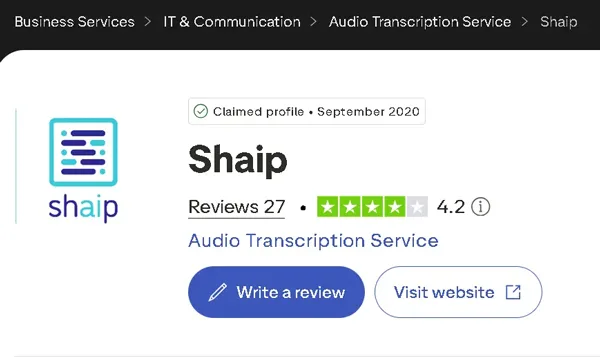
I looked through reviews on three platforms, and the divide isn’t between time periods, it’s between people. Trustpilot has 27 reviews and an average rating of 4.2 out of 5, written mostly by B2B clients and long-time vendors, who praise the quality of the delivered data, the clear project guidelines, and the payments that actually come through. The Shaip Work app has 19 ratings in the App Store, and the average drops to 2.6. Glassdoor and AmbitionBox again give high ratings, ranging from 3.4 to 4.6 stars, but those reviews come from corporate employees who praise the internal culture and the ethical approach to data collection.
Why is the average split in two? Because 4.2 is the rating from those who buy the data, and 2.6 is the rating from those who produce it.
Complaints on the App Store keep coming in, and when I compiled them, four stood out:
- Timeouts during audio recording.
- Technical support that doesn’t respond to emails, whether about bugs or money.
- Payments that don’t come through, systematically, not just as isolated incidents.
- Deliveries rejected on made-up grounds, after the voice recording or photos had already reached them. This seems to me to be the worst of all, because the goods remain delivered and unpaid for.
One of the reviewers writes that he filed a complaint with the Department of Labor. (I don’t know how that turned out, but filing an official complaint takes time and patience, you don’t do it just for fun.)
And on Trustpilot, I came across the same accusations: the platform is called a “scam,” with contributors left hanging, their tasks completed but no payment in sight.
Payment is the main point of accusation, and the positions are completely at odds with one another. Corporate clients say they’re satisfied, while those doing tasks report rejected deliveries and withheld payments.
How’s the support? It depends on the situation. As a B2B customer, you have an account manager who responds to you, and you can use the app or the Collaborate portal to send emails about bugs and payment disputes. It’s all for nothing.
Those who praise the platform cite data accuracy, on-time delivery, and SOC 2 Type 2 compliance.
I added 27 and 19 and came up with 46 reviews, out of the over 500,000 contributors the company claims to have (the figure comes from their marketing materials). The sample is small and doesn’t give us the full picture. But they all fall short in the same area: the gig itself. An average rating of 4.2 doesn’t help you, because that’s not your score. SOC 2 Type 2 compliance doesn’t help either, as long as your delivery fails for a reason that no one explains to you.
If you’re joining as someone who does tasks, I’d look at the 2.6 rating.
Red flags you should never ignore
The policy on shaip.com does not specify how long it retains the data it collects from you, nor does it name a data protection officer, even though the company collects biometric and linguistic data from around the world.
I searched for allegations of fraud, privacy violations, and unfair practices, and most of them revolve around payments. People who don’t know each other, some on the App Store, others in Facebook groups, tell the same story. They recorded audio or collected photos, submitted their work, and then received a rejection or no response. And the money? None of them ever saw it. This is also where the accusation stems from: that the company takes their voices and biometric data to train AI, then cancels the job order to avoid paying.
If the accusation holds true, rejecting the work isn’t a mistake, it’s a tactic, because the data stays with them and the payment never goes through.
One user said they filed a complaint with the Department of Labor for unpaid transcription work, but I couldn’t find the outcome anywhere. I haven’t come across any fines from the FTC or any other regulatory authority (which isn’t exactly the same as saying they don’t exist). The terms and conditions allow the company to share your data with “business partners” and “affiliates” without any checkbox to opt out specifically, so your voice could end up being licensed to AI developers outside the company without anyone telling you.
Who can use Shaip AI?
A phone number is required during registration, it’s not a field you can leave blank.

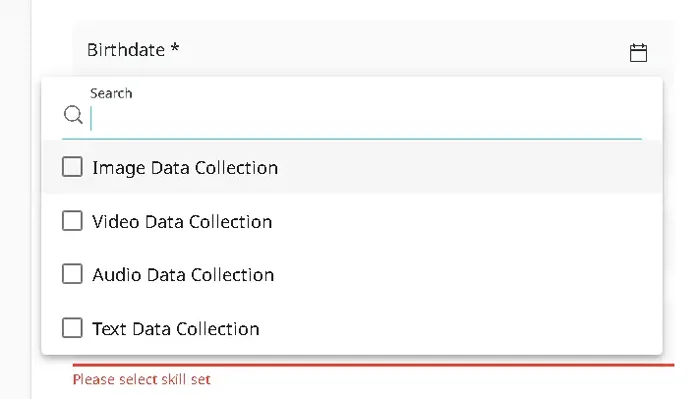
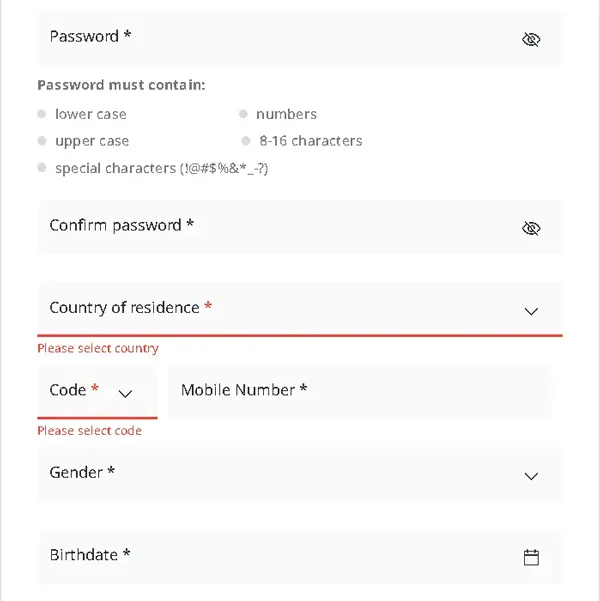
You might think it’s just a phone number. And you’re right, except that it comes as part of the entire freelancer form, which you access by clicking the “Freelancer” button in the top right corner of their homepage. It asks for your first name, last name, password, country of residence, gender, date of birth, ethnicity, education, and language proficiency, and at the end you check the boxes for your skills, with four options: image, video, audio, or text data collection. I understand the skills section, since it indicates what kinds of tasks suit you, but I don’t get the ethnicity field (I don’t see how it makes a difference for an audio recording project), and I filled out the form anyway.
There’s another way to get started that completely bypasses the freelancer account.
You go directly to the live project you’re interested in and complete the application form there. If your application is approved, you’ll receive onboarding instructions and can start working on tasks right away. You can sign up from anywhere in the world (that’s actually true), but projects are region-specific, so the list of open projects you see isn’t the same as the list you’re allowed to apply to, and I’ve seen plenty of projects that are closed to certain regions.
How long do you wait for a response, regardless of which of the two paths you take? It doesn’t say anywhere. I think an estimate, however rough, would have helped us all, but I searched through their pages and found nothing, so you just apply and wait for an email.
Can you use it on your phone?
With Shaip AI, you can work from your phone, though not on all projects.
I opened it on my phone and it looks good, because the site is optimized for small screens. So you can browse your active projects from there, and since they don’t have an app, there’s nothing to download.
I’ve come across projects where your phone isn’t just a screen you look at, but a work tool.
What kind of work is involved here? Audio recordings, where you read sentences aloud or record free-form conversations (which isn’t the same thing), so the AI can learn what a human voice sounds like when speaking. Media collection, including regular photos and short videos of objects, expressions, or places. And data annotation, on your phone’s screen, where you label images, identify objects, or filter content to ensure it’s safe.
So yes, it’s possible. Your phone is enough, but not for every project.
In my experience, AI training platforms require a computer for some projects. Shaip is no exception, and I don’t see why it would be.
Is Shaip AI LEGIT or SCAM?
You risk delivering your work and not getting paid. This is a common complaint among people who take on projects here, and the complaints are recurring, with rejected tasks, technical errors, and payments that never arrive. That doesn’t mean it’s a shady company. Shaip is an established B2B provider with a secure infrastructure, and the large companies that buy its AI training data are satisfied with what they receive.
But it’s the buyer who’s satisfied, not the seller, because the risk of working for nothing still falls on the freelancer.
The site is legit, and the work-from-home AI training jobs are real, so you can make some extra money here. But not a steady income. What’s holding you back? Qualifications. I’ve looked for projects I could qualify for myself, and I didn’t find them easily (the work isn’t the problem, but the screening process that comes before it). And that’s where expectations make all the difference, if set right from the start. Second place, that’s all I’d give it. A site where you can earn a little on the side, not one you can rely on.
Let me know in the comments how it went for you on Shaip, especially if you managed to get paid.