
I’ve tested hundreds of GPT and survey sites so far, and InstaGC is one of them. I made an account on it, used it carefully, and then compared it with all the others. I know it well.
In my experience, these sites aren’t alike at all. Some really do help you make a bit of extra money. Others can’t be trusted, and instead of paying you, they try to trick you. There are plenty of good sites, but you need to know how good a site is before you sign up for it. And a site that isn’t worth it costs you time first of all, because you waste it bit by bit before you realize you’re getting nothing out of it.
So which side does InstaGC fall on? Is it a site you can trust, where you can really make a bit of extra money online?
In this review, I’ll tell you honestly what it offers and take you through the whole site, part by part, the way I used it myself. You’ll see exactly what to expect, and it’ll be easy for you to decide whether it’s right for you or not. And if it isn’t, it’s better to find out now than after you’ve wasted your time on it!
What is InstaGC and how does it work?
The abbreviation GPT made me think of something completely different. But on sites like InstaGC, it comes from “Get Paid To,” and it means, in plain English, that you get paid to do something.
And that’s exactly what you do there. You start on some simple online tasks, get points for every task you finish, and then trade the points in for rewards.
It reassures me a little that it’s no secret who’s behind it. InstaGC is owned and run by Day Online Solutions, LLC. The founder is Andrew Day, who is also listed as the company’s president, and the site has been around since 2011, so it isn’t one that just launched. But a name and a company don’t tell me yet whether the site is worth my time. They only tell me who’s accountable for it.
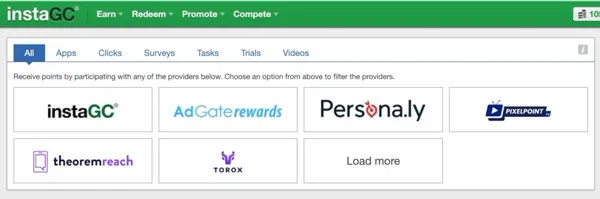
The answer comes from the ways to earn, from how much you can build up with each one, and from how long it takes you. Because here you pay with your time and get points, and the two need to be set side by side, method by method.
You’ll find them all below, with what each one pays and how much time it needs.
Most of the surveys I started on InstaGC ended in a disqualification. I’d get to minute 5, calmly answering the questions, and then a message would come up saying the survey was full, that it had closed, or that I didn’t qualify. And this didn’t happen now and then. It happened most of the time.
It’s a shame about those minutes. Actually, you do still get something. The official rule gives 1 point ($0.01) for each disqualification, up to 5 a day. Added up, that’s 5 cents a day at most for all the surveys you got kicked out of. The rule also says that after 10 disqualifications in one day, you no longer get any points for the time you lost. If the limit is 5, the threshold of 10 makes no sense to me, and the rule doesn’t say what happens between the fifth and the tenth.
I expected the time listed next to the survey to be at least close to the truth. It said “5 minutes” or “10 minutes,” and in my experience, that number had nothing to do with how long I actually spent. Because the routers take you through several pages of demographic questions before you reach the actual survey, a 5-minute one ends up taking you 15-20 minutes. For that time, you get between 15 points ($0.15) and 75 points ($0.75). With dynamic routers like Tap Research, the scale changes and ranges from 6 to 264 points. Is 15 cents worth 20 minutes? Not to me.
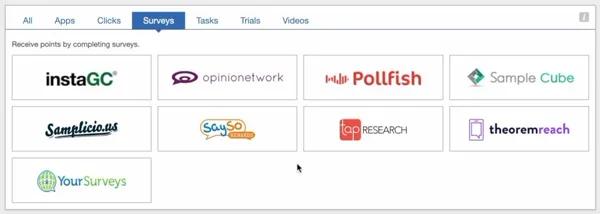
These routers have to do with how the site is built. InstaGC doesn’t create surveys and doesn’t host them. It gets them from partner firms and from routers (networks that pool surveys from several companies) and sends you to them. It’s a middleman and nothing more. In the live interface, I counted eight partners:
- Your Surveys
- opinionnetwork
- Pollfish
- Sample Cube
- Samplicio.us
- SaySo Rewards
- Tap Research, with its variable point scale
- TheoremReach
Before you click on any link, the dashboard shows you the survey code (for example, Y-11793960), the estimated time (for example, 4, 10, or 40 minutes), and how many points it pays. The code and the points helped me choose. The time shown, not so much.
Not all surveys are open to you from the start. To fully unlock certain sections, the official support rules require at least 500 points earned on the site. Before each study, you also go through qualifying or profile questions (date of birth, gender, state, ZIP code). The company is looking for a specific person, say a 45-year-old who owns a home and buys pickup trucks. If that’s not your active profile, the algorithm hides the links from you or blocks them. From the company’s side, it makes sense. But you never see what was hidden from you.
There’s no maximum number of surveys per day. How many you find depends on your demographics, the profile being targeted, and the budgets companies have for market research. When you log in also matters a lot. New surveys show up during business hours, Monday through Friday, in the daytime, when companies launch their research campaigns, and availability drops sharply late at night, on weekends, and on federal holidays. If you can only log in in the evening or on weekends, you’ll find a lot less. Direct invitations are rare, and most of the time you’re the one looking for surveys in the public grid on the dashboard. To find them faster, you can sort them by “Recommended,” “Quickest,” “Low Points,” or “High Points,” and view them grouped or ungrouped.
If you’re interested in surveys in general, I’ve also written reviews on the blog of Keep Rewarding, Shopper Thoughts, GrapeData, and Hagen Sinclair. I recommend reading each one to see whether they can be trusted and whether they’re worth it.
For an 18-year-old who wants real money online to pay for their own things, the survey section on InstaGC isn’t an option. For hours on end, you answer the same profile questions, the system kicks you out in 90% of cases, and in the end you’re left with around 5-10 cents for an hour of clicking that wears you out. At that rate, getting to 75 cents, what a single well-paid survey pays, takes you 7.5 to 15 hours. Quite a few years ago, the site was one of the best “Get Paid To” (GPT) sites. Now I can say the infrastructure behind it is almost abandoned. It frustrates me to see a site with that name end up like this.
Offerwalls for money
When I first got onto the offerwalls on instaGC, I’d look longingly at the games that promised 2,000 points, $20 just to play something on your phone. It seemed like a good offer to me, and I thought that was where I’d earn the fastest.
The money for a game like that doesn’t come from instaGC, though. Just like with surveys, the site has no offers or games of its own. It hosts outside networks, called offerwall providers, and when you finish an offer, the network pays instaGC a payout, and part of it reaches you as points. And those 2,000 points are only the part that’s left after instaGC keeps its share.
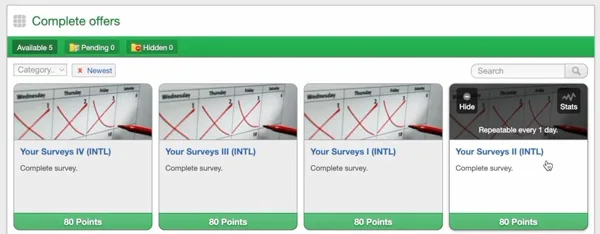
The networks you see depend on your country. You’ll find the standard networks, AyetStudios, RevU (Revenue Universe), Torox (formerly OfferToro), AdGem, Lootably, and MyLead, and next to them the site’s own offer grid, “Complete Offers,” which you have right in your account.
The simplest offers are sign-ups for new online services. You make an account, leave your email, confirm the account, and that’s about it, with no money involved.
Phone games ask for a lot more. You download them and have to hit some very specific targets, almost always in stages, with not many points per stage. For example, level 5 gets you 10 points and level 20 gets you 200 points. I did the math, and since 225 points equal $2.25, level 5 means 10 cents and level 20 means $2, a tenth of the 2,000 points that tempted me at the start.
Card offers are the ones I’m afraid of. They’re paid trials of an online service, like a streaming site or an app that protects your identity, and to join you pay real money upfront or leave your debit or credit card details. I have a hard time paying money to get points.
Their terms also have strict rules that can take away everything you’ve earned, and they’re worth knowing before you start:
- Points from bigger actions aren’t yours right away. Anything worth 225 points ($2.25) or more, whether it’s an offer, a survey, or a task, automatically goes through security checks and stays frozen for about 5 days or longer.
- You’re not supposed to cancel a card trial right after you get the points, or too early. The terms say so themselves. The service has to be used for as long as the trial lasts. Anyone who signs up and cancels after 5 minutes just for the points gets a chargeback from the provider, which takes the reward back, and if they do it multiple times, instaGC closes their account on the spot.
- Points from card payments, purchases, and trials stay locked longer, about 14 days or more.
- Almost every game or app that pays well is only for people who have never had it. If you’ve ever downloaded it, even a few years ago, the tracking software flags you and all the time you put into playing goes unpaid. It’s a shame to lose that time.
I understand why a company checks a bigger amount before paying it. But I don’t know how soon counts as “too early” for trials, and for a rule that can close your account, I’d want to see a clear number. And the games on my phone from a few years ago? I don’t remember all of them anymore.
Now I no longer think the offerwalls here are the place to earn fast. If you’re 18 and want real extra income, it’s not worth wasting your time on them, because on instaGC things don’t work the way they should.
Offer tracking fails very often, and nobody from support answers tickets. You can work on an offer and end up with zero points, with no one to ask for help. I resent a system that takes your time and then goes silent.
And to reach the stages that pay a lot, you have to choose between time and money. Either you play a great deal, within a limit of 7 to 30 days, or you put your money into a card trial you might forget to cancel.
For testing phone apps or games for real money, there are modern sites like FireFaucet, Earnopolis, or Timebucks, where someone is actually moderating and support answers around the clock. When tracking fails, they put your points back manually.
A 2,000-point game doesn’t tempt me anymore if I don’t know who’s going to put my points back.
Trials
The surveys on InstaGC get you used to small amounts, 15 cents each. And when you go into trials and see offers for $12 or $32, it’s hard not to look at them longingly.
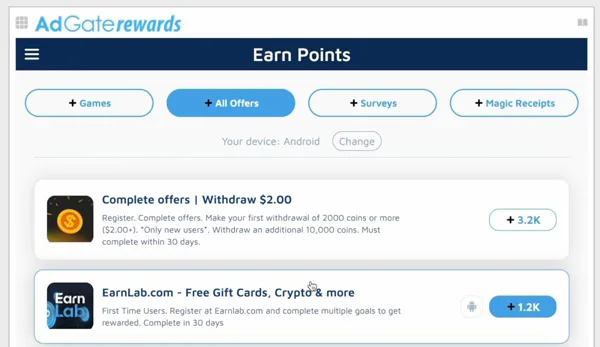
There you find offers from other companies that give you points if you sign up for their services for a trial period. Before it showed me anything, the page wanted to know what devices I have, iPhone, iPad, or Android, so that I would only get trials and apps that work on my phone’s or tablet’s operating system. The offers are from AdGate Rewards, but depending on where you live, you can also see trials from other networks that connect companies with you: RevU (Revenue Universe), Torox, and Lootably.
The smallest offer I saw was from Amazon Prime Video, a free trial for a streaming service. It paid 55 points ($0.55) and had to be completed within 30 days.
Higher up were multi-platform sites like EarnLab, where the offer was only for people who had never had an account there, required signing up and reaching several goals inside the site, and paid 1,200 points ($12), also within the 30-day limit.
The best-paying ones came from GPT sites, InstaGC’s competitors. One was called “Complete offers | Withdraw $2.00.” You create an account, do tasks until your first withdrawal of 2,000 coins ($2 or a bit more), then withdraw another 10,000 coins, and only then do you get 3,200 points ($32). It’s a lot of money, but you get it only after working on another site until you’ve cashed out from it twice.
And these are only a few. It’s very possible you’ll find other offers on your end.
If you’re 18, be very careful here. I used to think the risk with a free trial was wasting some time. The risk is forgetting to cancel it. Take the Prime Video trial I mentioned. If you don’t turn off auto-renewal before the 30 days are up, the company charges your bank card for the full monthly subscription, which is often between $10 and $15. To cover a single $15 charge, you would need to do about 28 more offers like this one, each with its own cancellation date to remember. These charges scare me, because they go through automatically, without you tapping anything.
Is it worth the risk for 55 cents? Not for me.
If you still want to try, never use your main debit card. Use a temporary, single-use virtual card, like Privacy.com, with a maximum spending limit of $1. And if you forget to cancel, the company can’t reach the money in your real account.
Still, the simplest thing is to leave trials alone. There aren’t many points, they show up late, and they don’t make up for the risk of a $15 renewal you don’t see coming. It’s a shame about the $32, but I’d rather stick with the 15-cent surveys.
Refer a friend
When I saw that the InstaGC referral program gives you 10% of everything the people you refer earn, for the whole lifetime of the account, it really appealed to me. I was thinking I’d collect points even when I wasn’t the one doing surveys.
Everything related to referrals is in the main menu, under Promote, a dropdown tab. There you’ll find your unique referral links, promotional banners, a few ready-made landing pages and the page that tracks all your referrals. I clicked “Referral link” and it took me to the referral page on instagc.com, where the site gives you 2 links from the start. One is a standard link with numbers. The other one has your username in it and is easier to send to someone, because it doesn’t look like a code. Underneath, you have buttons to share them quickly on Facebook and Twitter/X.
The money comes from the sign-up bonus and from the commission, and each has its own rules:
- The sign-up bonus is 10 points (10 cents), and you don’t get it right away. The person you refer creates an account, confirms their email and finishes their first task on the site, and only after all three do the points reach your balance. That’s a lot of work on their part for your 10 cents.
- The commission is 10% of everything the people you refer earn, and it doesn’t stop.
- It applies to tasks (surveys, app downloads, offerwalls). Their bonuses, from promo codes to contest prizes, don’t count toward it.
- The site pays the commission as an incentive, out of its own money. Your friend doesn’t lose anything and keeps 100% of their points, and that seemed fair to me.
- There’s only one tier. You only get a percentage from the people who joined directly through your link, not from the people they bring in.
- The terms don’t set any time limit, and the commission lasts as long as the account is active.
The word that matters here is “active.” People who sign up through your link now run into surveys and offerwalls with tracking errors, write to support and get no reply, get frustrated and leave almost immediately. The usage data shows that the vast majority go completely inactive within the first 48 hours. That’s a shame, because your commission depends on those accounts, and after 48 hours it drops to zero.
There’s also the part where you can lose points you already had. If someone you referred uses a VPN, fills out surveys with fake information or gets a chargeback on an offerwall, the site cancels your commission for that offer and deducts it from your balance. I’d hate to lose money over something someone else did, with no way to do anything about it.
How much would it come to, in the best case? Let’s say 10 friends sign up, confirm their email and do their first task. That’s 100 points, or $1. Then each of them spends an hour on qualifying questions that keep repeating and makes $1, of which I get 10 cents. From all 10, another $1. So, $2. And that’s if none of them leaves after 48 hours, which, based on the data above, is unlikely. That money doesn’t pay for the time I’d put into convincing them and promoting the link. It’s not worth building a side income from it.
When we recommend something to our friends or to the people who follow us on social media, we put our name on that recommendation. Right now, my friends would end up on a site that looks almost abandoned, where gift cards are often out of stock, surveys disqualify them 95% of the time and support tickets go unanswered.
And they’d know they got there through my link.
How do you get paid?
Once you reach 100 points, you’ve saved up your first dollar. The site uses no currency other than points, and all the math in your account starts from that rule. To cash it out, you open the Redeem tab and choose between Gift cards store and Other rewards. The second one is where the cash options are.
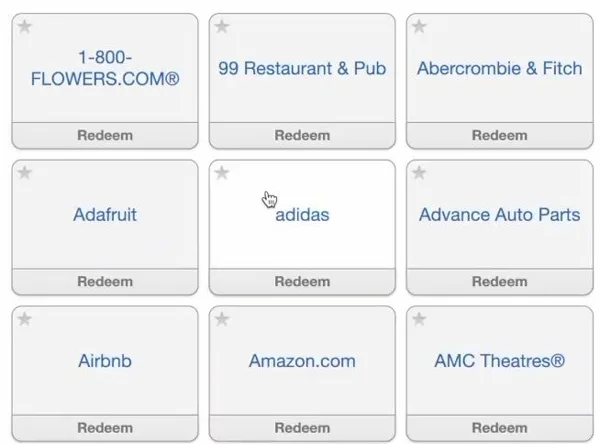
I started with the gift cards. I filtered the brands by country from the location menu (my account is set to the United States) and got a grid of stores, from Airbnb, Amazon.com, AMC Theatres and American Airlines to Apple Store and Adidas. For each one, you click Redeem and get a voucher code in digital form. Gift cards have the lowest thresholds on the site. An Amazon card starts at 100 points, so right from your first dollar.
I expected the big cards, at least, to be available. They aren’t. Several major categories, among them American Express and Aeropostale, have a bright red “OUT OF STOCK” label over them, and you can’t select them. People complain a lot on forums about these messages, because not even Amazon or Visa are spared, and they often stay out of stock for weeks on end. Because the site no longer adds new codes to its database. And what good is a $1 threshold if you have nothing to exchange it for? Next to none.
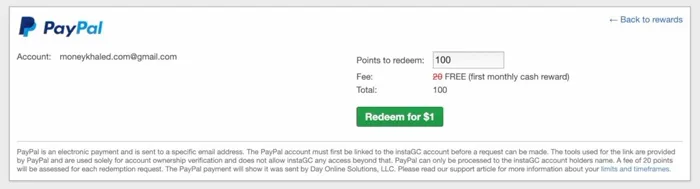
If you want cash and not store credit, go to Other rewards, where you’ll find PayPal and Bitcoin.
PayPal withdrawals work internationally and also start at 100 points. The standard fee is 20 points (20 cents) per withdrawal. The interface tells you the first cash payout of the month is free (“FREE (first monthly cash reward)”), but a second request in the same month costs you 20 points. If you’re cashing out $1 again, the fee is a fifth of it. I’d hate to lose that much of a dollar to a fee. With small amounts, one withdrawal a month, the free one, is the sensible option.
PayPal asks you to link your account through their own verification, to prove that the email receiving the money is really yours. That doesn’t bother me at all, because an extra check means more security for my money.
Bitcoin is more complicated. Over time, the site has also paid out in standard Bitcoin (BTC), directly on the blockchain, but crypto withdrawals depend heavily on your account level. If your account is new, you can’t use Bitcoin until you’ve successfully redeemed regular gift cards, so that you have an activity history. And that means the road to Bitcoin runs right through the store with the red labels.
The “Redeem for $1” button looks very inviting and makes you think the money is one click away. But the real data on how payouts work says otherwise, and I’ve mentioned this several times in this review. The payout system is broken at its core. Every point costs you time, and that time is money too, so it isn’t worth spending it on a site that no one maintains anymore and where you can’t be sure the payout button will work.
Your first 100 points let you request a payout, but they don’t guarantee it will actually arrive.
How much money can you make?
I once spent 40 minutes chasing survey links, and in the end I got a single $0.50 credit. That works out to about $0.75 an hour. I expected more, because each study shows between $0.35 and $2, and surveys are supposed to bring in between $1 and $3 an hour. But the hour is never a whole one. Profile checks keep breaking it up, and disqualifications come without warning.
I put the site’s methods side by side, by how much they pay per hour (100 points make $1):
- paid surveys, between $1 and $3, very inconsistent
- videos, between $0.06 and $0.20, with almost no work at all
- offerwalls and apps, from $0.50 to over $4, with active play
- clicks (CPC), under $0.10, too little to matter
Videos run almost on autopilot. They start on their own one after another, and according to the official documentation you get exactly 1 point (1 cent) for every 20 videos. To reach $1, you need 2,000. And you don’t reach that many easily, because the lists often freeze or run out of ads after an hour or two.
Offerwalls and installed apps pay the best. A mobile game can pay a few thousand points, $10-30 or even more, once you reach the high levels. Those are amounts you won’t find anywhere else on the site, but to get them you play the same game for hours on end, within a 30-day window, and I don’t know how many people stick with it until the end. Clicks are the simplest task: you click a link, wait 10 seconds, close the window, and get between 0.1 and 0.5 points, until you run out of them after a few clicks each day. That’s about it.
All these numbers, though, depend a lot on the country. Your country and your profile data decide 90% of what you earn. People in the United States, the UK, Canada, or Australia get the well-paid market research panels and the game offers with big rewards. Anyone logging in from another country often sees the daily task list completely empty. It seems normal to me that offers differ from one country to another, but an empty list means there’s nothing for you to do on the site.
The first dollar comes quickly in those countries. The minimum threshold is $1 (100 points) for the basic gift cards, Amazon for example, and a new account can reach it in the first 30-60 minutes by completing one or two short surveys. PayPal money was harder to come by. To get to the regular electronic payouts, you had to have already cashed out a certain amount in gift cards, an anti-fraud limit set by the platform.
Is it worth bringing in friends? With two or three, no. For each one you get 10 points (10 cents), and only if they complete an active task, plus 10% of what they earn. A friend who quits after their first dollar leaves you 20 cents in total. It’s different for someone with a big blog, a YouTube channel, or a subreddit, because hundreds of sign-ups through a personal link bring in points without any work. But even there, few of the people who sign up stay active, many leave because of system errors, and even a big influencer is quickly left without this income.
Nothing InstaGC offers adds up to a real income. We can’t cover rent or basic expenses with fractions of a cent. It doesn’t add up to a side income either, because after the screening loops and frozen points, an hour of work often ends up well below $1-2. That leaves pocket money, and even that doesn’t come easily. You can collect points for a $1 or $5 Amazon code, with a lot of patience for an interface that breaks, but you’ll go through hours of tracking errors and rewards that are no longer in stock. If every survey went like my 40-minute one, the $5 code would take almost 7 hours.
Compared with the newer user-testing or AI training platforms (Numo Labs, Contracted AI, OptimAI Network, RWS TrainAI, Outlier AI), InstaGC is outdated, with error-ridden tracking and payouts that are too low. I think your time and your personal data are better off there than here.
The points you collect aren’t safe either. A partner network can delete them a few days after you’ve received them, on the grounds that you answered too fast or too poorly, and frequent disqualifications also eat into your gross earnings. The big game offers, the ones worth a few thousand points, definitely go over 225 points, so they automatically go into a security freeze of at least 5 days, and you can’t withdraw them right away. And when something gets stuck, there’s no one to talk to, because there’s no human support, and the points can stay frozen forever. It’s a shame about the work you put in. A balance I can’t be sure of doesn’t feel like money I’ve saved.
How do you ask for help?
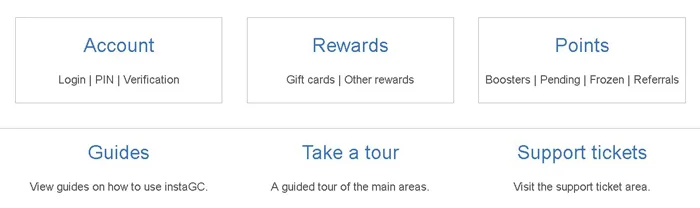
I expected support to have people who answer. What I found at instagc.com/support/ was mainly pages to read, split into three categories: Account for login and PIN, Rewards for withdrawing money, and Points for frozen or pending points. Each category takes you to explanations about getting started on the site, how the offer tools track what you do, and the platform’s rules.
Only when the explanations aren’t enough do you get to tickets. The form is neat (your username and email are already filled in), it asks you to pick a department before you can send it, and it lets you attach a screenshot of up to 5 MB. It all looks fine.
But once you send it, the ticket goes into a queue that nobody monitors. The way the page is built makes you expect a reply within 24-48 hours. I read messages from people who were missing money from their rewards or had frozen points, with their tickets left in “Open” status indefinitely, some of them for months, without a single reply from a person. It’s a shame, because a stopped payout or an offer that didn’t track is exactly when you need someone, and on instaGC there’s almost no way to reach them. There is no active team reading the tickets.
What you can do about missing points is set out in the rules. A task done directly on instaGC that doesn’t credit your points resets after 4 days, and you can start it over. It’s a second chance, but you pay for it with your time.
With offers from offerwalls like AdGate or RevU, anything from an app trial to reaching a level in a game, instaGC doesn’t get involved at all. Their official policy sends you to the external network. These are the steps for a claim:
- Go to the offerwall where you completed the offer.
- Find its support menu in the top corner of the interface.
- Send the claim directly to that network.
- Attach as proof your in-game profile ID, your progress with the date and time on it, and confirmation that the offer is complete. Without all three, the claim stands little chance, so it’s better to take the screenshots while you’re still in the game.
And if the network goes silent too, there’s no one left to turn to.
Support that doesn’t answer is, for me, the most serious warning sign on the site. I don’t rely on instaGC for anything that needs the technical side to work flawlessly. What I need is the certainty that someone will answer when something gets stuck, and here I don’t have it.
InstaGC on Trustpilot
The old reviews of InstaGC are good. People who wrote on SurveyPolice and Facebook said points were easy to collect and that it was a legit GPT site that paid properly. But the good reviews are few, and almost all of them are from the past.
Toward the end of 2023 things took a turn, around the time a file on InstaGC was opened with the BBB and it was clear the site was being maintained less and less. Since then, almost everyone has complained about the same two things: a payment system that collapsed and a support team that stopped responding.
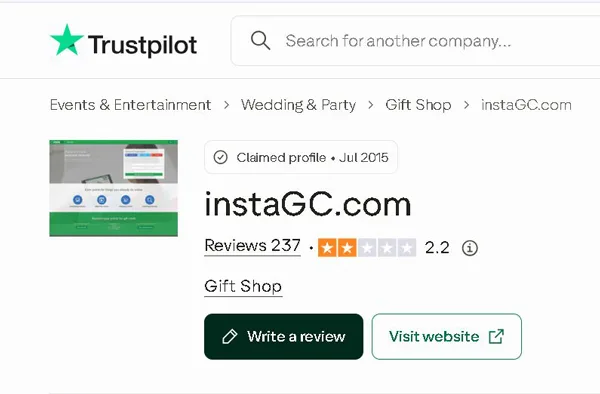
The current ratings show the change. Trustpilot has 2.2 stars from 237 reviews. PissedConsumer has 2.9 out of 5, calculated from a sample of 95 to 178 reviews, with 62% negative. SurveyPolice has 50 out of 100, from 50 reviews. They’re different scales, but none of them gets much above half. Trustpilot, PissedConsumer, and BBB together have over 400 reviews, and of the recent ones, about 60-70% are negative, close to the PissedConsumer percentage.
To me, a small number says more. Of the 237 reviews on Trustpilot, only 9 are from the last 12 months, and almost all of them are negative. People write that the “instant” gift cards are gone, that PayPal withdrawals take months, and that tickets sent to support get no answer. The 2024-2025 reviews on SurveyPolice also talk about payments that no longer go through and requested withdrawals where the money never came.
Several people with no connection to each other say that payment, which used to come right away, has started arriving late or getting stuck altogether. The part that scares me, though, comes right when you ask for your money. The account gets flagged for a manual identity check with no clear reason, you’re asked for your driver’s license and utility bills, and after that the account stays locked indefinitely. Others write that their account was often put on hold or that their points froze in the middle of a withdrawal. A late payment, I could live with. Sending in my documents and then being left with no account and none of the points I’d collected, that’s what I’m afraid of. And you have no one to write to, because in the recent reviews everyone says support doesn’t exist.
The positive reviews don’t look like they were paid for. The negative ones are long and full of detail, and even though they come from different people, they describe the payment getting stuck in the same way. When this many people who don’t know each other tell the same story, I believe them.
The old reviews are still good. But they’re talking about an InstaGC that was still paying.
Red flags you should never ignore
I thought the hard part on InstaGC was earning the points. From what people write on Trustpilot, PissedConsumer, and BBB, the hard part doesn’t come until you withdraw.
Their complaints, starting with the one mentioned most often:
- When people ask about frozen points or document verification, support doesn’t reply at all for months on end (over 30 mentions).
- PayPal withdrawals take months, and the gift cards that should arrive instantly are delayed too (over 20 recent mentions).
- The account gets locked at withdrawal, after an arbitrary request for documents, and the verification never ends (over 15 reports). It’s a shame about the points earned up to then, locked in an account you can no longer use.
- Several people say they filed fraud complaints with the FTC over confiscated or unpaid points.
Independent reviews confirm the first three. On the FTC, I only know what people say: a credible allegation, but not proven yet.
Both the terms and the privacy policy let InstaGC ask for an ID and utility bills whenever they want, and the same documents say that personal and demographic data ends up with third-party market research firms. The risk to your SSN or bank details is moderate. Personally, I’m afraid to leave them on a site that doesn’t respond even when you ask it to delete them.
Who can use InstaGC?
When you go to a rewards site, the most natural thing is to look around it first, see what offers it has and how much they pay, and only then hand over anything of your own. Here it’s the other way around.
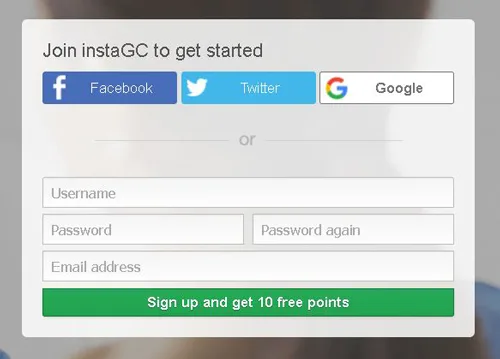
You make your account quickly and you don’t pay anything for it. But the moment you have your username and password, the site puts a mandatory security wall in front of you, titled “Link your verified PayPal account.” You can’t see anything past it, no offers, no dashboards, and you can’t click anywhere until you press the green “Link verified PayPal” button and log in to a real PayPal profile, fully verified through a bank account or a credit card. This step scares me. Because you’re linking the account your money moves through to a site you haven’t seen the inside of yet. A student who doesn’t have a bank account or a verified PayPal will never get past the wall.
Up to that point, the checks are the usual ones. You choose between one-click sign-up with Facebook, Twitter/X or Google and the standard form, where you create a username and a password and enter your email address. Then you fill in your first and last name, use the “How did you find us” menu to say how you came across the site, and check the box agreeing to the Terms of Service, Privacy Policy and Cookie Policy.
The age rule says 18 for an independent account. There are also exceptions, in some countries, for people between 13 and 17, with explicit permission from a parent or legal guardian. Except that PayPal only signs contracts with people who are 18, and the verified PayPal is required right at sign-up. So the minimum age is 18, with exceptions. Or, put more honestly, 18 and that’s it.
The green sign-up buttons promise 10 free points just for joining the community. Those points are worth $0.10. I thought a bonus that small came with no conditions. But for it, you give your real name, your email, and access to the profile you use for your transactions. Is it worth it? Not to me.
The “Sign up and get 10 free points” banner looks like an easy win. But a site that asks for your verified PayPal before it lets you see the interface is putting up a very aggressive barrier, and if you’re 18 and looking for a clean, uncomplicated way to make money fast, this sign-up is a red flag from the very first step.
Your data is worth a lot, especially your financial data. And InstaGC is a site that’s no longer maintained and that doesn’t show you its task list up front. I don’t see why I’d link my verified account to it. A verified PayPal is worth more than a site you haven’t seen the inside of.
Can you use it on your phone?
If you type InstaGC into the app store on your phone, you’ll come across apps that carry the site’s name. They don’t belong to the site. One of them, “InstaGC: Earning Task App Help,” is on Google Play and is actually a guide made by someone else, loaded with video ads, that tries to make money off the InstaGC name without having any connection to the company. And it’s a shame about the time you lose on their ads, when you were actually looking for the site.
InstaGC doesn’t have an official app in the App Store, on Google Play, or in any other serious app store. It’s been missing for years now. I expected at least a simple one to show up in all that time, and I don’t think a company that leaves things like this for so many years puts much care into its site.
To collect points from your phone, you open the site in your browser, in Safari if you have an iPhone or in Chrome if you have an Android phone. They have a version of the homepage suited to the small screen. Did it make the work any easier for me? Not really. To me it felt clunky and dated, and it annoyed me more than it helped me. If you want to make a bit of money from your phone by testing apps or playing new mobile games, InstaGC isn’t the right choice for that.
But at least the account is the same everywhere. Your login details, points, and transaction history sync automatically between your phone and your computer, because everything you do is recorded on their servers. It reassured me that I can then find on my computer everything I’ve collected from my phone.
Is InstaGC Legit and worth trying?
I got paid by InstaGC several times, and each time the money came quickly. I relied on it because it was a GPT and survey site that had been around since 2011 and that people considered trustworthy.
But my last withdrawal took more than 3 months. And that’s on a site with “instant” payouts. Support doesn’t answer messages anymore, and the last few times I checked, I couldn’t find any payment method on the site.
Its history, going back to 2011, is still its strong point. But a long history doesn’t pay my withdrawals. The problems showed up in the last 2 years, with payments that come late or get stuck and a support team that doesn’t do anything for people anymore.
I’m most worried about personal data. To withdraw, they ask you for sensitive information during verification, and many people report that their accounts got blocked. Then you’re left without an account, with your information already submitted.
Is it worth the risk for a few surveys? Not for me. I don’t recommend it if you want money you can rely on. I’m sorry to say this about a site that paid me so many times, but please go with other GPT sites.
If you’ve been through something like this too, have questions, or just want to leave a comment, I’ll see you below!