
Is Sermo legit? Is it safe? Is it worth it? These are normal questions to ask, because a lot of survey sites don’t keep their promises: the surveys don’t come in regularly, and the payments aren’t clear.
Sermo is a paid medical survey site made only for doctors and other healthcare professionals. I signed up for it and tested it thoroughly. It’s not the first survey site I’ve tried, and I compared it to the others.
Here’s what I found, so you can decide if it’s right for you.
What is Sermo and how does it work?
A Sermo account is free, but only licensed healthcare professionals can sign up: doctors, nurses, pharmacists and physician assistants. If you’re a patient or you work in another field, there’s no way to get in.
The money comes from online medical research surveys. Drug companies and healthcare companies pay for them, and you get extra money for answering them.
Besides surveys, Sermo lets you talk anonymously with other healthcare professionals about difficult patient cases. Every member is verified, so the discussions stay between people in the profession. You can also rate prescription drugs there.
Sermo was launched in 2005 by a doctor, Daniel Palestrant. It’s now owned by a private U.S. company based in New York. Peter Kirk is the company’s CEO, and Andy Bray is its CFO.
Knowing what Sermo is doesn’t tell you yet whether it’s worth your time. That’s up to you. Below, I’ll go through these one at a time: the surveys, how you get paid, how much you can earn and what other people say about the site. That way, you’ll have something to base your decision on.
Paid medical surveys
On Sermo, the paid medical surveys aren’t the same for everyone. Drug and healthcare companies pay Sermo to find exactly the people they’re looking for. That might be an oncologist at a big city hospital or a pharmacist at a community pharmacy. So once you prove you have a license, Sermo compares your profile to what the companies are asking for and sends you invitations. The surveys aren’t open to everyone. They’re only for doctors, nurses, pharmacists, and other healthcare professionals with a verified license, who get paid for their clinical experience.
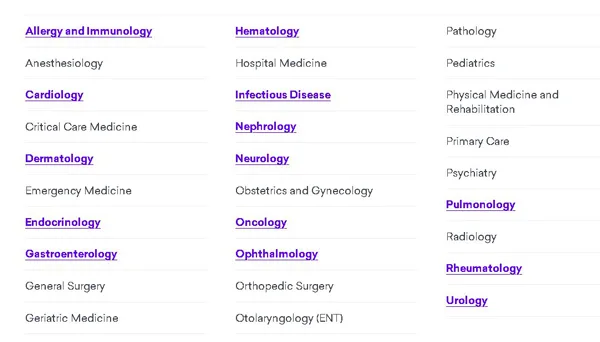
To match you, Sermo looks at your specialty and subspecialty, how many years of experience you have, where you’re located, and how and where you treat your patients, for example in a hospital or in a private practice. Sermo says it covers at least 96 specialties. The page for doctors lists these:
- Allergy and Immunology
- Pathology
- Anesthesiology
- Primary Care
- Infectious Disease
- Cardiology
- General Surgery
- Orthopedic Surgery
- Dermatology
- Endocrinology
- Gastroenterology
- Geriatrics
- Hematology
- Emergency Medicine
- Physical Medicine and Rehabilitation
- Hospital Medicine
- Nephrology
- Neurology
- Obstetrics and Gynecology
- Ophthalmology
- Oncology
- ENT
- Pediatrics
- Pulmonology
- Psychiatry
- Radiology
- Rheumatology
- Critical Care
- Urology
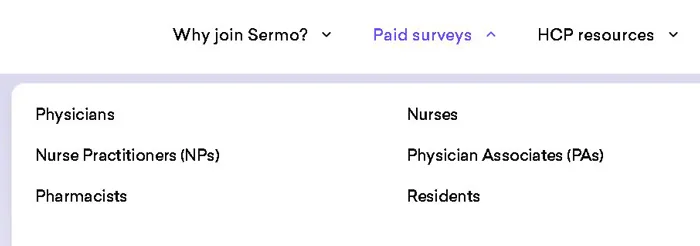
Besides doctors, Sermo has separate surveys for Nurse Practitioners (NP), Physician Associates/Assistants (PA), nurses, pharmacists, residents, and other licensed professionals, such as dentists, veterinarians, psychologists, and podiatrists. The Sermo community has members in about 150 countries, but the surveys for doctors mostly run in 30 of them, including the US, the UK, Canada, Germany, France, Spain, Italy, Japan, Australia, Brazil, and Mexico.
You’ll find your invitations in the Surveys tab in the top menu, in the Surveys box in the top right corner of the homepage, or in your email and mobile app notifications. Before you start a survey, you can see how much it pays in dollars and about how many minutes it takes.
Almost every survey starts with a short screening questionnaire, called a screener. It isn’t paid, and the questions in it come from the drug or research company, not from Sermo. So the company uses them to decide whether you’re a fit. For example, say you treat 5 asthma patients a month, and the company is only looking for doctors who treat 20 or more. Then you’re screened out of the survey, and you get $0.
The quota can also leave you with nothing. Each survey only takes a set number of people (the quota), and the spots go to whoever gets there first. Even if the survey showed open spots when you started it, the quota for your specialty or region can fill up in the meantime, and the survey closes before you finish.
If you pass the screener and finish the survey, you get paid. Sermo calls this payment an honorarium. I’ll tell you how to cash it out in the next section. Surveys can be multiple-choice questionnaires (quantitative). The ones that pay better are live phone interviews, online focus groups, patient chart reviews, and patient diaries (qualitative).
You get at least $5 for a completed survey. A typical 10- to 15-minute questionnaire usually pays between $20 and $50. Sermo’s example for a 30-minute interview or chart review is $200 to $300, and the most complex surveys pay $500 or more. Sermo doesn’t name a fixed limit above “500+.”
The surveys on Sermo are real, and they pay well. It’s just extra money you compete with other people for, not a guaranteed daily income. You can’t know ahead of time how many surveys you’ll get per day, because it depends on how much research is needed right now in your specialty and subspecialty, and that changes over time. And when you get screened out, you lose minutes you don’t get paid for.
It’s worth it if you’re a specialist with a verified license, especially in oncology, neurology, dermatology, or rheumatology, or if you work as a doctor, pharmacist, or nurse in the US or Western Europe and want to earn some money during 15-minute breaks. To do that, you need to turn on instant alerts by email or in the app so you can catch the invitations before the quotas fill up.
Sermo isn’t for you if you don’t have a healthcare license, because you won’t pass verification, or if it bothers you to walk away with nothing from an unpaid 10-minute screener. In that case, I recommend my reviews of Earnopolis or Timebucks. On those sites, there are no limits.
How do you get paid?
For every paid online survey, you get money added to your balance in your local currency, like dollars, euros or pounds. Sermo calls this reward an “honorarium.” You’re not earning points or tokens: 1 euro in your balance is a real euro. That makes withdrawing simple, and so does the minimum payout, which is very low: between $2 and $10, depending on the method and the country.
You withdraw your money from the Surveys page, using the Withdraw button. There are five official methods, and how many of them you’ll see there depends only on the country where you practice. Charitable donations no longer show up on the Help Center’s payment options page, which was updated in January 2026.
Here they are, starting with the ones that work almost everywhere and ending with the one that’s only for the US:
- PayPal (through Hyperwallet): minimum of 10 in your local currency (10 dollars, 10 euros or 10 pounds), maximum of 5,000 per day, available in multiple countries worldwide, fee of up to $0.50 or the equivalent, 1–5 business days
- Sermo Prepaid Mastercard: minimum of $2 per load, maximum of $5,000 loaded per day, available everywhere except Venezuela, in US dollars
- Wise (direct bank transfer): minimum of 10 in your local currency, maximum of $5,000 per transaction, available in 25 countries, including the US, Canada, the UK, EU countries, Japan and Australia, plus Wise’s fees
- Amazon Gift Cards: minimum of 10 in your local currency (USD, CAD, EUR, GBP or JPY), maximum of 5,000 per transaction (300,000 JPY in Japan), available only in the US, Canada, Japan, Germany, France, Italy, the Netherlands, the UK and the Isle of Man, no fee, sent by email in 1–5 business days
- Prizeout (digital gift cards): minimum of $5, maximum of $500 per transaction, available only in the US, no fee, sent by email, often with a percentage bonus on certain store gift cards
For PayPal, you need the same email address you use on Sermo. A Wise withdrawal gets canceled if you don’t enter your bank details within 5 days, and the email from Wise arrives in 1–5 business days. Amazon gift cards only come in fixed amounts of 10, 25, 50 or 100, and you have up to 1 year to use them on Amazon.
With the Mastercard, you pay $10 when you get it and again every time it’s renewed. You also pay $2.50 for ATM withdrawals and 5.75% on payments in another currency. The physical card comes in the mail in 7–30 days. It can hold no more than $9,000, and the 12-month limit is $30,000.
How much does Sermo pay for surveys?
A survey on Sermo usually pays $20 to $50 for 10–15 minutes. Phone interviews or patient chart reviews can pay $200–$500, and sometimes even more.
On a regular online survey site, you make about a dollar an hour, and anyone can sign up. Sermo pays specialist rates because you can only join with a verified medical license (I explain who can sign up further down).
You can’t take surveys all day. Invitations come whenever they come, and sometimes the spots are already filled before you get a chance to answer. You also have to answer screener questions, and you don’t get paid for those. Your medical specialty makes a big difference in how much you earn.
Nobody guarantees you an hourly rate. From what I’ve seen, the money from Sermo is extra cash you earn in your spare time, even if you’re a doctor or a nurse. It isn’t income you can count on month to month.
How do you ask for help?
Sermo’s support team is polite and helps with specific problems: technical bugs, license verification, and stuck payments. What they don’t do is reverse a screen-out or a “quota full” kickout.
The easiest way to reach them is an email to [email protected]. Or you can go to support.sermo.com, where you’ll first get a chatbot, Sermo Bot, and open a ticket from there. There’s also a US phone line, but it’s only for general questions, not member support. The site doesn’t say anywhere how long it takes to get a reply.
If you have a specific problem, open a ticket at support.sermo.com with the Study ID and a screenshot. By that I mean a license verification that’s stuck, a password that doesn’t work, or a completed survey that still isn’t showing up in your balance after 7 days. They usually fix tracking issues like these within a few days.
If you got kicked out of a survey because the quota filled up, don’t bother writing to support. The client’s rules don’t allow payment for an unfinished study, and you’ll almost always get a standard rejection. Move on to another invitation.
What users really say about Sermo?
The Trustpilot score is 4.3 out of 5 (4.5 green stars, labeled “Excellent”), based on 970 reviews. The company has claimed the profile, and there are no alerts or warnings on it.
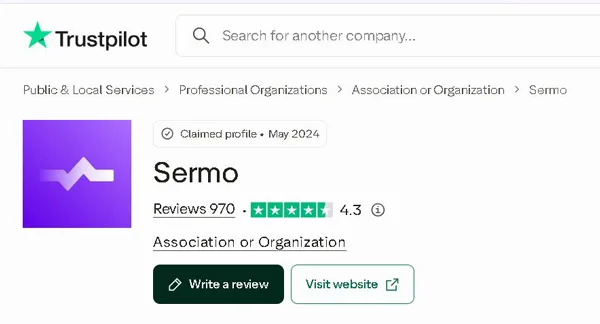
Here’s the breakdown by stars:
- 5 stars: 79%
- 4 stars: 11%
- 3 stars: 4%
- 2 stars: 1%
- 1 star: 5%
The numbers look good. Out of those 970 reviews, though, only 20 are from the past year.
I read the recent reviews, the ones from the second half of 2025 and from 2026. A few are positive. People like the case discussions, which they say taught them something, and they like that support responds quickly. One person wrote in late 2025 that their rewards balance disappeared and support fixed it quickly.
But the negative reviews are almost all about the same thing: you get a survey invite, spend 10-15 minutes on screening questions, and then find out you don’t qualify. In May 2026, one user got screened out of a 10-minute survey at the 8-minute mark. They’d already given their time and their professional details, but they didn’t get anything. Someone else said in November 2026 that it isn’t worth it: you keep getting invites, and you keep getting disqualified.
A few people say they finished everything they were asked to do, and the promised reward never came. Others complain that they’re asked over and over to resubmit their ID and Social Security number to be verified again.
Red flags you should never ignore
In its terms of use, Sermo gives itself broad rights over your balance. If you take an 11-month break where you don’t withdraw anything and don’t complete any online surveys, Sermo can close your account, and you lose your entire balance along with it. The same 11-month limit applies to honoraria you haven’t claimed. After that, they’re taken back, and you have 6 months to ask Sermo to send them again. If you don’t ask by then, you lose them for good.
A few people wrote in reviews that they finished an online survey and the honorarium never showed up in their balance. If this happens to you too and you think you were owed the payment, the terms of use require you to tell Sermo within 6 months. Otherwise, you could lose it.
You don’t get paid for the screener, no matter how much time you spend on it. It’s the set of questions you answer before the online survey, and it shows whether you fit the profile a pharmaceutical company or a researcher is looking for. If you don’t, you’re out before the survey starts. The terms of use tie payment to the final confirmation page. Without that page, you get nothing, and even a completed “opportunity” doesn’t by itself confirm that Sermo has to pay you. The screener is what users complain about most, and several reviewers see it as a way for the site or its clients to get initial data for free.
When you sign up, you give Sermo your medical license, a form of ID, and sometimes the last 4 digits of your Social Security number (SSN). An outside provider can also verify your identity with a selfie and a scan of your facial features. That’s in the privacy policy, which adds that under some laws, the data from the scan may be considered biometric. On Trustpilot, several people wrote that they were asked to redo the verification multiple times over the years, and that they couldn’t withdraw money until they did.
The privacy policy also says Sermo passes on your professional data and data about how you use the site. This data goes to its clients in the pharmaceutical industry, its advertising partners, and DMD Healthcare Communications Network.
Can you join Sermo?
You can only sign up for Sermo if you work in health care, and you also have to prove it. Sermo checks your license, your ID and a selfie you take on the spot, and until that’s done, you don’t have full access to your account. If you pass verification, signing up is free.
When you sign up, you pick one of these roles:
- Physician (MD/DO): doctors, including residents and fellows in accredited postgraduate training programs
- Nurse Practitioner (NP): nurse practitioners
- Physician Assistant / Associate (PA): physician assistants
- Nurse: nurses (Registered Nurses or LPNs, depending on the country)
- Pharmacist: pharmacists
- Other Health Care Provider: dentists, optometrists, midwives, therapists, psychologists, podiatrists, veterinarians
If you don’t have a medical license, you won’t pass verification, even if you’re 18. So patients, the general public and undergraduate students, including pre-med students, can’t join.
I saw in my account that sign-up has three steps: CREATE, VERIFY and COMPLETE. It takes about 5 minutes to submit everything, but no matter who you are, you don’t get in right away. There’s a strict identity and license check.
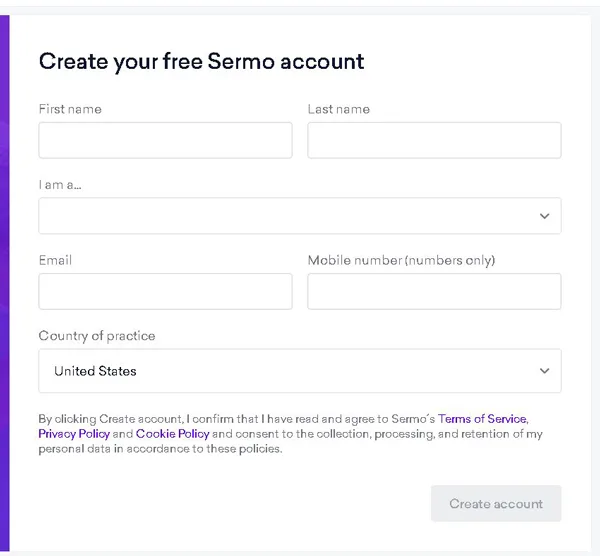
You create your account with an email and a password, not with a one-click Google or Apple sign-in. In the CREATE step, you fill in your first and last name, your role in the “I am a…” field, your email, your mobile number and the country where you practice. You enter the number using digits only. Your name has to match your license and your ID exactly, because those are what Sermo checks in the last step.
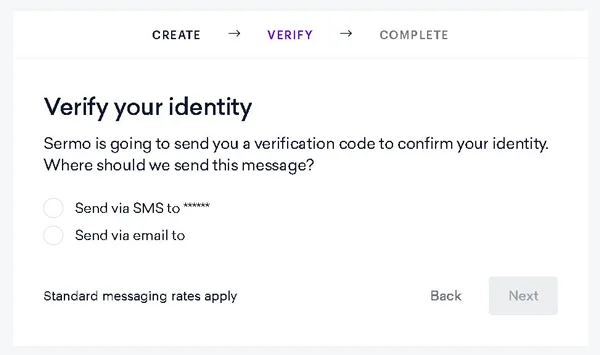
When you click Create account, Sermo goes straight to VERIFY and sends you a one-time code to confirm your identity. You get it by text or by email, whichever you choose, and without it you can’t get to the license check.
In the COMPLETE step, you prove that you really work in health care and have a license, and for that you need three things. The first is proof of your license: your official registration or license number (for example, an NPI in the US or a GMC number in the UK) or a clear photo of your license, your diploma or your hospital ID badge. Residents upload proof that they’re enrolled in a residency program. The second is a government-issued ID, meaning a driver’s license or a passport. The third is a selfie taken on the spot, which the site’s automated system uses to match your face to your ID and your license.
If your license is listed in a public database, the site’s automated system finds it right away. If it isn’t, the Member Solutions team checks your documents manually.
Right after you sign up, once you’ve passed verification, Sermo gives you $10 (or 10 in your country’s currency, for example 10 euros or 10 pounds) for a 5-minute online profile survey that you have to finish. The money shows up in your Sermo balance within 48 hours of finishing the survey.
If you’re a doctor or an APP (meaning an NP or a PA), pass verification and are in a participating country, the $10 is easy to get. Nurses, pharmacists and people in the other roles don’t automatically qualify for this bonus.
Sermo doesn’t publish its list of participating countries. You only find out whether your country is on it when you see the bonus show up in your dashboard.
Can you use it on your phone?
On your phone, you can go to sermo.com in your mobile browser, since the site is built to work on a small screen too. There’s also the official app, “Sermo – Healthcare Community.” It’s free, and you can get it from the Apple App Store for iPhone and iPad or from the Google Play Store for Android.
The app is worth getting mostly for the notifications. Turn on its alerts, because spots in paid online surveys fill up, and that way you hear about a new survey the moment it shows up. Use it for quick checks, too, and for short multiple-choice surveys that take 5 to 10 minutes.
For a well-paying online survey that takes 30 to 40 minutes, or for reviewing patient charts, switch to a laptop or tablet. If you’re on a phone and the survey link sends you to another site, the page might show errors, freeze, or not fit the screen. That happens a lot less often on a computer. And if the survey is complex, with large charts, it runs more smoothly on a laptop.
In the app, you can also talk with colleagues and see how medications are rated. If you call patients, you can do it through Sermo Mobile / Dial, so your personal cell number doesn’t show up on their end.
Is Sermo REAL or FAKE?
Sermo is a real company. It’s registered, and it has been doing medical research for more than two decades. I looked for warnings from regulators and for lawsuits against it and didn’t find any, and the BBB has relatively few official complaints for a site this big. As for getting paid, several independent reviewers, the BBB and Trustpilot all say the same thing: people get paid through PayPal, gift cards or bank transfer.
Whether it’s worth signing up depends on your profession and what you want to get out of it. If you work as a doctor in a specialty that’s in high demand, Sermo can bring in a few hundred extra dollars a year, and that helps. And your answers go into research that shapes medical products. It’s not money you’ll get month after month, though, so don’t count on it as a steady income.
Earnings vary a lot, and again it comes down to your specialty. If yours isn’t one that market research companies are looking for right now, you might see almost no online surveys. The screening before a survey isn’t paid, and that can feel like you’re being lured in. You can’t leave a small balance sitting there forever, either. The inactivity limit is 11 months, and they’re strict about it.
To me, it’s a good fit for licensed medical professionals who want a safe place to discuss cases. They’ll sometimes get screened out of a survey, and they need to be okay with that.
Sermo asks for your medical license, your ID and facial biometric data, and that’s a lot for an extra money site to ask for. If you don’t want a private market research company holding your professional and biometric data, or if you want guaranteed payments, you’re probably better off skipping it.
If you’re looking for a site to be your main source of earnings, or you want cash, go with Prolific, Prime Opinion, Zoombucks, Marketagent or Ipsos iSay instead. They’re also survey and paid task sites. You can make good money on all of them and build up a sizable amount quickly. Most of them pay in cash too, maybe even all of them. At least one will definitely accept you, wherever you live.
If you’ve used Sermo, have a question or want to say something, leave me a comment below. I’d love to read it.